
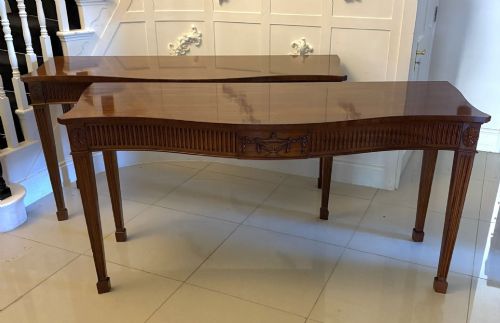
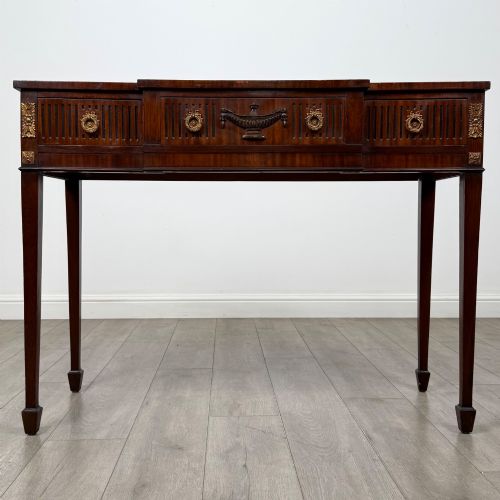


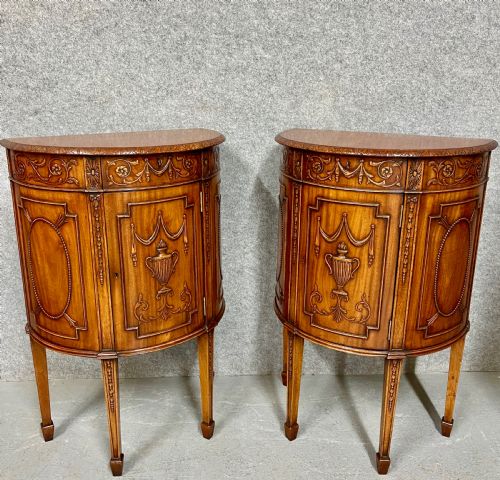

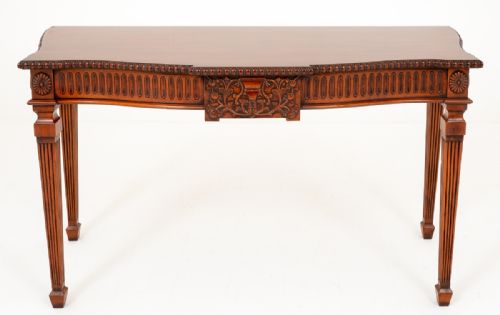

Adam Style Console
These adam style console tables bring neoclassical proportion and classical ornament directly into the hall or drawing room.
Materials and Construction
Makers utilised solid mahogany, pine, and walnut as structural timbers, frequently pairing them with marble tops on giltwood or painted frameworks. Carving, gesso, and applied paint deliver the classical vocabulary of urns, husks, and fluting across the wooden surfaces.
Joinery methods reflect the cabinetmaker's hand, using traditional tenons and dovetailed frames to support heavy stone tops or extended serving surfaces. Giltwood and painted variants rely on layered gesso grounds beneath the finish to build up crisp relief detail along the frieze.
Design and Execution
The distinction between ordinary and exceptional pieces rests in the sharpness of the carved detail and the integrity of the materials. Crisp execution of classical motifs along the frieze and legs elevates a table above mass-produced revival pieces.
Proportion and surface finish dictate the visual weight of the console. Tables featuring integrated marble tops, carefully matched mahogany grains, or original painted schemes command greater presence than standard timber variants.
Listings feature mahogany, pine, walnut, and marble alongside giltwood and painted finishes across nineteenth- and twentieth-century dates.
The Adam Style Console Glossary
- Demi-lune
- A half-moon shaped table designed to stand flat against a wall, frequently utilised as a console or pier table in narrow hallways.
- Serpentine
- A furniture front curving inward centrally and outward at the ends, creating a sinuous silhouette common on eighteenth- and nineteenth-century serving tables.
- Giltwood
- Timber coated with gold leaf or metal leaf over a prepared gesso ground, creating a reflective metallic surface seen on decorative neoclassical consoles.
- Pier table
- A decorative table built to stand against the wall between two windows, often paired with a matching wall mirror above.
- Neoclassical
- A style originating in the eighteenth century drawing inspiration from classical antiquity, characterised by symmetry, straight lines, and architectural motifs.
Adam Style Console: Frequently Asked Questions
Where should I place a console table?
These tables suit narrow entrance halls, living rooms, or dining spaces where surface area is required without blocking foot traffic. Their shallow profile allows them to sit flush against a wall.
Pairing a console with a mirror or placing it beneath a picture window creates a balanced focal point in a reception room.
What is the difference between a console and a serving table?
Console tables are primarily decorative furniture pieces designed to stand against a wall, often topped with marble or giltwood ornament. Serving tables generally offer sturdier wooden construction intended for dining room use.
Many nineteenth-century examples blur these distinctions, functioning equally well as hall furniture or serving surfaces.
How do I identify the period of an adam style console?
Dating relies on timber selection, secondary woods, construction marks, and the character of the carving. Eighteenth-century originals show period-specific joinery and hand-tooling, whereas nineteenth- and twentieth-century revivals display machine-cut elements or later secondary timbers.
Stylistic cues such as sharper neoclassical carving or specific revival proportions point toward nineteenth-century interpretation rather than the original Georgian era.
Can these tables hold heavy objects?
Tables featuring solid mahogany frames and stone or marble tops provide substantial weight and stable surfaces for lamps and decorative objects. Lighter painted or pine variants suit display purposes rather than heavy loading.
Wall-fixing brackets are sometimes utilised for demi-lune or pier tables that carry heavy marble slabs to ensure absolute stability.