



8 Day Table Clock
An 8 day table clock brings mechanical precision and period elegance to a desk, shelf or mantelpiece, spanning eras from Georgian craftsmanship to Art Deco design.
8 Day Table Clock
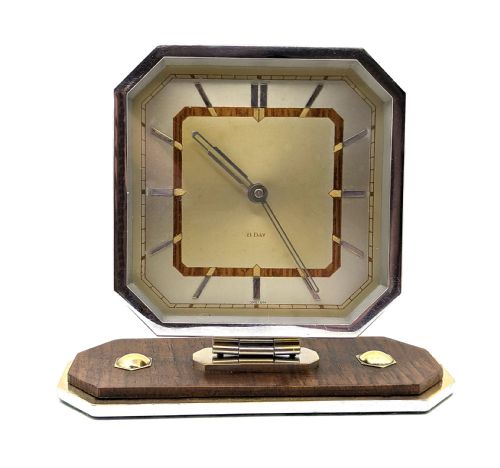
An 8 day table clock is a portable timekeeper designed to stand on a bracket, desk, mantel or table without requiring daily winding. The selection ranges from robust Georgian mahogany bracket clocks to sleek Art Deco chrome and green glass desk timepieces from the nineteen-thirties.
Buyers frequently encounter Victorian marble mantel clocks, Edwardian inlaid wooden timepieces and sophisticated French carriage clocks housed in gilt brass and glass. These objects served domestic utility and decorative display across sitting rooms, studies and bedrooms.
The form encompasses diverse regional styles, including German movements by makers such as H.A.C., English fusee-driven mechanisms, and Swiss travel clocks. Each period brings distinct architectural silhouettes, from gothic influences to streamlined modernist geometry.
Materials and construction
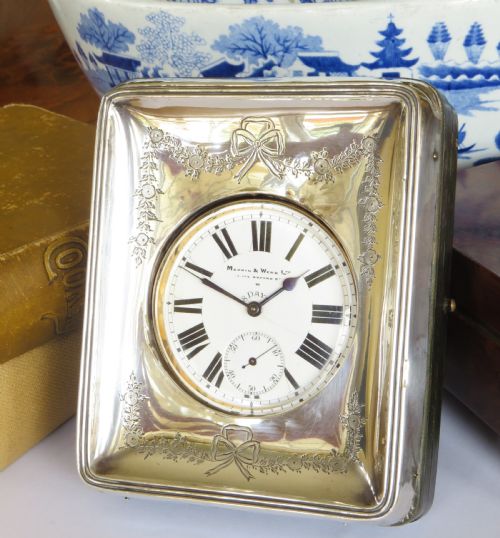
Horologists constructed these clocks using durable hardwoods like mahogany, walnut, oak and rosewood, frequently incorporating marquetry, brass inlay or champlevé enamel for visual depth. Metals such as gilt brass, ormolu, chrome and silver-mounting provide structural integrity and polished decorative surfaces.
Dial and case assembly combined glass, enamel, marble and metal components, enclosing mechanical movements driven by springs, fusees or jewelled escapements. Master workshops utilised specialised casting, engraving and woodworking techniques to ensure reliable timekeeping over an eight-day cycle.
Materials utilised across the available pieces include mahogany, walnut, oak, brass, glass, chrome, marble, enamel, and silver.
Assessing craftsmanship and execution
Quality rests in the precision of the movement, the crispness of the case carving or metal engraving, and the selection of materials such as figured mahogany or heavy cast bronze. Finer examples display meticulous dial execution, harmonious proportions and signed movements from established makers.
Mappin & Webb·Thwaites of London·Philippes Paris·Winterhalder W & H·Richard Rooker
The 8 Day Table Clock Glossary
- Bracket clock
- A portable table clock traditionally designed to sit on a matching wall bracket or furniture surface. These clocks often featured sophisticated striking or chiming mechanisms housed in wood or metal cases.
- Fusee
- A conical pulley connected to the mainspring by a chain or cord, designed to equalize the variable pull of the spring as it unwinds. This mechanism improves the timekeeping accuracy of mechanical clocks.
- Champlevé
- An enamelling technique where troughs or cells are carved into a metal surface and filled with vitreous enamel before firing. It frequently appears on decorative Edwardian and nineteenth-century clock cases.
- Carriage clock
- A small, spring-driven clock developed for travelling during the nineteenth century, typically featuring a rectangular brass and glass case with a carrying handle on top.
8 Day Table Clock: Frequently Asked Questions
How do I wind an 8 day clock?
Winding typically involves inserting a specific key into the winding arbors on the dial face and turning it gently clockwise until resistance is felt. Care must be taken not to overwind the mainspring.
Most mechanical examples require this action approximately once a week to maintain continuous operation and accurate timekeeping.
Where should I place a table clock?
These clocks sit securely on level horizontal surfaces such as mantelpieces, sideboards, desks or dedicated wall brackets. Stability is essential to ensure the pendulum or escapement beats evenly.
Placement should avoid direct sunlight, damp environments, and areas subject to excessive vibrations that might disrupt the movement.
How can I tell the period of a clock?
Dating relies on stylistic indicators such as the case architecture, wood selection, dial numerals, and decorative motifs like Art Deco geometry or Georgian brass fretwork. Signatures, maker marks, and the specific mechanics of the movement also help establish origin and age.
Comparing construction techniques across documented eras provides further context for a clock's manufacturing date.