


19th Century Staffordshire China
These pieces of 19th century staffordshire china bring character and history to any room, offering traditional ceramic forms from eras past.
19th Century Staffordshire China
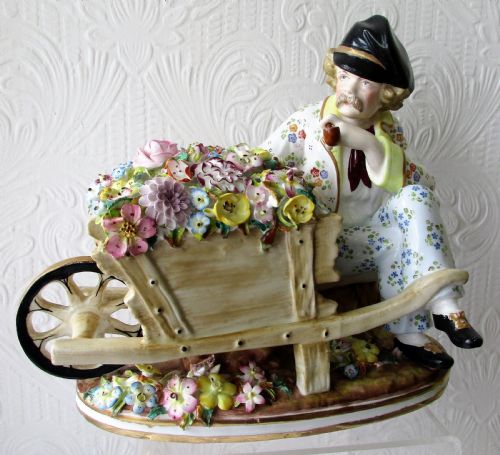
When you search for 19th century staffordshire china, you encounter a diverse range of ceramics including serving platters, decorative plates, jugs and pitchers, and porcelain figurines. The selection on this page draws heavily from Georgian and Victorian periods, showcasing utilitarian vessels alongside ornamental figures.
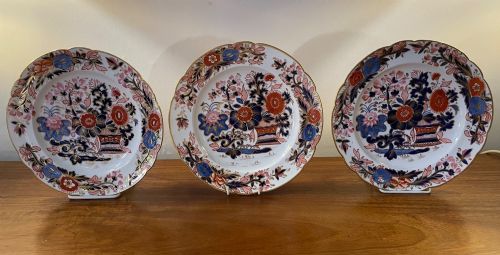
Buyers frequently meet blue and white transfer-printed patterns, alongside hand-painted botanical designs and Imari palettes. These wares encompass functional dining pieces like soup bowls and meat platters as well as cabinet items and small children's services.
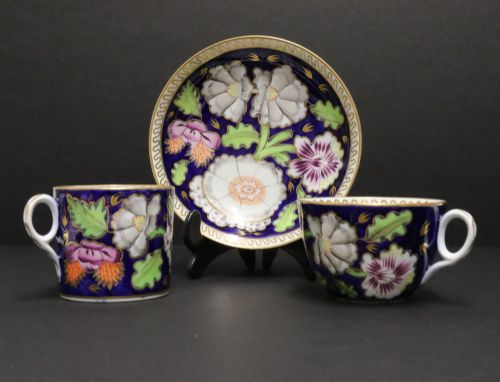
Items range from robust ironstone dishes to delicate bone china teacups, reflecting the broad output of English potteries during the eighteen-hundreds. Each object carries the distinct decorative style of its decade, spanning Chinoiserie motifs to Rococo Revival forms.
Materials and Methods
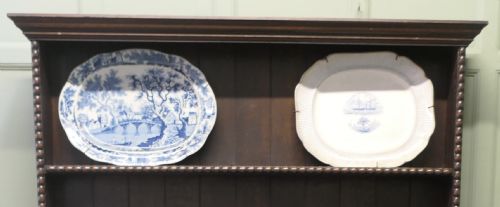
Potters shaped these objects from earthenware, ironstone, porcelain, and bone china, applying white glazes as a base for intricate decoration. Blue and white pieces rely on transfer printing techniques to transfer detailed landscape scenes and patterns onto the ceramic body.
Enamel colours and gold leaf provide the vibrant highlights seen on hand-painted vases, figurines, and cabinet trios. Dense ironstone formulations allowed makers to produce heavy meat platters and soup bowls designed for durability in busy households.
Elephants foot patterns and canine figurines remind us that nineteenth-century ceramic decorators possessed a wonderfully eccentric imagination.
Markers of Quality
Quality in these ceramics rests upon the crispness of the transfer print and the precision of the hand-painted details. Finer pieces display well-defined brushwork in enamel colours and careful application of gold leaf accents.
The weight, resonance, and stability of the ceramic body distinguish standard utilitarian wares from superior cabinet pieces. Potters who achieved smooth, even glazes and well-proportioned moulding produced enduring items that retain their visual clarity today.
John Bevington·Brameld and Co·John Davenport
The 19th Century Staffordshire China Glossary
- Ironstone
- A dense, durable type of earthenware patented in the nineteenth century to rival imported Chinese porcelain. It provided a sturdy body for heavy meat platters and large serving dishes.
- Transfer printing
- A method of decorating ceramics by engraving a design on a copper plate, printing it on tissue paper, and pressing it onto the biscuit ware before glazing. This technique enabled factories to produce consistent, detailed patterns efficiently.
- Flow blue
- A style of blue and white pottery where the cobalt blue colour blurred slightly into the surrounding white glaze during firing. This effect created a soft, misty appearance popular on mid-century plates and child's services.
- Imari palette
- A decorative scheme utilising underglaze cobalt blue combined with iron red, green, and gold highlights. It emulates the striking appearance of traditional Japanese export porcelain.
- Pearlware
- A refined earthenware developed in the late eighteenth century featuring a subtle blue-tinted glaze that pooled in recesses to mimic Chinese porcelain. It served as a popular canvas for blue and white transfer-printed scenes.
19th Century Staffordshire China: Frequently Asked Questions
What is ironstone china?
Ironstone is a heavy, durable ceramic material developed to withstand daily kitchen and dining use while mimicking expensive porcelain.
Its dense body made it ideal for large meat platters, soup bowls, and serving dishes that required extra strength.
How do I clean antique ceramics?
Wash these pieces gently by hand in lukewarm water using mild soap, avoiding harsh scrubbing or dishwashers.
Dry them thoroughly with a soft cloth to protect delicate enamels, gold leaf, and aged glazes.
What is transfer printing?
Transfer printing is a technique where engraved patterns are stamped onto paper and transferred onto the unglazed ceramic surface.
This method allowed factories to produce intricate pictorial landscapes and botanical designs with remarkable consistency.
How can I date my piece?
Dating relies on stylistic clues like Regency or Victorian shapes, pattern names, and the specific materials used by potteries.
Examining the glaze characteristics and any maker marks helps narrow down the decade of production.