
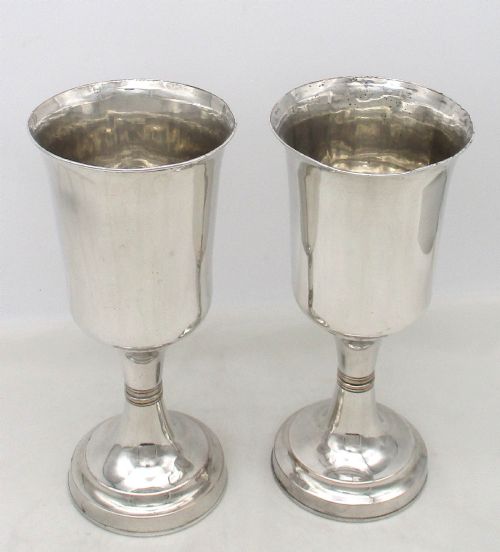


19th Century Silver Goblet
A 19th century silver goblet brings weight and ceremony to the table, and this selection ranges from church chalices to export pieces.
19th Century Silver Goblet
When you search for a 19th century silver goblet, you encounter drinking vessels created for domestic toasts, loving cups, and ecclesiastical communion. The Victorian era dominates the forms here, spanning simple sterling presentation pieces to heavy church chalices in silver plate and Sheffield plate.
You will also find regional variations on this page, including Chinese export silver with embossed aquatic motifs and Anglo-Indian trophy cups. These drinking vessels serve as tactile records of nineteenth-century craftsmanship, shifting between domestic utility and ritual display.
How They Were Made
The objects on this page rely heavily on sterling silver, silver plate, and Old Sheffield plate, often enhanced with gold gilt interiors. Makers employed techniques such as chasing, embossing, and crisp engraving to decorate the bowl and stem.
Chinese export and Indian Kutch pieces utilise distinct regional hammering and high-relief casting methods to depict flora and fauna. Church chalices often combine solid silver or heavy plating with parcel gilt linings to withstand ritual use.
Several nineteenth-century goblets feature hand-chased koi carp swimming upstream, apparently determined to conquer the rim.
What Varies in Quality
Quality rests in the crispness of the chasing and the integrity of the underlying metal, distinguishing mass production from careful hand-craftsmanship. A strong piece displays balanced proportions between the bowl, stem, and foot without awkward junctions or thinning plate.
The depth and clarity of the engraved or embossed decoration separate standard domestic items from master-wrought export silver and ecclesiastical vessels. Maker marks, where present, add historical weight and confirm the origin of the metalwork.
George Unite·Wang Hing And Co·Zee Wo
The 19th Century Silver Goblet Glossary
- Sheffield Plate
- A composite material made by fusing a sheet of silver to a copper ingot. This technique was largely superseded by electroplating in the mid-nineteenth century.
- Parcel Gilt
- Silverware where specific areas, most often the interior of the bowl, receive a thin coating of gold. This protects the metal from acidic contents during use.
- Loving Cup
- A large drinking vessel provided with two or more handles, passed between guests at banquets and celebrations. They frequently appear in silver plate from the nineteenth century.
- Chasing
- A metalworking technique where the artisan pushes the metal from the front using punches to create a raised design. It differs from embossing, which works the metal from the reverse.
19th Century Silver Goblet: Frequently Asked Questions
What is the difference between a goblet and a chalice?
Goblets generally served domestic dining and celebratory toasts, while chalices were designed specifically for church communion services and ecclesiastical use.
Ecclesiastical chalices often feature wider bases and heavier nodes on the stem to ensure stability during ritual handling.
How do I clean a silver plated goblet?
Use a soft cloth and a gentle silver polish formulated to preserve thin plating layers. Avoid harsh abrasive pastes that wear away the silver coating over time.
For pieces with gold gilt interiors, take extra care around the rim to prevent accidental removal of the gilding.
Can I still drink from a nineteenth century goblet?
Many solid silver and silver plated vessels remain structurally sound for occasional toasts and celebratory use today. You should check the interior condition, particularly on parcel gilt items, before consuming beverages.
Acidic drinks should not be left in silver-plated or copper-cored vessels for extended periods.
How do I identify Chinese export silver?
Chinese export pieces from this period often display distinct maker marks alongside traditional motifs like dragons, bamboo, or koi carp. The weight and high silver purity distinguish them from standard European wares.
Local workshops in Hong Kong and Shanghai produced these items specifically for Western markets.