

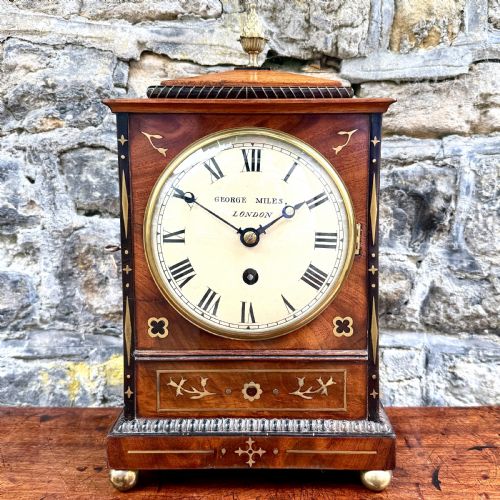


19th Century Library Clock
These 19th century library clock examples are reliable timepieces housed in compact wooden or metal cases, designed to sit quietly upon a desk or shelf.
19th Century Library Clock
A 19th century library clock typically takes the form of a mantel clock, a bracket clock, or a desk clock intended for domestic or study use. These pieces often feature glass panels that reveal the internal movement, alongside traditional wooden cases.
The materials span mahogany, rosewood, ebonised wood, and brass, matched with white enamel dials. Many examples originate from Victorian and Regency periods, while others reflect French Empire styles or industrial designs.
Buyers frequently encounter five-glass library clocks and fusee timepieces bearing the signatures of notable London makers. Architectural forms such as portico clocks and wall-hung variants also appear within the selection.
What varies in quality
The standard of timber selection and cabinetwork defines the character of the case, with figured veneers and precise brass stringing marking superior examples. Plain mahogany or straightforward ebonised boxes represent simpler production.
Movement signed by established makers commands greater interest than unsigned or generic mechanisms. The clarity of the enamel dial and the integrity of the bevelled glass panels further distinguish individual pieces.
19th Century Library Clock Retail Price Guide 2026
Typical asking prices for 19th century library clock among the pieces listed under this phrase on Sellingantiques today, from the lower quarter to the upper quarter. They describe what is for sale here now, not the wider market.
The selection includes fusee mechanisms, four-glass cases, and industrial desk compendiums.
Webster Cornhill London·Dent·Phillips Brothers·Plumbly and Tupman·Barraud and Lunds·John Massey London
The 19th Century Library Clock Glossary
- Fusee
- A conical pulley used in mechanical clocks to maintain even power as the mainspring unwinds. This mechanism ensures consistent timekeeping throughout the duration of the wind.
- Platform escapement
- A self-contained escapement unit mounted on a small platform within the clock. It allowed portable clocks to keep accurate time without needing a strict vertical pendulum.
- Ormolu
- Gilded bronze ornamentation applied to furniture and clock cases. It added a bright metallic contrast to dark woods during the Regency and French Empire periods.
- Marquetry
- Decorative woodwork where pieces of contrasting veneer form intricate patterns on a surface. It appeared frequently on late period clock and wall cases.
- Portico clock
- A mantel clock designed with architectural columns supporting the entablature around the dial. This classical style drew inspiration from ancient Greek and Roman architecture.
19th Century Library Clock: Frequently Asked Questions
Where should I place a library clock?
These clocks fit naturally on a mantelpiece, a sturdy desk, or a bookshelf where their mechanical movement can be appreciated up close.
Because many examples utilise delicate glass panels and heavy brass or wood cases, select a stable surface away from direct sunlight and draughts.
How do I wind a fusee clock?
A fusee clock requires a specialised winding key inserted into the dial aperture to tension the mainspring.
Turn the key steadily until resistance indicates the spring is fully wound, taking care not to overwind antique mechanisms.
How do I identify a Regency period clock?
Regency clocks typically display restrained classical proportions, dark mahogany or rosewood timbers, and minimal brass mounts. Their design reflects early nineteenth century British taste.
Examining the dial signature and interior movement style often helps confirm the manufacturing era.
Did these clocks stay in libraries?
While the term library clock suggests a specific room, nineteenth century owners placed them in studies, parlours, and offices.
Their relatively quiet striking or silent timepieces suited spaces dedicated to reading and writing.