

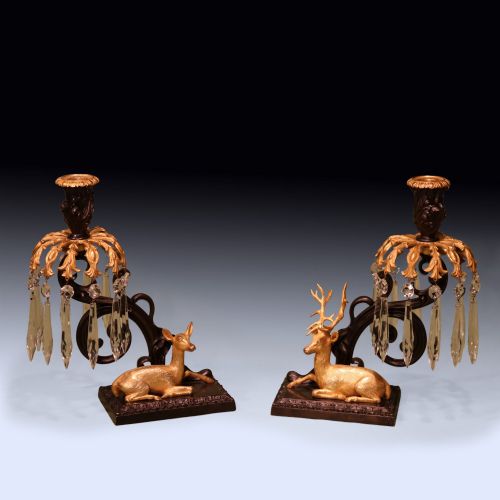


19th Century Glass Lustres
These 19th century glass lustres catch the candlelight and throw it across a room through cut crystals.
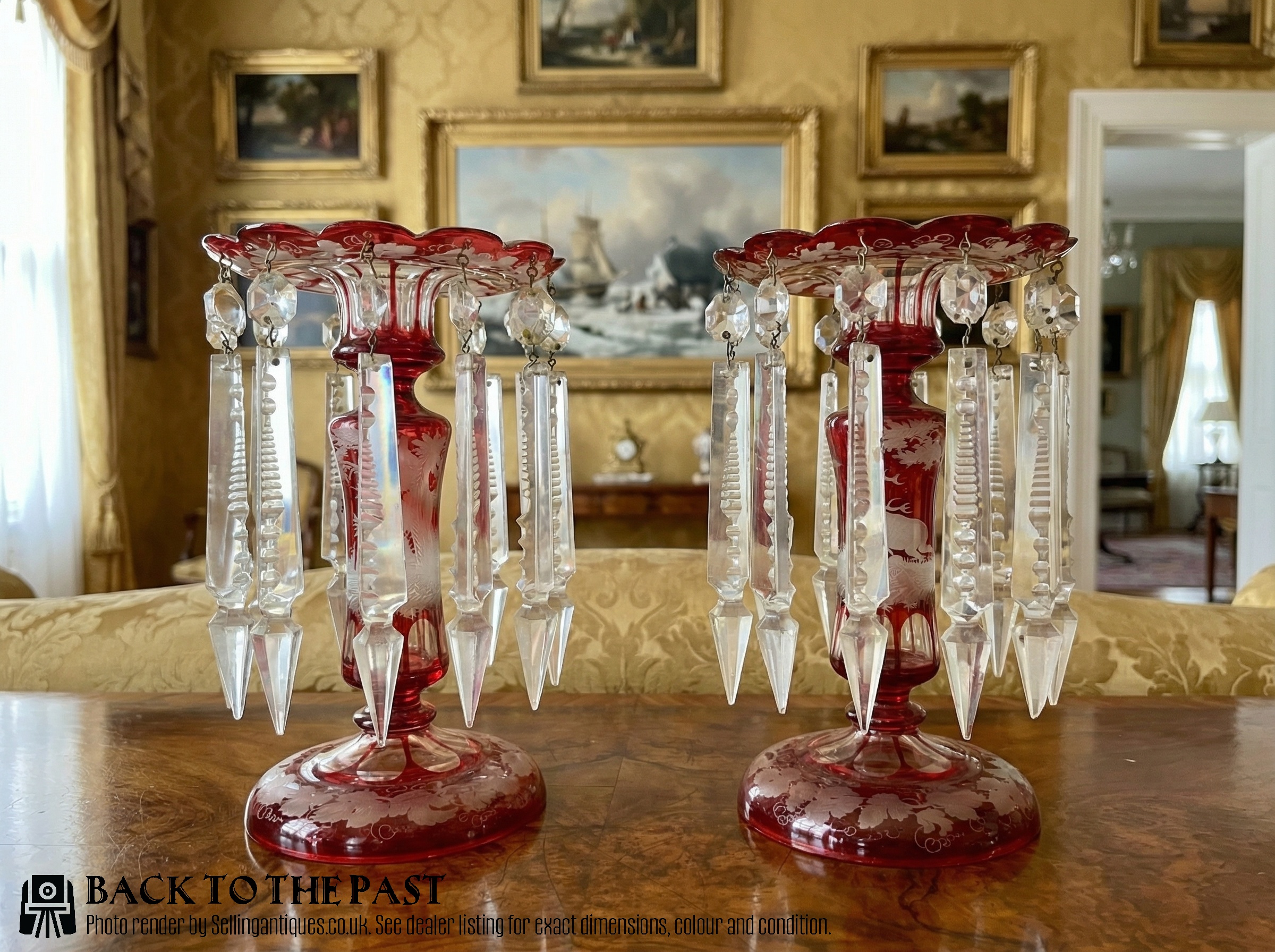
19th Century Glass Lustres
Buyers searching for 19th century glass lustres encounter table lustres, mantle lustres, and candlesticks designed to hold candles while hanging glass prisms reflect the light. Most examples found here appear as pairs, originating from Victorian Britain, France, and Scandinavia.
Makers utilised brass, ormolu, bronze, and alabaster mounts to support the glass bowls and stems. These decorative objects sat upon dining tables and mantelpieces to illuminate rooms before the widespread adoption of gas and electric lighting.
How they were made
The bodies utilise blown or moulded glass, often enhanced by flash glass techniques where a thin layer of coloured glass coats a clear core before cutting through to reveal the contrast. Cut glass and lead crystal components undergo hand-faceting to maximise light refraction.
Metalwork mounts in brass, ormolu, and gilded bronze secure the glass elements using threaded rods or pins. Prismatic drops hang from brass or wire loops fitted around the rim, swinging freely to catch ambient movement.
Stag and doe figures occasionally support the candle sockets, watching over the mantelpiece through centuries of changing light.
What varies in quality
Quality separates through the depth of the glass cutting and the weight of the metal mounts. Heavy lead crystal with crisp, sharp facets sits above lighter moulded glass with softer edges.
The richness of the coloured flash glass and the complexity of the enamel or gilt decoration dictate the tier of the piece. Complete sets of matching prismatic drops preserved without replacement indicate higher original status.
The 19th Century Glass Lustres Glossary
- Lustre
- A decorative candlestick or vase fitted with hanging glass prisms designed to reflect light. They became popular during the nineteenth century for formal rooms.
- Prismatic drop
- A cut glass pendant suspended from the rim of a lustre. These pendants refract candlelight across the surrounding walls.
- Flash glass
- Glass made by coating a core of one colour with a thin layer of another colour. Artisans cut through the outer layer to create contrasting patterns.
- Ormolu
- Gilded bronze or brass used for mounts and decorative trim. The technique involves applying a gold amalgam to the metal base.
- Opaline glass
- An opaque, pale glass with a milky appearance. It mimics porcelain and frequently appears in nineteenth-century French decorative objects.
19th Century Glass Lustres: Frequently Asked Questions
What are 19th century glass lustres?
These pieces function as decorative candle holders adorned with hanging glass prisms.
They combine blown or cut glass bodies with metal mounts to reflect and amplify flame light.
How were glass lustres used?
Owners placed them on mantelpieces and dining tables to brighten dark rooms.
The suspended crystals caught the flicker of candles and scattered light across the interior.
How do I live with glass lustres?
Position them away from high traffic areas where the hanging drops might sustain knocks.
Keep them out of direct, intense sunlight to protect any painted enamel or gilt highlights.
How do I identify Victorian lustres?
Look for characteristic colours like ruby, emerald green, and opaline paired with brass fittings.
Examine the cut of the crystal drops and the weight of the metal bases to judge the period.