


19th Century Earthenware Spill Vases
These 19th century earthenware spill vases bring quintessential Staffordshire ceramic character to a mantelpiece, offering both sculptural presence and practical function for holding taper candles.

19th Century Earthenware Spill Vases
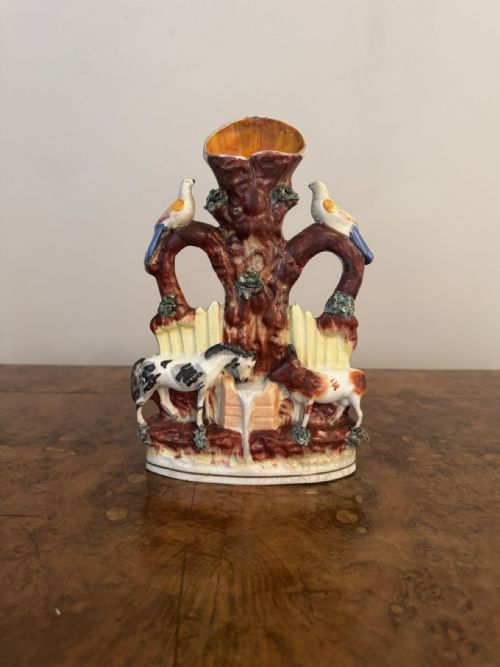
When you search for 19th century earthenware spill vases, you encounter distinctive ceramic vessels designed to hold wooden spill splints for lighting fires and candles. The examples found here span the Victorian, Georgian, and Regency eras, with a strong representation of Victorian Staffordshire production.
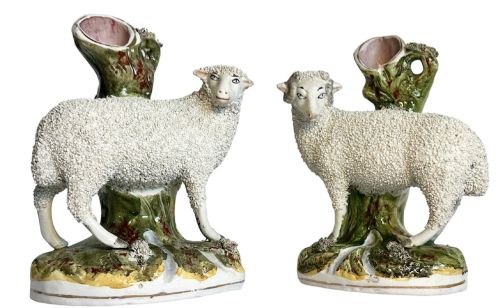
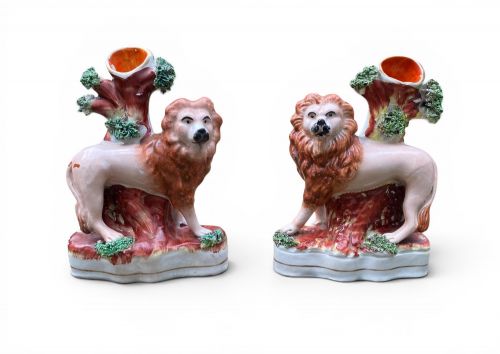
The forms vary from simple pairs of sheep and lambs to elaborate figural groups, castles, swans, and turret and bridge motifs. Many incorporate animal subjects like deer, lions, sheep, and swans, often modelled as paired mirror-images intended for display on either side of a fireplace.
Makers such as Walton contributed to this tradition, utilising early pearlware glazes alongside later lead glazes and enamel decoration. These pieces capture the domestic decorative tastes of nineteenth-century Britain through charmingly naive yet highly recognisable sculptural pottery.
How they were made
Potters shaped these vessels using earthenware clay, frequently finished with pearlware glaze, lead glaze, or enamel colours, and occasionally accented with gold leaf. The manufacturing process relied on press-moulding techniques to create hollow figures and flat-backed forms suited for placement against walls and mantelpieces.
Firing took place in traditional kilns where pieces received their primary ceramic body before undergoing hand-painting with enamels. Potters then applied transparent glazes to seal the surface, giving the figures their characteristic glossy sheen.
Listings feature 19th century earthenware pieces spanning Regency, Georgian, and Victorian periods, incorporating pearlware and lead glazes.
What varies in quality
The presence of early glazes such as pearlware, alongside well-documented maker attributions, elevates an item above standard decorative production. Pairs that retain their original matching form and balanced proportions command greater interest among collectors.
Walton
The 19th Century Earthenware Spill Vases Glossary
- Spill vase
- A hollow ceramic vessel designed specifically to hold wooden spill splints used for transferring flames from a hearth to candles or pipes.
- Pearlware
- A refined earthenware developed in the late eighteenth century featuring a subtle bluish glaze that pools in recesses to imitate Chinese porcelain.
- Flatback
- A style of Staffordshire figure moulded with a finished front and sides while the reverse remains flat, intended for display on mantelpieces against a wall.
- Lead glaze
- A traditional shiny glass coating applied to earthenware pottery before firing, providing a durable waterproof surface.
- Staffordshire pottery
- Earthenware produced by numerous potteries operating in the Staffordshire region of England throughout the nineteenth century.
19th Century Earthenware Spill Vases: Frequently Asked Questions
What is a spill vase?
A spill vase is a hollow pottery container made to hold thin wooden splints, known as spills, which were used to light lamps and fires before safety matches became common.
In nineteenth-century homes, these decorative vessels sat on mantelpieces as both functional items and colourful ornaments.
How do I date Staffordshire pottery?
Dating involves examining the type of glaze, the modelling style, and the construction of the base, such as whether the piece is flat-backed. Earlier Regency examples often feature pearlware glazes, while later Victorian items display denser earthenware bodies and different enamel palettes.
Comparing known maker marks, where present, and stylistic conventions helps narrow the decade of production.
Were these vases made as pairs?
Many nineteenth-century earthenware spill vases were modelled as mirror-image pairs to balance the decoration on either side of a fireplace mantel. Animals such as sheep, deer, and lions frequently appear in matched pairs.
Finding a complete pair intact remains desirable for collectors of Staffordshire figures.
How should I clean my earthenware spill vase?
Clean these ceramic figures gently using a soft, dry brush to remove dust from the crevices and painted surfaces. Avoid submerging antique pottery in water, particularly pieces with delicate enamel paint or gold leaf accents, as moisture can damage the fragile glaze and historic body.