

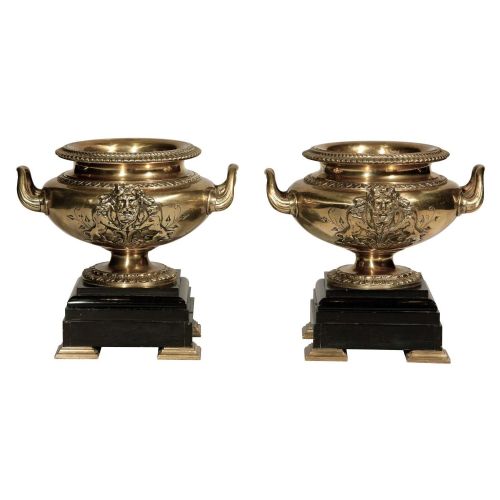


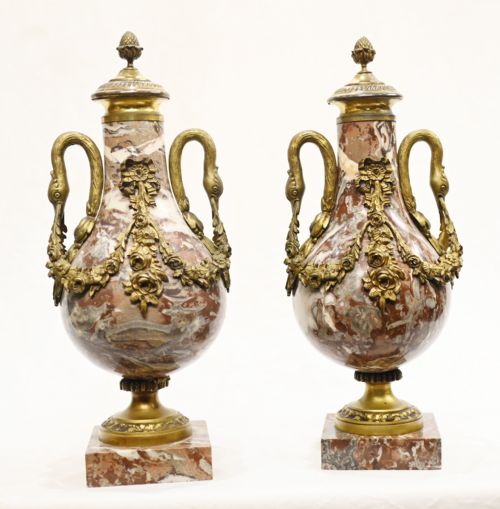


19th Century Cassolettes
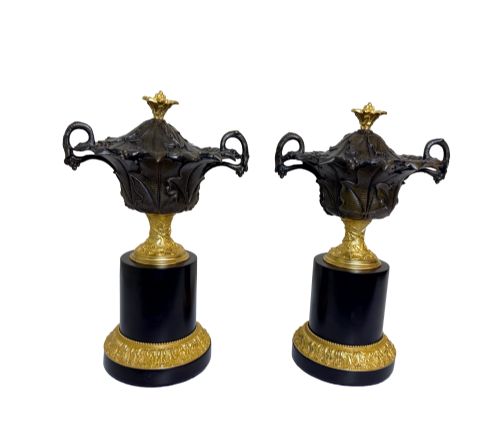
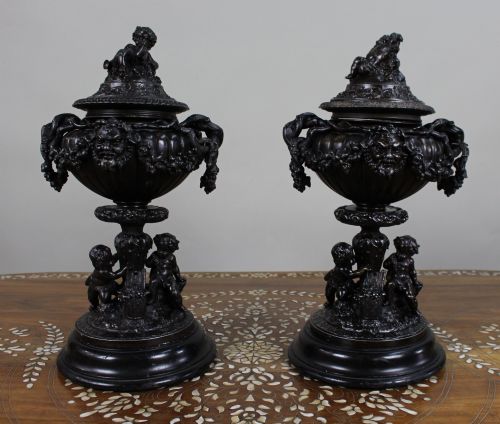
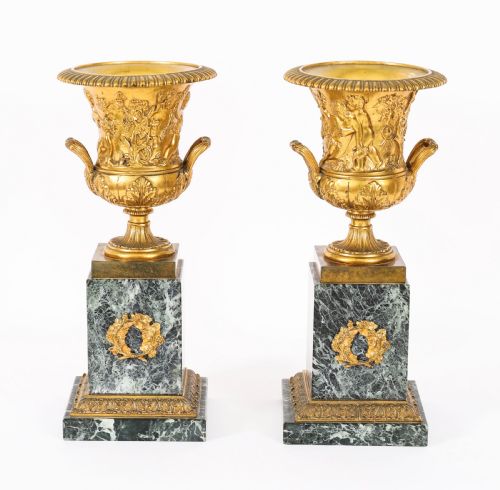
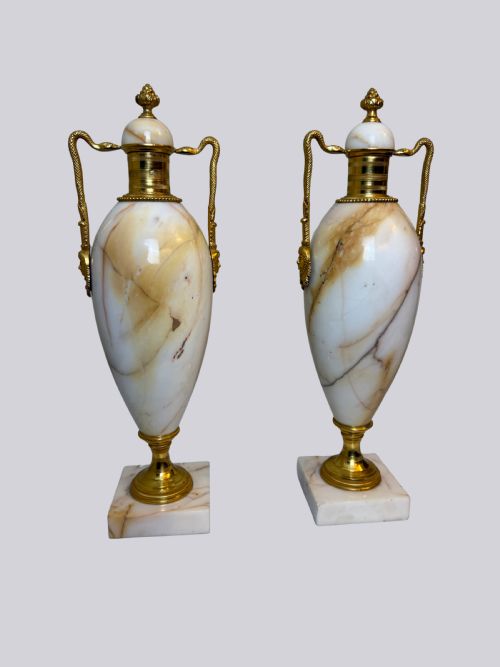
These 19th century cassolettes combine pivoting reversible lids with classical urn forms, offering a decorative centrepiece with functional versatility for an interior.
19th Century Cassolettes
When you search for 19th century cassolettes, you encounter ornamental vessels designed with reversible covers that transform a lidded vase into a candleholder or burner. The versions met most frequently on this page originate from French workshops spanning the Victorian era and the 1890s, often appearing as matched pairs.
Makers of these decorative objects drew heavily upon Neoclassical, French Empire, and Regency styles, translating classical architecture into domestic display pieces. Forms range from dedicated cassolettes to broader categories like decorative urns, clock garnitures, and lidded vases sharing similar silhouettes.
Materials and construction
Foundational construction relies on contrasting hardstones and cast metalwork, pairing bodies of green marble, white onyx, and rouge marble with mounts of gilt bronze and ormolu. Artisans also incorporated patinated bronze, porcelain, and majolica to add colour and texture to the composition.
Metal components were cast and chased with fine detail before being gilded or patinated, then secured to stone plinths using threaded rods and bolts. The dual-purpose lid mechanisms required precise fitting so that the reversible top sat flush whether showing the decorative finial or the candle socket.
19th Century Cassolettes Retail Price Guide 2026
Typical asking prices for 19th century cassolettes among the pieces listed under this phrase on Sellingantiques today, from the lower quarter to the upper quarter. They describe what is for sale here now, not the wider market.
Listings feature green marble, white onyx, and rouge marble paired with gilt bronze and ormolu across the 19th century.
Evaluating craftsmanship and proportion
Quality separates objects by the crispness of the bronze chasing and the selectness of the marble figure. Superior examples display deeply chiselled acanthus leaves, sharp floral mounts, and heavy stone bodies with uniform veining.
Proportion and structural integration dictate the visual success of the piece. Finer items demonstrate a deliberate balance between the stone body and the metal mounts, ensuring the handles, bases, and reversible lids form a cohesive sculptural unit rather than an assembled collection of parts.
Auguste Cain·Royal Worcester·Flight Barr And Barr
The 19th Century Cassolettes Glossary
- Cassolette
- A decorative vase or urn featuring a reversible lid that exposes either a solid decorative top or a nozzle for holding a candle. This dual function defined domestic display pieces in the classical taste.
- Ormolu
- Finely ground high-carat gold applied to a bronze base using a mercury amalgamation technique, yielding a rich golden lustre. The term also describes objects mounted or decorated with this gilded bronze.
- Gilt bronze
- Metal cast in bronze and subsequently covered in a layer of gold leaf or gold paint to simulate solid precious metal. It provides durable surface decoration on mounts and handles.
- Clock garniture
- A set comprising a mantel clock flanked by matching ornamental pieces such as cassolettes or urns designed to sit on either side. These matching suites unified the decorative scheme of a mantelpiece.
- Bacchic mask
- A sculptural face depicting Bacchus, often surrounded by grapes and vine leaves, utilised as a decorative handle or mount on classical urns.
19th Century Cassolettes: Frequently Asked Questions
What is a cassolette?
A cassolette is a decorative urn or vase designed with a removable, reversible lid that transforms the vessel from a closed decorative object into a candleholder.
Originating from classical forms, these dual-purpose pieces were widely produced in the nineteenth century for display on mantelpieces and side tables.
How do you use a cassolette?
To change the function of the piece, you simply lift the lid and turn it over to reveal the hidden candle socket.
Most owners choose to display them in their closed decorative configuration, reserving the candle-burning function for special occasions.
Are cassolettes always sold in pairs?
While many survive as matched pairs intended to flank a central clock or ornament, single examples and larger garniture sets also occur.
Pairs were standard for symmetrical placement on nineteenth-century mantelpieces and console tables.
How do I identify French Empire style?
French Empire style draws heavily on ancient Roman, Greek, and Egyptian motifs, featuring strict symmetry, classical figures, and martial attributes.
Look for gilt bronze mounts shaped like laurels, sphinxes, and palmettes applied to dark marble or bronze bodies.