





1960s Modernist Jewellery
1960s modernist jewellery breaks with traditional symmetry, offering striking sculptural forms in silver and gold.
1960s Modernist Jewellery
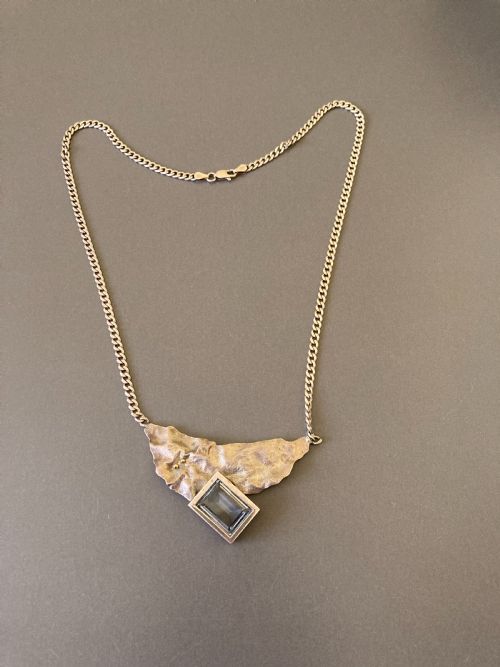
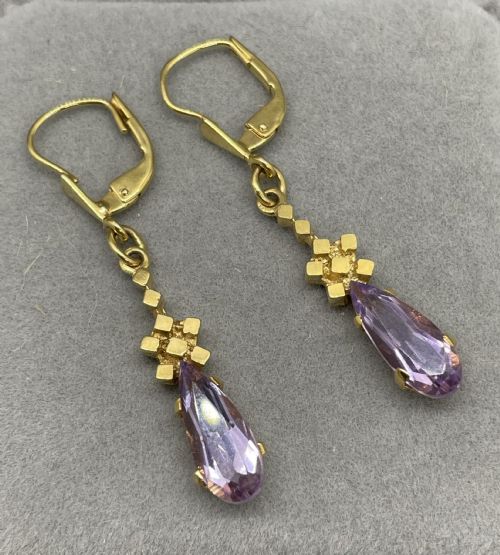
These pieces encompass rings, necklaces, earrings, brooches, and pendants spanning the mid-century period, with a strong representation of Scandinavian design. A buyer searching for 1960s modernist jewellery encounters abstract shapes, organic textures, and bold metallic settings.
The selection ranges from Danish silver rings and Finnish pendants to gold pieces set with turquoise, coral, and pearls. Makers and origins vary across Britain, Scandinavia, Japan, and Australia, reflecting an international shift towards expressive wearable art.
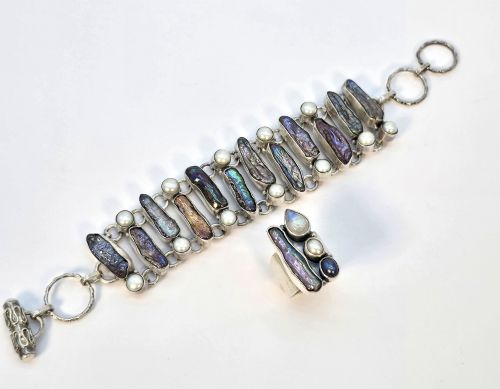
Matching sets, such as a silver and Biwa pearl bracelet and ring combination, sit alongside individual statement items like abstract brooches and lattice rings.
How they were made
Silversmiths and goldsmiths utilised sterling silver, 18ct gold, and 9ct or 14ct yellow gold as the primary foundations for these geometric and organic forms. Casting and hand-working techniques created textured metal surfaces that emphasise the raw quality of the precious materials.
Gemstones and organic elements including turquoise, Biwa pearls, cultured pearls, rubies, diamonds, blue topaz, rose quartz, coral, milk opal, amethyst, enamel, and zirconia are integrated directly into the metalwork. Settings frequently prioritize the natural irregularity of the stone, whether smooth cabochons or baroque pearls.
Listings feature pieces from the 1950s, 1960s, and later than 1960, executed in sterling silver, 18ct gold, and silver.
What varies in quality
The distinction between standard production and exceptional work lies in the boldness of the design and the precision of the metal fabrication. Pieces by notable makers demonstrate superior handling of abstract volume and tactile surface texture.
The selection of stones, from finely matched Biwa pearls to substantial Australian milk opals and turquoise, dictates the visual weight of the piece. Heavier gauge gold and silver settings provide structural integrity that supports more ambitious sculptural arrangements.
Georg Jensen·Randers Silver·Andrew Grima·Charles de Temple·David-Andersen
The 1960s Modernist Jewellery Glossary
- Biwa pearl
- An elongated, freshwater cultured pearl originating from Lake Biwa in Japan, known for its distinct organic shape. These pearls appear frequently in mid-century silver suites.
- Cabochon
- A gemstone polished to a smooth convex dome rather than faceted. This cut suits opaque stones like turquoise and opal found in modernist settings.
- Pendant torque
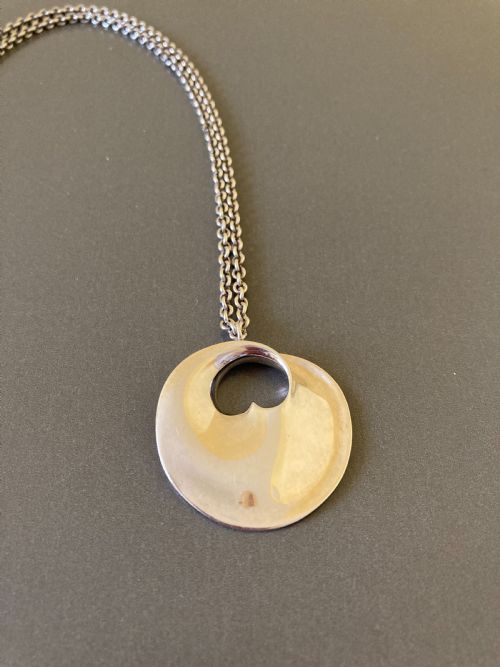
- A rigid, circular neck ring that holds a suspended ornament. This architectural form is characteristic of Scandinavian modernist design.
- Sterling silver
- An alloy consisting of silver and other metals, usually copper, to increase durability. It serves as the primary white metal for much of the Scandinavian and Japanese work here.
1960s Modernist Jewellery: Frequently Asked Questions
How do I identify a 1960s modernist ring?
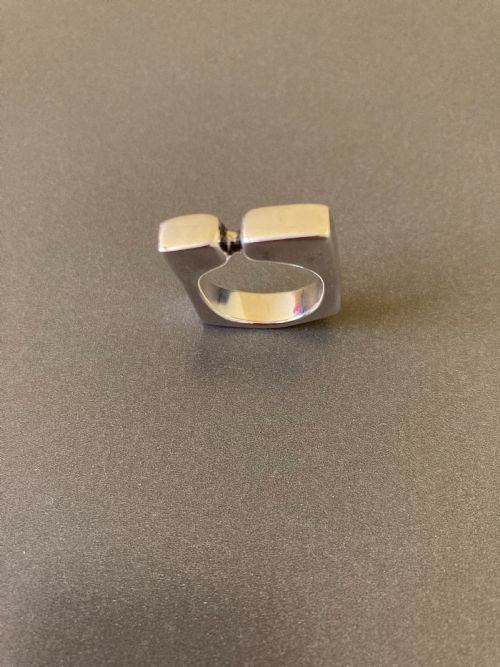
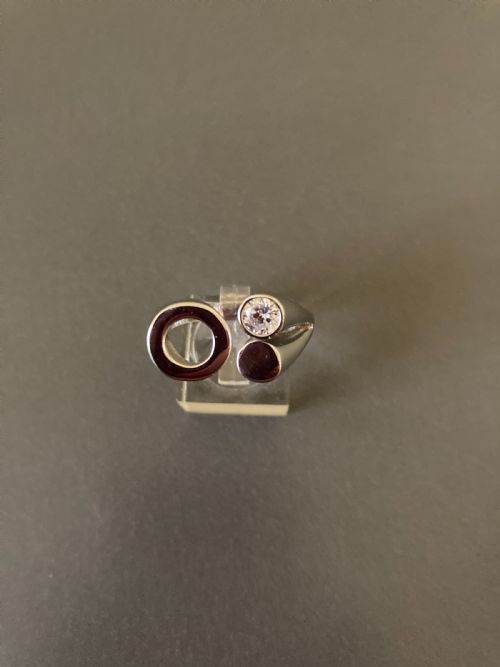
Look for asymmetrical settings, textured or cast metal surfaces, and a preference for abstract geometric shapes over traditional cluster or solitaire designs. Stones are often secured in heavy bezels that highlight their natural contours.
Signatures or maker marks on the inner band frequently point to Scandinavian or British workshops from the mid-twentieth century.
What is a pendant torque?
A pendant torque is a rigid, open-ended metal collar that sits closely around the neck, often featuring a removable or fixed drop pendant at the centre. This form emerged strongly in Scandinavian modernism during the mid-century period.
The design allows the metalwork to sit squarely on the collarbone as a continuous sculptural element.
Are pearls common in modernist jewellery?
Biwa pearls and cultured pearls appear regularly alongside silver and gold in mid-century pieces. Designers favoured them for their organic, irregular shapes which contrasted sharply with strict geometric metalwork.
These pearls are typically set raw or in custom bezels rather than traditional uniform strands.
How should I care for gold and turquoise pieces?
Turquoise is a relatively soft and porous gemstone that requires gentle cleaning with a soft, dry cloth rather than liquid submersion or chemical dips. Store these items separately to prevent harder metals from scratching the stone surface.
Gold settings can be maintained with mild soapy water and a soft brush when free of delicate organic stones.