
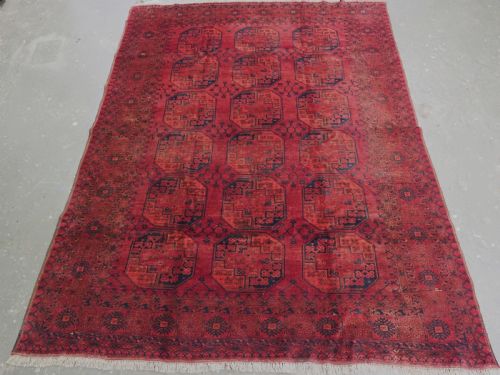
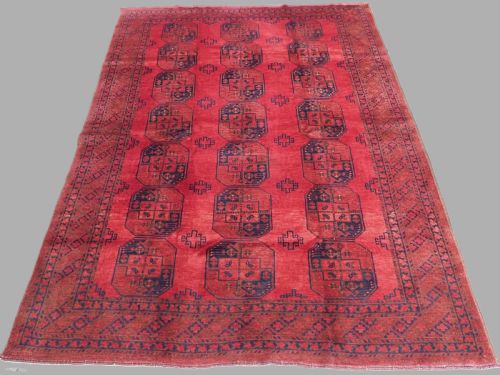


1920s Afghan Wool Rug
A genuine 1920s afghan wool rug brings deep red tones and tribal character to a room.
1920s Afghan Wool Rug
A 1920s afghan wool rug encompasses village and tribal weaving traditions from the 1920 period. These textiles include larger carpets, runner rugs, and specific formats such as prayer rugs and storage bags.
Village weavers and tribal groups produced these pieces utilising traditional patterns like the gul, seh mihrab, and various mosque designs. Buyers most frequently encounter village rugs and carpets displaying warm red colour palettes.
The inventory demonstrates a strong representation of Baluch, Ersari, and Kizil Ayak tribal influences. Each piece reflects the functional weaving methods of Afghan tribal groups from the early twentieth century.
Materials and Construction
Weavers relied primarily on wool and hand-spun wool for the pile, yielding a soft and glossy finish. Natural dyes provided the deep rich red colours and secondary tones seen across the pieces.
Foundation materials commonly incorporated cotton alongside wool elements, particularly for kilim ends and plain weave backs. Artisans constructed these durable textiles to withstand heavy daily use in nomadic and village settings.
Certain prayer rugs from this era feature playful rams horn mihrabs accompanied by small woven stars.
Markers of Quality
Quality in a 1920s afghan wool rug rests on the handling of the wool and the depth of the natural dyes. Softer, glossier piles and rich red colour saturation indicate superior materials chosen by the weaver.
The intricacy and execution of traditional motifs, such as repeat lotus leaf patterns or double lantern border designs, separate standard village work from finer tribal examples. Structural integrity and preserved kilim ends also contribute to the standing of an individual textile.
The 1920s Afghan Wool Rug Glossary
- Mihrab
- A niche design on a prayer rug indicating the direction of prayer. Village weavers often incorporated single, double, or seh mihrab formats.
- Gul
- An octagonal medallion motif frequently repeated across Turkmen and Afghan carpets. This pattern forms the primary visual anchor for many tribal designs.
- Kilim
- A flatweave textile produced without a pile. These sections often appear at the ends of rugs and prayer formats.
- Balisht
- A traditional storage or grain bag featuring a plain weave back. These utilitarian objects demonstrate nomadic weaving techniques.
1920s Afghan Wool Rug: Frequently Asked Questions
How do I identify an Ersari carpet?
Ersari carpets typically display classic Turkmen motifs and deep red colour palettes executed in heavy wool. They originate from the Ersari tribal group.
These large pieces were built for durability while maintaining a traditional aesthetic characterised by warm tones and balanced layouts.
Were these rugs made for daily use?
Nomadic and village weavers constructed these textiles to endure demanding environments. The heavy duty wool and sturdy construction served practical purposes in daily life.
Consequently, many surviving examples retain robust structures suitable for placement in high traffic areas of the home.
What are kilim ends?
Kilim ends consist of flatwoven sections extending beyond the knotted pile at the top or bottom of a rug. They protected the main carpet structure from fraying.
Encountering long kilim ends on village and prayer rugs indicates a well preserved piece retaining its original length.