
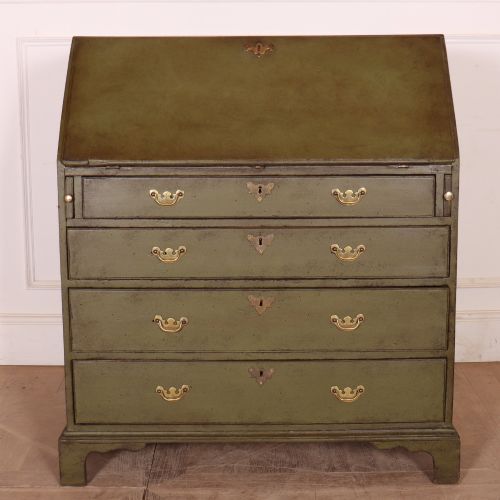

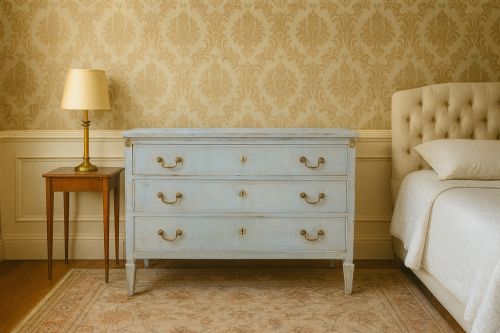


18th Century Painted Bureau
An 18th century painted bureau brings hand-finished colour and concealed workspace into a room, offering practical storage with historic character.
18th Century Painted Bureau
An 18th century painted bureau combines a sloping writing flap with internal compartments and drawers beneath, often rising into taller bookcase variants. You will most frequently meet standard English forms alongside larger bureau bookcases and occasional continental examples.
The styles span traditional Georgian proportions, English country pieces, and distinct regional iterations like Gustavian or Dutch Baroque. These items served as working desks and private writing cabinets for domestic households.
Surviving pieces reflect diverse decorative treatments, ranging from simple historic painted finishes to intricate Chinoiserie lacquer work. The underlying construction typically relies on timber carcasses prepared to receive paint.
Materials and Construction
Carpenters constructed these desks using native timbers such as oak and pine, sometimes incorporating finer woods like satinwood for specific surface details. The primary structure supports a downward-folding writing flap that conceals internal pigeonholes and small drawers.
Makers applied paint directly to wooden surfaces, frequently building up multiple layers to achieve a durable coloured finish. Brass handles, escutcheons and hinges provide functional hardware across the drawers and fall fronts.
Listings feature 18th century and Georgian periods alongside 1800 and 1860 items, utilising brass, glass, pine, lacquer, and satinwood.
Judging Quality and Finish
The refinement of the painted surface and the handling of decorative motifs distinguish finer examples from simpler provincial work. Finer pieces display careful proportioning in the layout of internal stationery compartments and exterior drawer tiers.
Original hardware, sound timber framing, and the survival of early painted layers carry significant weight in evaluating a piece. The integrity of the fall-front hinge mechanism and the smooth operation of internal drawers indicate superior cabinetmaking.
The 18th Century Painted Bureau Glossary
- Bureau
- A writing desk featuring a sloping hinged flap that opens to reveal a fitted interior of small drawers and pigeonholes. It typically sits above a chest of larger drawers.
- Bureau Bookcase
- A two-part form combining a slant-front writing desk base with an enclosed upper shelving or cabinet section. These pieces offer extended storage and display capabilities.
- Chinoiserie
- A decorative style employing European interpretations of Chinese artistic motifs, often rendered in raised lacquer or painted designs. This technique frequently appears on high-status cabinets and desks.
- Gustavian
- A Swedish neoclassical design movement characterised by restrained classical ornament and pale painted finishes. These items emerged during the late eighteenth century.
- Satinwood
- A lustrous hardwood with a yellowish sheen used for fine cabinetwork and decorative veneers. It provides a smooth contrast to painted structural elements.
18th Century Painted Bureau: Frequently Asked Questions
How do I use a bureau desk?
Lower the hinged writing flap to create a stable desk surface for writing or placing a laptop. Internal compartments organise small stationery items while the lower drawers store larger household papers.
Close and lock the fall front when not in use to conceal your working materials. This keeps the writing area tidy and protects the interior fittings.
Where should I place a bureau?
Position your bureau against a stable interior wall away from direct sunlight and radiators to protect the painted wood surface. Adequate clearance in front of the piece is essential for lowering the writing flap and pulling out chairs.
Living rooms, studies, and large hallways provide suitable environments where the cabinet adds both surface character and concealed storage. Ensure the floor is level so the drawers operate smoothly.
How do I tell regional styles apart?
English pieces typically follow Georgian proportions with straightforward bracket feet and restrained cornices. Gustavian examples from Sweden lean towards lighter pale palettes and neoclassical carvings.
Dutch variations often showcase bombe profiles with curved fronts and sides. Examining the underlying wood and hardware style helps clarify the likely country of origin.
Can I store books inside a bureau bookcase?
The upper cabinet sections of bureau bookcases provide suitable shelving for books and display items. Ensure the shelf supports are secure before loading heavier volumes onto the wooden tiers.
Keep glass doors clean and avoid overloading the internal shelves to maintain structural balance. The lower desk area remains reserved for writing materials and flat storage.