


18th Century Leather Chest
These 18th century leather chest examples offer robust storage and tactile surfaces, bringing period character and sturdy construction directly into a room.
18th Century Leather Chest
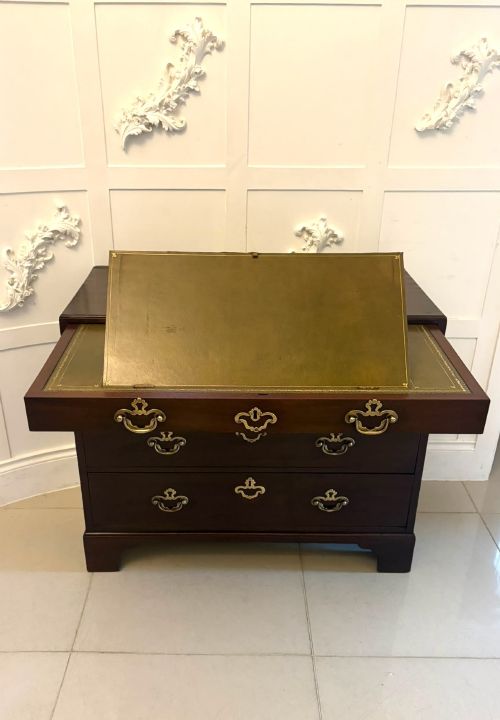
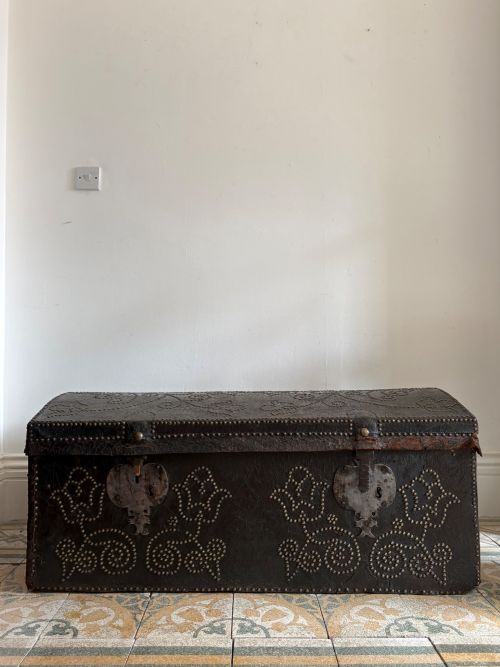
The versions most commonly met on this page span Georgian cabinet pieces and studded hide trunks originating from English, Dutch, and Spanish workshops. These objects combine wooden carcases with protective outer skins of leather or hide, frequently accented with brass studwork and carry handles.
Materials and construction
Maker construction relies on timber carcases of mahogany, walnut, or foundational wood clad in hide or leather secured with decorative brass studs. Iron hinges, locks, and side carry handles reinforce the structures for domestic utility or travel.
Surface treatments combine treated animal hide with brass work, while interior sections often incorporate fitted writing drawers, compartments, or paper linings.
Several trunks feature decorative brass studwork that doubles as structural reinforcement for the hide.
Quality variations
Distinctions in quality rest upon the sophistication of the internal fittings, such as elaborate Chippendale desk interiors or metamorphic writing slopes, alongside the fineness of the exterior brass studwork and hardware. Superior examples display precise joinery in primary woods like mahogany or walnut beneath their hide coverings.
The condition and original integrity of the leather or hide surface, together with the survival of authentic iron and brass mounts, separate utilitarian travel trunks from high-status domestic furniture.
Robert Gillows II
The 18th Century Leather Chest Glossary
- Dome top
- A rounded lid construction designed to shed water during travel and provide greater internal capacity in trunks and coffers.
- Bachelor's chest
- A compact domestic chest incorporating a pull-out slide or fitted writing drawer for correspondence.
- Studded
- Decorated and secured using rows of metal tacks or brass nails, which also helped fasten the leather covering to the wooden carcase.
- Coffer
- A heavy chest traditionally used for storing valuables, often constructed with a solid wooden base and protective outer skin.
- Lowboy
- A small low table with drawers, functioning as a dressing table or writing stand in period interiors.
18th Century Leather Chest: Frequently Asked Questions
What were these chests used for?
These pieces served as robust containers for transporting personal belongings during travel or as primary storage furniture within period homes.
Many examples also doubled as writing desks, incorporating fitted drawers, internal compartments, and leather writing slopes for correspondence.
How do I live with one?
An 18th century leather chest functions effectively as a coffee table, bedside storage piece, or statement placement in a hallway.
Keep the leather conditioned with appropriate museum-grade wax and place the piece away from direct heat sources to preserve the hide.
How do I tell periods apart?
Early pieces often feature dome tops, heavy iron mounts, and simple hide coverings secured with brass studs.
Later Georgian examples show refined mahogany and walnut carcases with sophisticated internal writing compartments and refined hardware.
Were these chests made for travel?
Trunks and coffers equipped with side carry handles and robust leather or iron reinforcement were built specifically for journeys.
Other domestic forms like chests of drawers remained stationary inside rooms despite incorporating protective leather skins.