



18th Century Italian Majolica
These 18th century italian majolica pieces are tin-glazed earthenware vessels and wall art built for apothecary and display use.
18th Century Italian Majolica
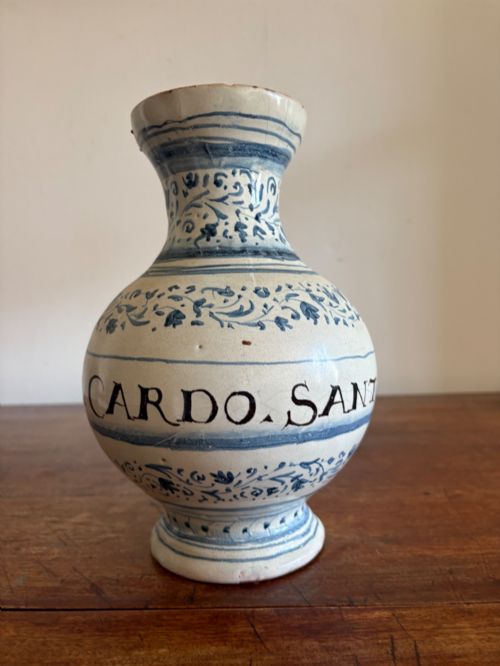
When you search for 18th century italian majolica, you find tin-glazed earthenware vessels, jars, flasks, and wall art produced during the eighteenth century. The versions you are most likely to meet on this page include pharmacy wet drug jugs, apothecary jars, and albarello forms.
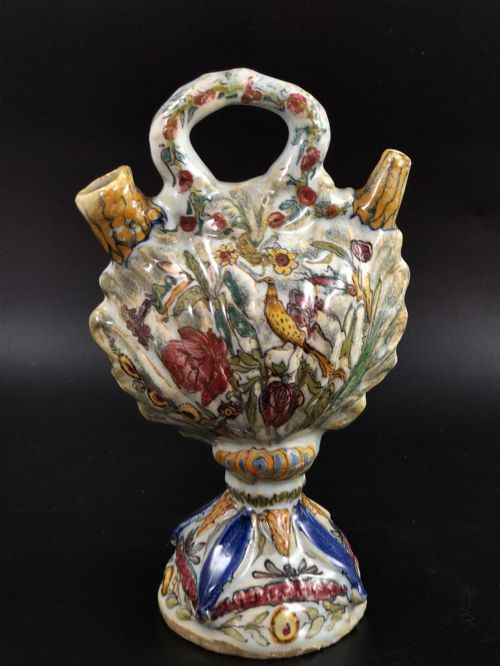
The objects span styles such as Italian Baroque and Renaissance influences, alongside general eighteenth-century European aesthetics. Forms range from scallop shell pilgrim flasks and lidded vases to devotional plaques depicting the Madonna with Child.
Makers and specific origins emerge through pieces attributed to locations like Naples, Nove, and Savona. These items serve both functional storage and decorative display roles, appearing in blue and white or polychrome palettes.
Materials and technique
Potters formed these pieces using earthenware clay, applying a tin glaze to create an opaque white surface suitable for painted decoration. Pigments were then brushed directly onto the unfired or raw glaze before the final firing.
The palette relies on cobalt blue for traditional blue and white designs, alongside multi-coloured pigments for polychrome examples. Artisans shaped diverse forms such as cylindrical albarelli, waisted jars, and moulded scallop shell pilgrim flasks.
Current listings feature earthenware materials decorated with tin glaze and pigments across the eighteenth century.
Judging quality
Quality in these ceramics rests on the crispness of the painted detail and the control of the glaze during firing. Pieces with well-defined brushwork and stable glazes stand apart from simpler or less controlled examples.
The complexity of the form also dictates the tier of the piece, with moulded pilgrim flasks and lidded vases showing higher ambition than standard cylindrical drug jars.
The 18th Century Italian Majolica Glossary
- Majolica
- A type of tin-glazed earthenware decorated with coloured pigments on an opaque white glaze. It was widely produced in Italy for both utilitarian and ornamental purposes.
- Polychrome
- Decoration employing multiple colours rather than a single hue. In these ceramics, it describes designs utilising various pigments alongside or instead of cobalt blue.
- Pilgrim Flask
- A flattened, circular pilgrim flask with loops for suspension, often shaped like a scallop shell. These vessels derive their form from medieval containers carried by travellers.
- Tin Glaze
- A lead glaze made white and opaque by the addition of tin oxide. This surface provides the smooth white background required for painted majolica decoration.
18th Century Italian Majolica: Frequently Asked Questions
What is an albarello used for?
An albarello is a cylindrical drug jar that held dry medicines, ointments, or herbs in European apothecaries. Apothecaries lined shelves with these jars for easy access and identification.
Over time, many of these utilitarian containers moved into domestic and decorative settings as collectors valued their painted surfaces.
How do I identify Savona majolica?
Savona pieces connect to production centres in the Liguria region of Italy, known for distinct regional painting styles on tin glaze. These items often feature characteristic blue and white motifs.
Examining the palette and form helps link specific jars and vessels to their geographic origins.
What is a pharmacy wet drug jug?
A wet drug jug stored liquid medicines, syrups, or oils in an apothecary shop. These vessels typically include a spout and handle for pouring.
Makers decorated them with painted labels to identify the contents, such as specific pharmaceutical preparations.
How do I care for tin-glazed earthenware?
Tin-glazed earthenware requires gentle handling because the ceramic body and glaze can chip or flake under impact. Keep these pieces away from high moisture and rapid temperature shifts.
Dust them softly with a dry cloth rather than using liquid cleaners or submersing them in water.