


Decorative Ceramic Flasks
Decorative ceramic flasks are ornamental vessels spanning multiple centuries, offering collectors striking glazes, hand-painted scenes, and distinct historical forms.
Decorative Ceramic Flasks
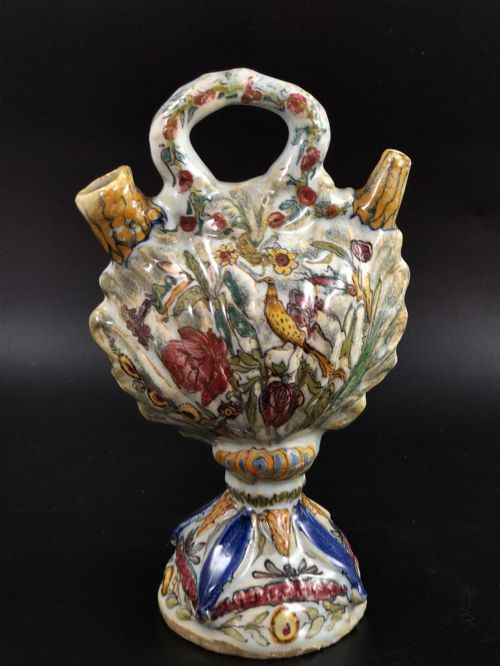
Decorative ceramic flasks encompass forms like moon flasks, pilgrim flasks, and snuffs bottles originating from European and Asian traditions. When searching for decorative ceramic flasks, a buyer encounters pieces shaped as scallop shells, two-handled vessels, and traditional moon flasks.
The evidence spans the eighteenth and nineteenth centuries into the nineteen-forties, touching styles from the Qing Dynasty to the Arts and Crafts movement and Italian Baroque. European factories and Chinese kilns both contribute to this varied category of ornamental containers.
Most examples function purely as decorative display objects rather than utilitarian liquid carriers, often featuring elaborate painted figural scenes or rich gilding. These pieces range from modest snuff bottles to substantial fifty-centimetre porcelain pairs.
How they were made
Potters shaped these vessels using earthenware, stoneware, and porcelain, applying tin glazes, enamels, and gold leaf for surface decoration. Master artisans employed techniques such as pate-sur-pate and hand painting directly onto the clay body before firing.
Decoration often involved intricate polychrome work, gilding, and raised enamel details that required multiple kiln firings to achieve depth and permanence. Individual artists signed certain pieces, recording skilled handwork on porcelain and earthenware surfaces.
One tiny nineteenth-century snuff bottle carries a symbol of longevity, proving that good things genuinely come in miniature ceramic packages.
What varies in quality
Quality rests in the precision of the hand painting, the complexity of the glaze work, and the ambition of the form, such as scallop-shell mouldings. Superior pieces show confident brushwork in figural scenes and crisp definition in relief moulding.
The reputation of the pottery and the skill of the named artist elevate certain examples, separating standard production wares from masterworks. Materials like gold leaf and pate-sur-pate add a layer of refinement that distinguishes finer items.
Doulton Lambeth·Royal Worcester·Minton·Wedgwood·Coalport·Roger Guerin
The Decorative Ceramic Flasks Glossary
- Moon flask
- A flattened circular flask with a short neck and small handles, often resting on an oval base.
- Pilgrim flask
- A vessel derived from medieval containers used by travellers, featuring loops for suspension and decorative flattened sides.
- Pate-sur-pate
- A ceramic technique where successive layers of liquid clay are built up to create a cameo-like relief design.
- Majolica
- Tin-glazed earthenware decorated with brightly coloured metal oxides on an opaque white background.
- Famille rose
- A Chinese porcelain palette dominated by opaque pink enamel, introduced during the Qing dynasty.
Decorative Ceramic Flasks: Frequently Asked Questions
What is a moon flask?
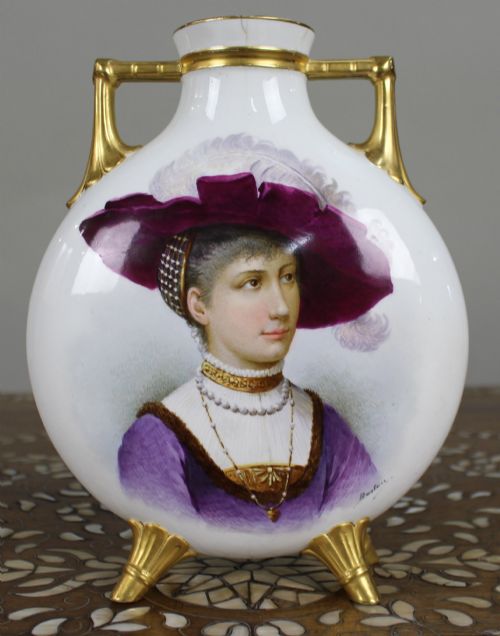
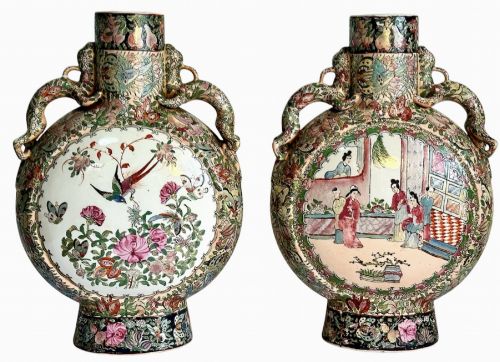
A moon flask is a flattened circular vessel with a short neck, designed primarily for display rather than holding liquids. These pieces often feature painted scenes on both flat sides.
Potters across Europe and China adopted this distinctive shape during the nineteenth century, sometimes adding decorative handles or resting them on fixed stands.
How do I identify majolica flasks?
Majolica is characterised by a tin glaze over earthenware, producing vibrant polychrome colours and a glossy surface finish. Look for rich greens, blues, and yellows applied to moulded sculptural forms like scallop shells.
Italian makers produced notable examples of these decorative pilgrim flasks during the eighteenth century.
What does pate-sur-pate mean?
Pate-sur-pate translates to paste on paste, describing a method where white slip is painted layer by layer onto a darker clay body. This builds a translucent, low-relief design resembling a carved cameo.
Factory decorators used this painstaking technique on nineteenth-century porcelain vases to create subtle tonal figures.
Where were these flasks made?
These decorative vessels originate from major European ceramic centres in England and Austria, alongside Chinese kilns producing wares for export and domestic use. Factories such as Royal Worcester, Minton, and Wedgwood created distinct regional interpretations.
Asian pieces from the evidence include Qing period porcelain moon flasks and snuff bottles.
How should I display ceramic flasks?
Ceramic flasks require stable, flat surfaces away from direct sunlight and heavy foot traffic to protect their delicate enamel and gilt decoration. Due to their often top-heavy or rounded bases, secure placement prevents accidental tipping.
Pairing matching vases or placing them as centrepieces highlights their painted panels and sculptural handles.