It was listed by Artware Fineart. Sold pieces stay on Sellingantiques as a record of what has passed through, and the next one is rarely far away.
Artware Fineart has dated this piece to the 1800s.
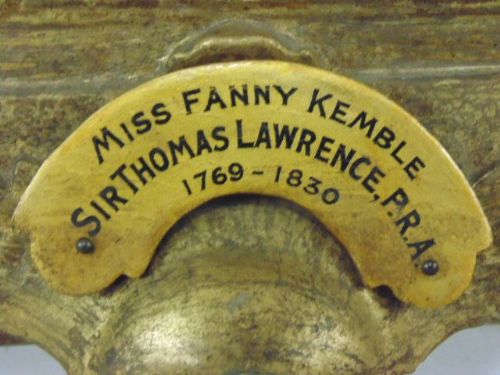
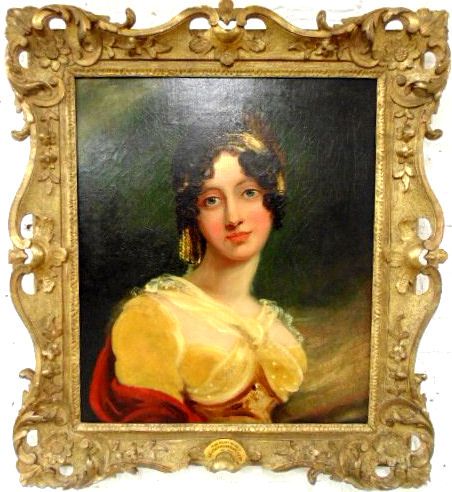
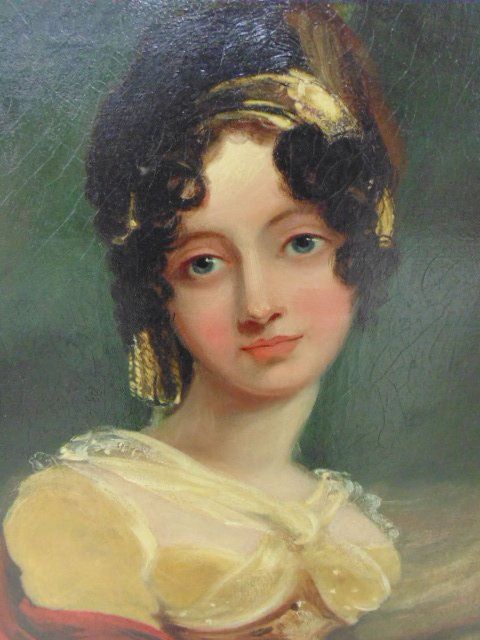
Portrait of Frances Anne (Fanny) Kemble 1809–1893
15th July 1829
oil on canvas
58 x 50 cm. (22.1/2 x 19.1/2 in.)
He flirted with her, as he did every woman who sat for him. He noticed, while sketching her face, that she had the same eyes as her aunt and his close friend, the dominant tragic actress of the British stage, Sarah Siddons. Lawrence made several portraits of Fanny Kemble inn 1829 and 1830 at the time of her famous debut on stage.
Frances Anne [Fanny] Kemble (1809–1893), [married name Butler], actress and author, was born on 27 November 1809 in Newman Street, London, not far from Covent Garden, the centre of the life of her theatrical family. Her parents were Charles Kemble (1775–1854) and Maria Theresa Kemble, née De Camp (1777–1838), both prominent actors, and her father was also the manager of Covent Garden Theatre. She was their second child and the elder daughter among four children. Her father's elder brother was John Philip Kemble, the foremost male tragedian of his generation, and his sister was Sarah Siddons, one of the most famous English-speaking actresses of all time. At least twenty-two of their close relatives were occupied full time in the theatre, and a dozen of them had entries in the Dictionary of National Biography. The talents of Fanny Kemble and her brothers and sister were particularly noticeable: she herself reigned for several years as the brightest of the young actresses of her day before beginning a brilliant career as monologist and a whole new life as a writer; her younger sister Adelaide Kemble was widely accounted one of the greatest singers England had ever produced; her elder brother John Mitchell Kemble was an eminent Anglo-Saxon scholar; and—not too surprisingly in this flamboyant family—her younger brother, Henry, distinguished chiefly for his personal beauty, died in a lunatic asylum, perhaps of venereal disease. The parents and children were fond of each other, but Fanny's father and mother seemed hopelessly unable to squeeze their oversized personalities into the same house with any comfort.
Fanny Kemble was educated partly at schools in Bath, Boulogne, and Paris, but learned even more in her irregular reading with her odd but highly intelligent and literate family. Surprisingly, she was not familiar with Shakespeare's works as a teenager. When her father was threatened with bankruptcy in 1829 in the impending financial crash of his theatre, he suggested to his nineteen-year-old daughter that she become an actress rather than a governess; on 5 October, only three weeks later, never having acted before on a public stage, she made her début in Covent Garden as Juliet, with her parents playing Mercutio and Lady Capulet. She was a stupendous success, and she thereafter so consistently filled the theatre on the nights she was acting that its crash was postponed. She was unusually short for a star, never conventionally beautiful, although she could create the illusion of being so; much of her effect on others came from her vivid dark eyes and velvety deep voice (baritone, she called it). In middle age, like all the women of her family, she became too stout to be convincing on stage as the impetuous girlish heroines in which she had once specialized, but she still moved with the grace of a dancer. She relied too heavily on the inspiration of the moment to create characters; her total innocence of learned technique was particularly noticeable when she played the grand Shakespearian roles she inherited from her aunt Mrs Siddons, to whom she was constantly compared.
Fanny Kemble was always phenomenally quick at learning parts and began playing a new ro
Artware Fineart has dated this piece to the 1800s.
You can view the stock and full dealer information on the Artware Fineart Profile Page
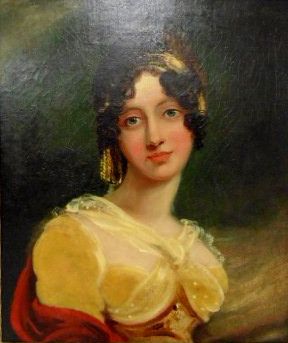
Attributed to Sir Thomas Lawrence, Pra, 1769 - 1830 Portrait of Frances Anne (Fanny) Kemble 1809–1893