It was listed by Artware Fineart. Sold pieces stay on Sellingantiques as a record of what has passed through, and the next one is rarely far away.
Artware Fineart has dated this piece to the 1960s.
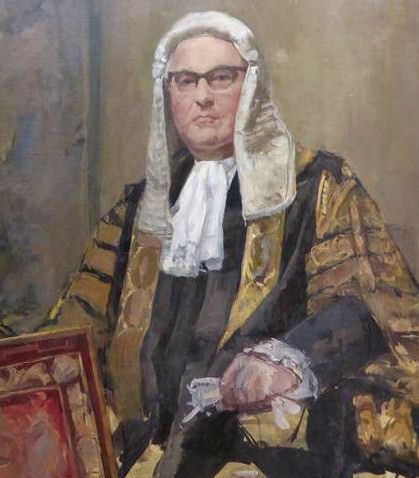
Reginald Manningham-Buller, 1st Viscount Dilhorne, PC, QC, 1905 -1980
Oil on Canvas
50 x 40 in. (127 x 102 cm.)
He served as Lord Chancellor from 1962 to 1964. Born in Amersham, Buckinghamshire, Manningham-Buller was the only son of Sir Mervyn Manningham-Buller, 3rd Baronet, grandson of Sir Edward Manningham-Buller, 1st Baronet, of Dilhorne Hall, Staffordshire, a junior member of the Yarde-Buller family headed by Baron Churston. His mother was the Hon. Lilah, daughter of Charles Cavendish, 3rd Baron Chesham. His uncle's seat of Dilhorne Hall having passed to an heiress ineligible for the baronetcy, Manningham-Buller made his home in Northamptonshire. He was educated at Eton College, where he caused a fellow pupil to be expelled for making advances to another boy. He then attended Magdalen College, Oxford, before being called to the Bar in 1927. Manningham-Buller was elected to the House of Commons in a 1943 by-election as Member of Parliament (MP) for Daventry. He was briefly a junior minister in the government of Winston Churchill before it lost power in the general election of 1945, and became a King's Counsel in 1947. In 1950, his seat became Northamptonshire South. When Churchill regained power in 1951 Dilhorne was knighted and became Solicitor-General; in 1954 he was sworn of the Privy Council and became Attorney General for England and Wales. In 1956 he succeeded his father as fourth Baronet. He continued as Attorney-General under Sir Anthony Eden and Harold Macmillan until July 1962, when he was rather abruptly named Lord Chancellor and sent to the House of Lords to replace Lord Kilmuir. On his appointment he was elevated to the peerage as Baron Dilhorne, of Towcester in the County of Northampton. Retained, after Macmillan's retirement, in the cabinet of Alec Douglas-Home, when the Conservatives lost the election of 1964 he was made Viscount Dilhorne, of Greens Norton in the County of Northampton, and Deputy Leader of the Conservatives in the House of Lords. In 1969 he was named a Lord of Appeal in Ordinary and continued in this capacity until his death. Manningham-Buller wrote the first report on the Profumo affair - an internal report for the Macmillan Government (confirmed by his daughter Dame Eliza when she appeared on the Desert Island Discs radio programme). Then when Lord Denning was appointed to investigate and report on the affair, Dilhorne passed his report over to Denning. Chapman Pincher in his book Inside Story published in 1978 quotes Manningham-Buller as jokingly saying he could have sued Tom Denning for breach of copyright because significant portions of Manningham-Buller's report appeared in Denning's report virtually unchanged. Denning did of course include much in his report that was not in Manningham-Buller's report. In 1957 Manningham-Buller prosecuted suspected serial killer Dr John Bodkin Adams for the murder of two elderly widows in Eastbourne, Edith Alice Morrell and Gertrude Hullett. Adams was acquitted on the Morrell charge but Manningham-Buller controversially entered a nolle prosequi regarding Hullett. Not only was there seemingly little reason to enter it (Adams was not suffering from ill health), but the Hullett charge was deemed by many to be the stronger of the two cases. Mr Justice Patrick Devlin, the presiding judge, in his post-trial book termed Manningham-Buller's act "an abuse of process".Devlin also criticised Manningham-Buller for his uncharacteristic weakness at a crucial moment in the Morrell case: evidence (some nurses' notebooks) that had gone missing from the Director of Public Prosecutions's files, turned up in the hands of the defence on the second day of the trial. Mannin
Artware Fineart has dated this piece to the 1960s.
You can view the stock and full dealer information on the Artware Fineart Profile Page

Alice Mary Burton 1893 - 1968 Reginald Manningham-buller, 1st Viscount Dilhorne, Pc, Qc, 1905 -1980