
A 2026 Guide by Sellingantiques
Original seventeenth-century furniture was bulky and rare, prompting a large revival trade.
The Victorians loved a romanticised past, making these pieces popular again.
By the 1920s, antique Jacobean style sideboards furnished thousands of suburban dining rooms.
Look at the scale of these units. They dominate a room.
Makers adapted the old court cupboard form. They're designed to hold modern tableware.
Waring & Gillow produced large numbers of these during the early twentieth century.
Maples & Co. dominated the London trade, turning out whole matching suites.
Many provincial firms built them without ever leaving a maker's mark.
The 2026 retail price guide for Antique Jacobean Style Sideboards is drawn from a proprietary archive of over 1.1 million retail prices indexed by Sellingantiques since 2003. This guide relies exclusively on their own internal data; no external sources or auction records are used.
Analysing nearly 25 years of UK antique market history alongside current retail values, the data indicates that typical UK retail prices for Antique Jacobean Style Sideboards range between £500 and £1,700. Entry-level prices generally fall under £500 and premium examples upwards of £1,700.
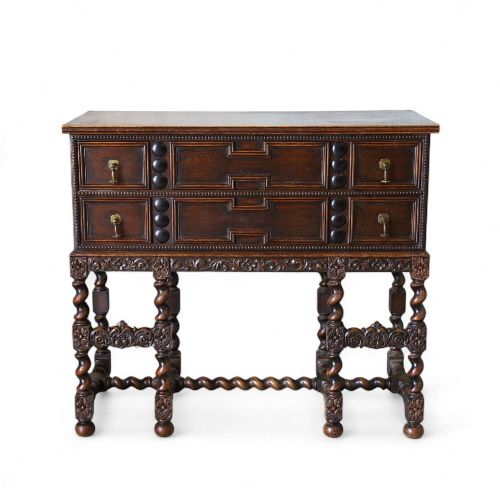
Geometric mouldings applied directly to the door panels recreate that early aesthetic.
Check the front legs for large turnings. They resemble carved melons.
Heavy stretchers connect the base near the floor. This adds stability.
Early revival pieces rely on thick solid oak boards and hand-cut joints.
Turn a late Edwardian example around. The backboards are often rougher.
You'll find machine-cut dovetails and thinner oak veneers over a cheaper core.
"Most incorporate hidden drawers lined with green baize fabric."
"Keep an eye out for deep cellaret drawers lined with lead."
"The dark fumed finish was created by exposing the raw oak to ammonia."
Based on almost 25 years of Sellingantiques UK antique market data, Antique Jacobean Style Sideboards appeared 311 times (out of 1,100,000 antiques) which gives it a rarity score of 94/100.
This score measures scarcity within the Sellingantiques archive only and is not a survey of the entire antiques market, so these statistics may not be indicative of the general availability of Antique Jacobean Style Sideboards elsewhere.
Solid oak shifts with the seasons. It swells in damp air and shrinks when you turn the heating on.
Slight sticking is normal. You can rub a wax candle along the door edges to ease the friction.
Dust gathers quickly in those deep geometric recesses. Avoid modern chemical sprays. They degrade the old polish and leave a dull film.
Use a soft bristle brush. A clean shoe brush works well to sweep out the crevices. Once a year, apply a thin coat of beeswax with a cloth and buff it out.
Makers treated the raw wood with ammonia gas. The vapour reacts with tannins in the oak, turning the timber a deep brown.
This process creates a colour that sits right through the surface layer. It became the standard finish for most antique Jacobean style sideboards.
Many revival sideboards feature a raised back gallery. This stops items sliding off.
They usually unscrew easily from the back. Taking it off reduces the visual bulk.
Please note: This Antique Jacobean Style Sideboards guide and its associated pricing data are provided for general informational purposes only. It does not constitute formal financial, investment, or appraisal advice and should not be relied upon as the sole basis for any commercial activity, purchasing, or sales decisions. Sellingantiques.co.uk accepts no liability for any actions taken in reliance on this information. Always consult with a qualified professional or independent appraiser.
