


A 2026 Guide by Sellingantiques

Rare American Antique George III Quality Solid Maple Wood Dresser and Rack, 18th Century
Priced at £7,850 from London City Antiques
Rooted in the medieval side tables used to prepare food before serving.
Look at seventeenth-century inventories to find early references to base units without the high racks.
By the Georgian era, antique kitchen dressers evolved into the familiar two-part forms seen in farmhouses across Britain.
Regional variations emerged strongly in Wales and the West Country during the nineteenth century.
Most antique kitchen dressers lack specific maker names because village carpenters built them for local communities.
Distinctive Montgomeryshire styles featuring shaped friezes and enclosed bases linked to unnamed rural workshops in Wales.
Search for regional traits rather than stamped signatures when examining eighteenth-century country furniture.
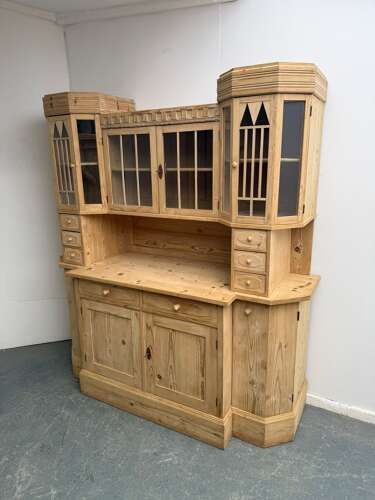
Small 1930’S Pine Dresser, 1930
Priced at £600 from Pinefinders
The 2026 retail price guide for Antique Kitchen Dressers is drawn from a proprietary archive of over 1.1 million retail prices indexed by Sellingantiques since 2003. This guide relies exclusively on their own internal data; no external sources or auction records are used.
Analysing nearly 25 years of UK antique market history alongside current retail values, the data indicates that typical UK retail prices for Antique Kitchen Dressers range between £700 and £3,500. Entry-level prices generally fall under £700 and premium examples upwards of £3,500.
The open plate rack remains the defining upper element of antique kitchen dressers.
Check the base section for the typical arrangement of three frieze drawers sitting above panelled cupboard doors.
Iron or brass drop handles and escutcheons fitted to the drawer fronts for everyday access.

Early 20th Century Painted Pine Dresser & Rack, 1930
Priced at £875 from Brookside Antiques
Early country pieces rely on stout pegged mortise and tenon joints to keep the heavy frame square.
Slide a drawer out to see thick hand-cut dovetails joining the sides to the front panel.
Later Victorian production bringing thinner timbers and machine-cut mouldings to the antique kitchen dresser trade.
"Meat hooks occasionally fitted to the upper boards to cure small cuts in the ambient heat of the hearth."
"Find tiny iron cup hooks under the lower shelf, added later in the nineteenth century to hang handled mugs."
"Some Welsh types feature loose boards that easily slide out to make cleaning behind the heavy unit easier."
Based on almost 25 years of Sellingantiques UK antique market data, Antique Kitchen Dressers appeared 1243 times (out of 1,100,000 antiques) which gives it a rarity score of 78/100.
This score measures scarcity within the Sellingantiques archive only and is not a survey of the entire antiques market, so these statistics may not be indicative of the general availability of Antique Kitchen Dressers elsewhere.
Most antique kitchen dressers were built in two distinct parts. The upper rack sits on the base unit, often held in place by wooden shoes or simple iron brackets at the back.
Lifting the rack off makes moving them much easier. You will usually need two people to lift the top section away safely without catching the ceiling.
A damp cloth works best for basic dusting. Wipe the surfaces gently to lift loose dirt from the shelves and door panels. Dry the wood immediately with a soft towel so moisture never sits on the joints.
Once a year, you can apply a thin coat of clear beeswax polish. Work it in sparingly and buff it off with a clean duster to revive the shine. Avoid modern aerosol sprays, as they build up a sticky silicone residue over the antique patina.
A pot board dresser features an open lower tier instead of enclosed cupboards. The base has drawers at the top, supported by turned legs that rest on a solid wooden shelf just above the floor.
This open shelf was originally used to store heavy iron cooking pots and copper kettles. You often find these open styles associated with earlier country furniture or specific regions like Wales.
Early plates were generally smaller than modern dinnerware. The grooved channels carved into the shelf boards were spaced to hold those older, shallower plates upright against the backboards.
Many people tilt their larger modern plates at a steeper angle to make them fit. You can also stack plates flat on the wider base top, reserving the narrow upper rack for cups, jugs, and smaller side plates.
Please note: This Antique Kitchen Dressers guide and its associated pricing data are provided for general informational purposes only. It does not constitute formal financial, investment, or appraisal advice and should not be relied upon as the sole basis for any commercial activity, purchasing, or sales decisions. Sellingantiques.co.uk accepts no liability for any actions taken in reliance on this information. Always consult with a qualified professional or independent appraiser.
