

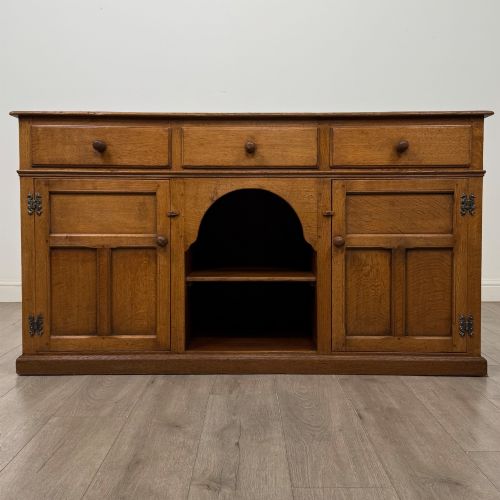

Antique Dog Kennel Dressers
A country dresser with a recessed open bay in the middle of its base, flanked by drawers and cupboards, built for farmhouse kitchens where the gap took a crock, a churn or a dog.
Antique Dog Kennel Dressers
The name comes from the base. Instead of a run of cupboards across the bottom, the centre is left open as a recessed bay, with drawers or cupboards to either side and, in most cases, a shelved rack standing above. The opening gave floor space in a working kitchen.
These are vernacular pieces, made by country joiners for farmhouse and cottage use, chiefly in the late 18th and 19th centuries, rather than to any published design. Titles on Sellingantiques reflect that plainness: the form, the timber, a period, and often nothing else.
Oak dominates, naming fourteen of the twenty titles, with pine the only other timber that appears. Four titles claim Welsh origin, the single regional attribution the category carries. Nearly all are offered as complete dressers; one is a base without its rack, and one is described as two-part.
Dating is broad. Nine listings say no more than "19th Century", three say Georgian and one Victorian, with only four carrying a clean year, running between 1800 and 1900. Read the period on most of these as the dealer's judgement rather than a documented date.
Where The Range Sits
Timber does most of the sorting. Oak fills the upper half of the sampled range, and the pine examples cluster lower, with the two cheapest pine pieces sitting among the lowest-priced listings in the category. Since only those two timbers appear, that split covers nearly everything.
Completeness matters next. A dresser offered whole, base and rack together, sits above the lone dresser base listed without its top. The rack is half the piece visually, and a base on its own reads as a side table with drawers.
Earlier attribution lifts a piece as well. The three titles saying simply Georgian, and the one dated 1820, sit in the upper part of the range, while the 1900-dated example sits at the bottom. Welsh-named oak pieces all sit above the lowest band. Size can't be read from the titles at all; only one mentions it.
Antique Dog Kennel Dressers Retail Price Guide 2026
Typical UK retail prices for dog kennel dressers, calculated from the Sellingantiques database of over a million retail prices indexed since 2003. This retail price guide relies exclusively on Sellingantiques data; no external sources or auction records are used, so the figures do not describe the wider market.
Dresser comes from the French dressoir, the board where food was dressed before it went to the table.
The Antique Dog Kennel Dressers Glossary
- Dog kennel dresser
- A dresser whose base has a recessed open bay in the centre, flanked by drawers or cupboards.
- Rack
- The shelved upper structure standing on the base, named in one title here as "Dresser & Rack".
- Dresser base
- The lower half offered on its own, without the shelved top; one listing in this category is base only.
- Two-part
- Base and rack made as separate sections that lift apart, as one title states.
- Welsh
- A regional attribution used in four titles, in each case alongside oak.
- Golden oak
- A colour description for oak with a warm, mellow surface tone, used in one title.
Antique Dog Kennel Dressers: Frequently Asked Questions
Why is it called a dog kennel dresser?
The base has a recessed open bay in the centre rather than a continuous run of cupboards. That opening gave floor space in a farmhouse kitchen for a crock, a churn or a dog, and the nickname stuck.
It describes the shape of the base, nothing more. The drawers and cupboards flanking the bay, and the rack above, follow normal dresser lines.
What wood are they usually made from?
Oak, in fourteen of the twenty titles on Sellingantiques. Pine is the only other timber named, accounting for four.
The oak pieces span Georgian, Regency and Victorian entries, and one is described as golden oak. Pine examples sit lower in the sampled range.
Are these Welsh dressers?
Some are described that way. Four titles claim a Welsh origin, always alongside oak, and it's the only regional attribution the category carries.
The rest are named by form, timber and period alone. Country joiners built this shape for farmhouse use, and a dealer's Welsh attribution is a judgement rather than a documented origin.
How old are dog kennel dressers?
The form belongs chiefly to the late 18th and 19th centuries. On Sellingantiques the dated field runs from 1800 to 1900.
Only four listings give a clean year. Nine say no more than "19th Century", three say Georgian, one Victorian, and two carry no date at all.
Can you buy the base without the rack?
It happens, though rarely. One listing in the category is a dresser base in golden oak, offered without its shelved top.
Everything else reads as a whole dresser, with one described as two-part and one as "Dresser & Rack". Complete dressers sit above the base-only listing in the range.
How often do these come up for sale?
About three a year are listed on Sellingantiques. Across the archive, eleven different dealers have handled one.
That spread tells you something: it's a form almost nobody stocks twice.