


A 2026 Guide by Sellingantiques
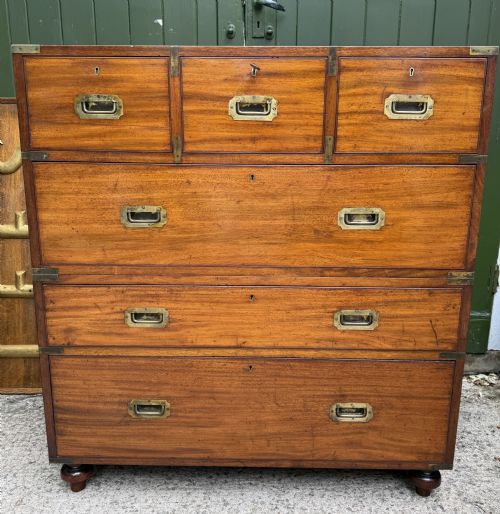
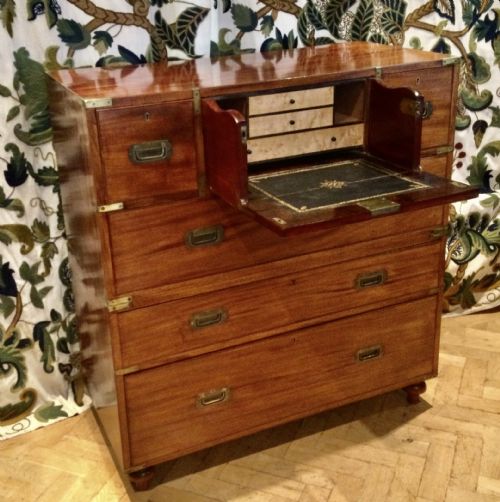
Military/campaign Chest of Drawers, 1870
Priced at £2,800 from Midwinter Antiques
British army officers bought these privately before deploying abroad. They needed practical furniture that survived rough sea crossings and long overland marches.
Look for the two-part design. Splitting the antique military chest into equal halves made it easier to balance on a pack animal.
Most date from the nineteenth century. The expansion of the empire drove demand for portable domestic equipment.
Often used in colonial bungalows just as much as canvas tents.
Standardisation arrived slowly. Early versions vary wildly in size before the trade settled on proportions suited to shipping crates.
Army and Navy Co-operative Society produced thousands. They supplied officers with standardised antique military chests late in the nineteenth century.
Hill and Millard operated out of Duncannon Street. Their stamped brass locks frequently appear on better quality officer equipment.
Provincial cabinet makers built plenty too. Many lack maker marks, relying instead on paper trade labels that rarely survive.
Two-part Teak Military Chest of Drawers, 1860
Priced at £2,650 from Georgian Antiques
The 2026 retail price guide for Antique Military Chests is drawn from a proprietary archive of over 1.1 million retail prices indexed by Sellingantiques since 2003. This guide relies exclusively on their own internal data; no external sources or auction records are used.
Analysing nearly 25 years of UK antique market history alongside current retail values, the data indicates that typical UK retail prices for Antique Military Chests range between £900 and £3,000. Entry-level prices generally fall under £900 and premium examples upwards of £3,000.
Removable turned feet screw directly into the bottom half. You just unscrew them and pack them inside a drawer before transport.
Strapping bands of brass wrap around the edges. This reinforces the dovetail joints against the constant strain of moving.
Check the handles on the side panels. Heavy iron drops sit flush within recessed backplates.
English Military Campaign Chest, 1860
Priced at £2,650 from Arcadia Antiques
Early examples feature standard cockbeading around the drawers. This proved impractical as it caught and chipped during transit.
Cabinet makers quickly adopted flat drawer fronts. Flush surfaces survived rough handling much better.
Dovetail joints anchor the carcase. Craftsmen cut these tight to ensure the box held square under the weight of packed belongings.
"Officers sometimes requested bespoke compartments for specific items. You can find custom fitted sections for washbasins or shaving gear."
"Teak examples occasionally surface. Cabinet makers in India constructed them for British officers stationed there using local timber."
"They stack securely without fixings. Gravity and a simple wooden lip keep the top half firmly seated on the base."
Based on almost 25 years of Sellingantiques UK antique market data, Antique Military Chests appeared 1406 times (out of 1,100,000 antiques) which gives it a rarity score of 75/100.
This score measures scarcity within the Sellingantiques archive only and is not a survey of the entire antiques market, so these statistics may not be indicative of the general availability of Antique Military Chests elsewhere.
It made moving the heavy chest manageable. Two soldiers could lift one half each.
Splitting the weight kept the load balanced on pack mules during long marches.
Leave them alone if they show a dull original patina. Collectors prefer undisturbed surfaces over high shine.
Just dust the metal lightly with a soft brush. Harsh chemical cleaners seep into the surrounding wood and bleach the finish.
Wooden knob handles suggest domestic use rather than overseas service. Cabinet makers built campaign-style chests for home buyers who liked the rugged aesthetic.
Protruding knobs catch on rigging and other crates during shipping. A piece designed for actual military transport almost always features recessed hardware.
Many chests survive without their original feet. They were often lost during transport or simply left packed in a drawer and forgotten.
Having replacements turned is an option if you want the correct height. A skilled turner can match the thread pitch so the new feet screw directly into the existing base plates.
It often looks fine sitting flush on the floor without them.
Please note: This Antique Military Chests guide and its associated pricing data are provided for general informational purposes only. It does not constitute formal financial, investment, or appraisal advice and should not be relied upon as the sole basis for any commercial activity, purchasing, or sales decisions. Sellingantiques.co.uk accepts no liability for any actions taken in reliance on this information. Always consult with a qualified professional or independent appraiser.
