
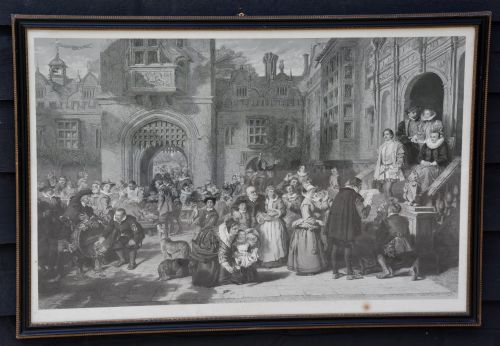


A 2026 Guide by Sellingantiques
Armour decorators pioneered the acid-biting process in early sixteenth-century Europe.
Daniel Hopfer adapted this metalwork technique to flat plates around 1500, printing the etched results onto paper.
The medium grew popular because it felt closer to freehand drawing than rigid engraving. Artists sketched directly onto the grounded plate without learning complex tool skills.
Rembrandt pushed the boundaries in the seventeenth century. He experimented with varying acid exposure times to create deep atmospheric shadows across his prints.
Jacques Callot worked in the early seventeenth century. He developed a harder ground formula that allowed for much finer, more controlled lines.
Giovanni Battista Piranesi produced large views of Rome during the eighteenth century. His dramatic architectural plates remain highly sought after.
James McNeill Whistler led the Etching Revival in the nineteenth century. He famously printed his own plates, manipulating surface ink to change the mood.
The 2026 retail price guide for Antique Etchings is drawn from a proprietary archive of over 1.1 million retail prices indexed by Sellingantiques since 2003. This guide relies exclusively on their own internal data; no external sources or auction records are used.
Analysing nearly 25 years of UK antique market history alongside current retail values, the data indicates that typical UK retail prices for Antique Etchings range between £200 and £1,300. Entry-level prices generally fall under £200 and premium examples upwards of £1,300.
Plate marks are crucial. The heavy roller press pushes the metal edges into the dampened paper, leaving an indented border around the image.
Etched lines lack the sharp precision of a burin cut. Acid creates slightly irregular edges, giving these prints a softer character.
Look for the artist signature or monogram. These were often scratched directly into the plate, appearing in reverse on the final printed sheet.
The craftsman smokes the grounded plate over a taper. This blackens the surface so the scratched copper lines show up clearly while working.
Stopping out controls line thickness. The etcher removes the plate from the acid bath, varnishes light areas, and returns it to bite the darks deeper.
Wiping the inked plate requires a practised hand. Leaving a thin film of ink on the surface produces a warm tone across the final antique etching.
"Many painters preferred etching over other print methods. It required no specialised tool training, allowing them to work naturally with a simple steel needle."
"Plate wear tells a distinct story. Later impressions show fainter lines, documenting the long working life of a popular copper matrix."
"Combined techniques were standard practice. Artists frequently finished their etched plates with drypoint scratches to add rich shadows to the final composition."
Based on almost 25 years of Sellingantiques UK antique market data, Antique Etchings appeared 3379 times (out of 1,100,000 antiques) which gives it a rarity score of 51/100.
This score measures scarcity within the Sellingantiques archive only and is not a survey of the entire antiques market, so these statistics may not be indicative of the general availability of Antique Etchings elsewhere.
Engraving requires physical force. The printmaker pushes a sharp tool called a burin directly into the metal to carve out the lines.
Etching uses chemistry. The artist scratches through a soft wax ground, and acid bites the exposed metal to create the groove. This fundamental difference makes etched lines look fluid and drawn, while engraved lines appear formal and structured.
That indentation is called a plate mark. It's there because the printmaker runs the metal plate and the dampened paper together through a high-pressure roller press.
The heavy pressure forces the paper down into the inked grooves, but it also physically crushes the paper around the edges of the metal plate. A strong plate mark is a standard feature of intaglio printing methods.
Printmakers often took trial impressions to check their work. If the artist decided a shadow was too light or a figure needed altering, they reworked the metal plate.
Each time the plate was altered and printed again, it created a new state. Cataloguers use these states to track the evolution of the image over the artist's working process.
You're looking at laid paper. Paper makers created this by dipping a rectangular wooden mould laced with a grid of wires into a vat of liquid rag pulp.
As the water drained away, the pulp settled thinner over the raised wires. When you hold an antique etching to the light, those thinner areas show up as a bright grid pattern.
Wove paper became common by the early nineteenth century. That later method used a fine wire mesh, producing a smooth sheet without those distinct internal lines.
Please note: This Antique Etchings guide and its associated pricing data are provided for general informational purposes only. It does not constitute formal financial, investment, or appraisal advice and should not be relied upon as the sole basis for any commercial activity, purchasing, or sales decisions. Sellingantiques.co.uk accepts no liability for any actions taken in reliance on this information. Always consult with a qualified professional or independent appraiser.

