
There are no results to show on this page for that combination of filters:
Antique Engravings in Wales
A 2026 Guide by Sellingantiques
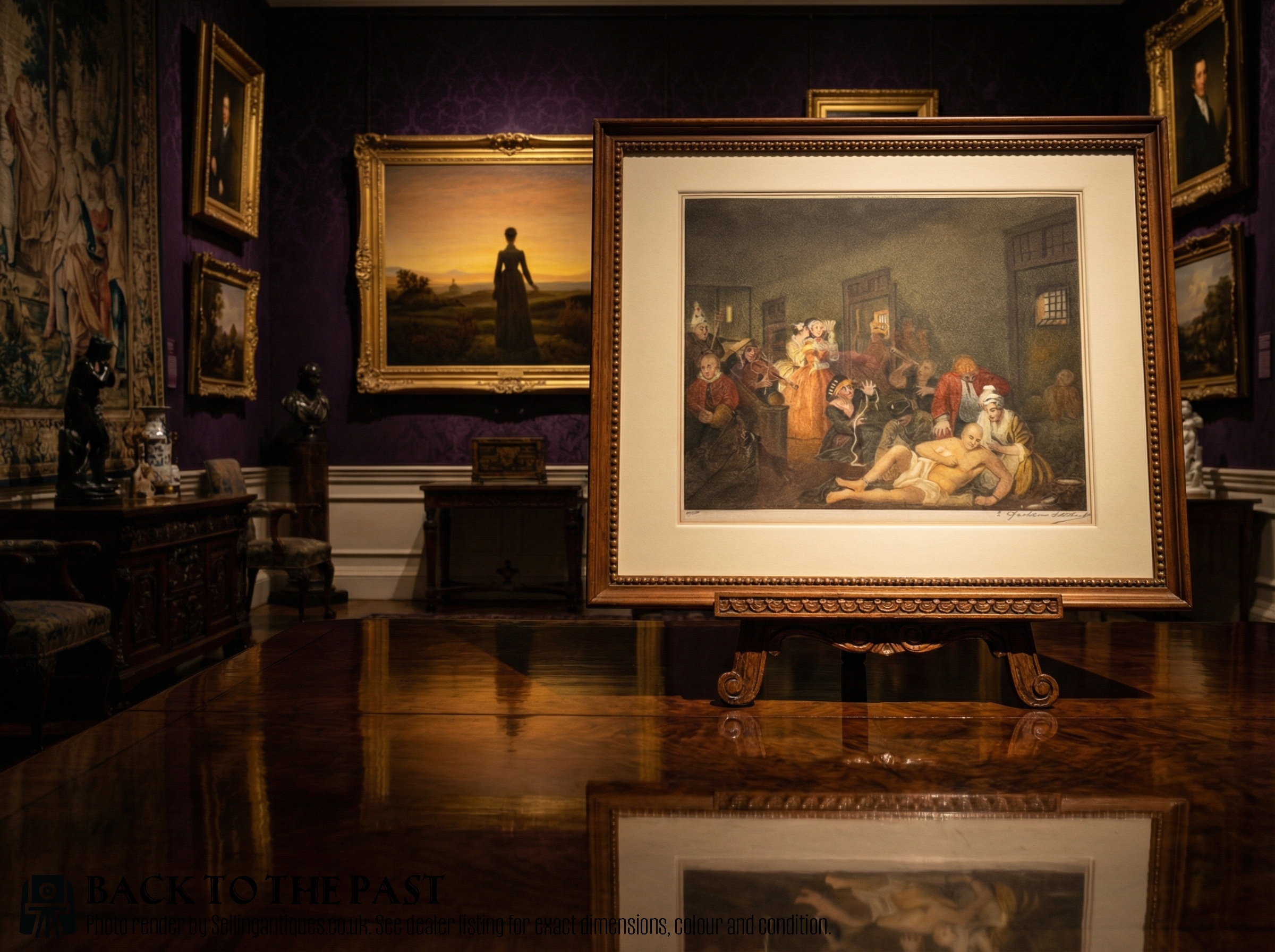
A Wonderful Set of Eight Coloured Stipple Engravings by E. Jackson Stodart (1879-1934), 1900
Priced at £350 from Christian Davies Antiques Ltd
Goldsmiths originally developed the technique during the fifteenth century to keep a permanent record of their ornate metalwork designs.
Book publishers quickly adopted antique engravings. They used them for title pages and architectural illustrations.
Independent print dealers sold them as loose sheets to collectors who pasted them into albums.
Maps relied on this method before lithography arrived and changed the trade.
Albrecht Dürer elevated the form in sixteenth-century Germany. His complex religious scenes set a new benchmark for detail.
William Hogarth published his own satirical copper plates in eighteenth-century London.
Gustave Doré provided dense steel-engraved illustrations for Bibles and literary classics during the Victorian era, capitalising on the harder metal.
The 2026 retail price guide for Antique Engravings is drawn from a proprietary archive of over 1.1 million retail prices indexed by Sellingantiques since 2003. This guide relies exclusively on their own internal data; no external sources or auction records are used.
Analysing nearly 25 years of UK antique market history alongside current retail values, the data indicates that typical UK retail prices for Antique Engravings range between £200 and £1,300. Entry-level prices generally fall under £200 and premium examples upwards of £1,300.
Look for a plate mark. It's the indentation left by the heavy printing press.
Carved lines swell and taper depending on how deeply the burin cuts the metal.
Shading relies on cross-hatching techniques. You won't find the continuous smooth grey tones common in modern photographic reproduction.
The engraver pushes the tool across the copper by hand to carve each individual line.
Stipple techniques emerged later. Artists punched tiny dots into the metal to build softer shadows.
Steel plates allowed much finer detail and larger print runs than softer copper. This shift changed the entire publishing industry.
"You can often identify the specific paper mill from the watermark held up to the light."
"Engravers sometimes left small hidden monograms or initials tucked inside the background scenery."
"Coloured antique engravings were often painted by hand using watercolours long after the black ink dried. Publishers hired teams of workers for this task."
Based on almost 25 years of Sellingantiques UK antique market data, Antique Engravings appeared 10646 times (out of 1,100,000 antiques) which gives it a rarity score of 12/100.
This score measures scarcity within the Sellingantiques archive only and is not a survey of the entire antiques market, so these statistics may not be indicative of the general availability of Antique Engravings elsewhere.
Professional paper conservators use humidity chambers to relax the fibres gently. They then press the sheet between acid-free blotters under weights for several weeks.
Do not try to iron it flat yourself. Heat will scorch the paper and often sets the creases permanently.
Leave it alone. The emulsion of the ink or the paper fibres will likely tear away if you pull at it. Moisture often causes the sheet to fuse with the glass over decades.
A conservator can sometimes release it using controlled moisture or freezing techniques. If you force it dry, you risk losing parts of the image.
You need UV-filtering glass and acid-free mounting board. Standard acidic mounts will burn brown lines into the paper margins over time.
Direct sunlight will fade the ink and bleach the paper.
Publishers tailored the lettering to their target market. Educational and religious prints often included Latin text to appeal to scholars across Europe.
Portrait prints might only carry the subject's name and the engraver's details. The inscriptions evolved as literacy rates grew and prints became accessible to the wider public.
Please note: This Antique Engravings guide and its associated pricing data are provided for general informational purposes only. It does not constitute formal financial, investment, or appraisal advice and should not be relied upon as the sole basis for any commercial activity, purchasing, or sales decisions. Sellingantiques.co.uk accepts no liability for any actions taken in reliance on this information. Always consult with a qualified professional or independent appraiser.
