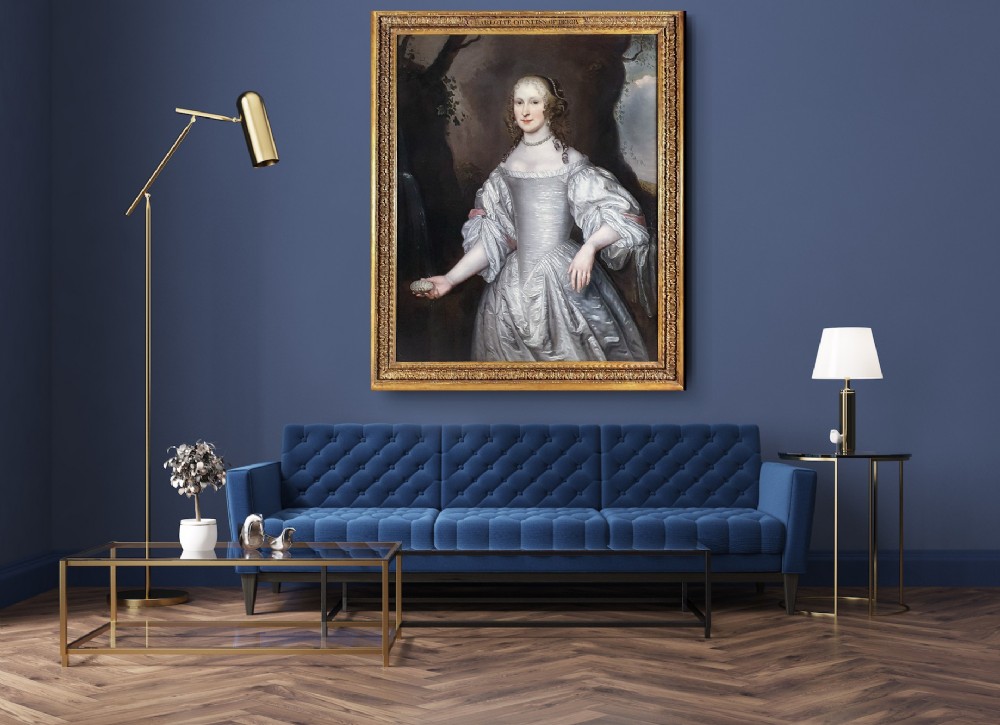
Titan Fine Art has dated this piece to the 17th Century.
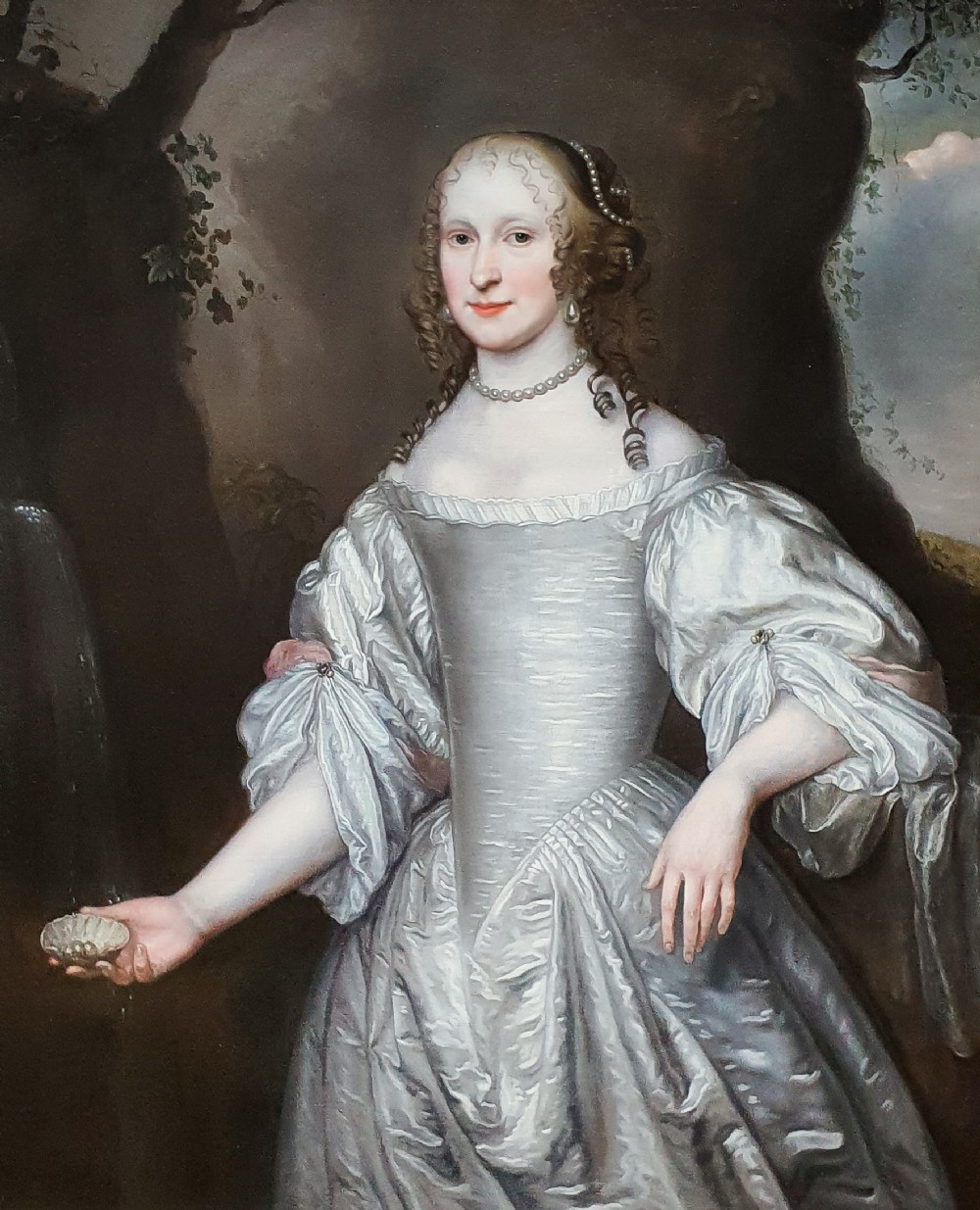
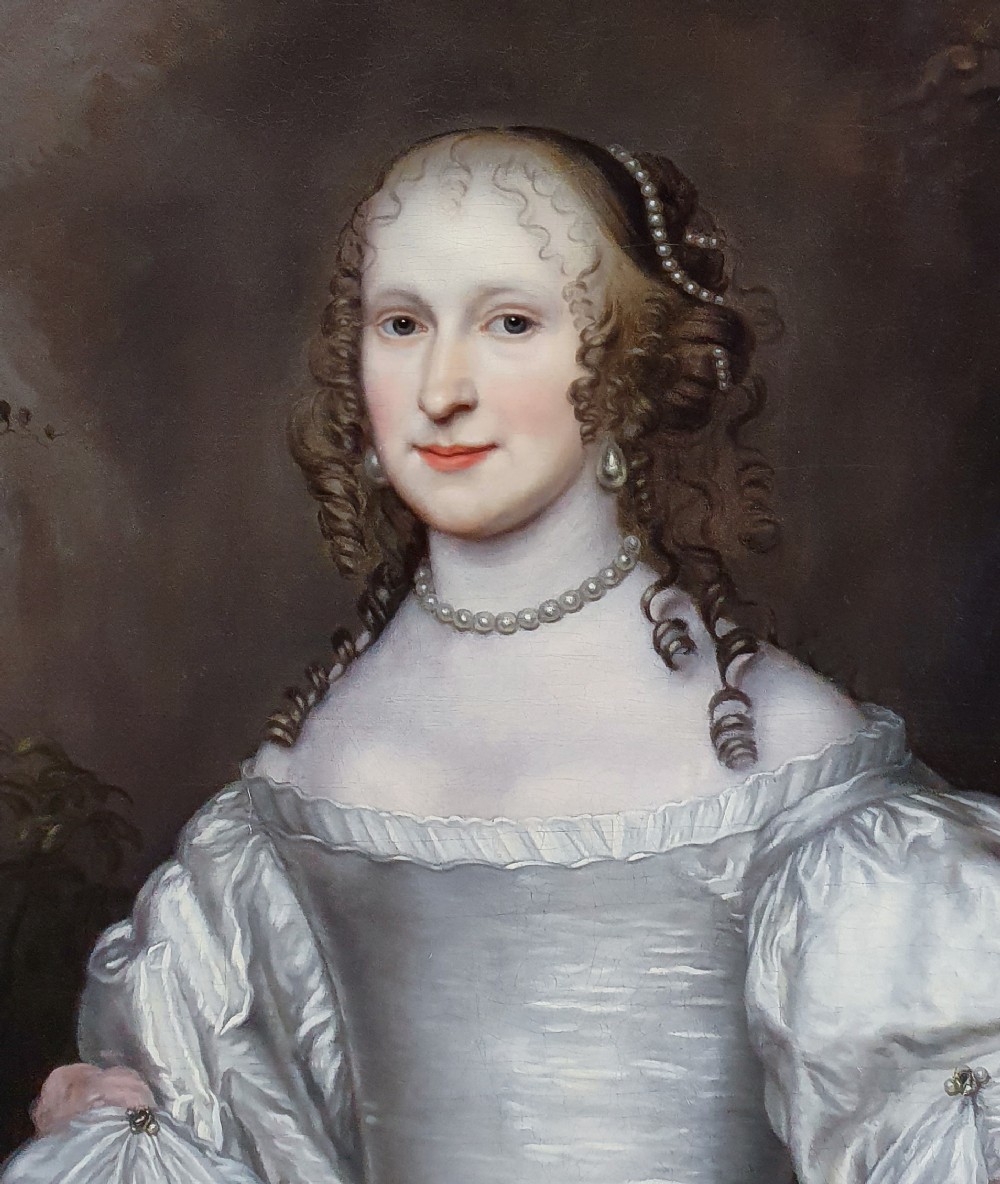
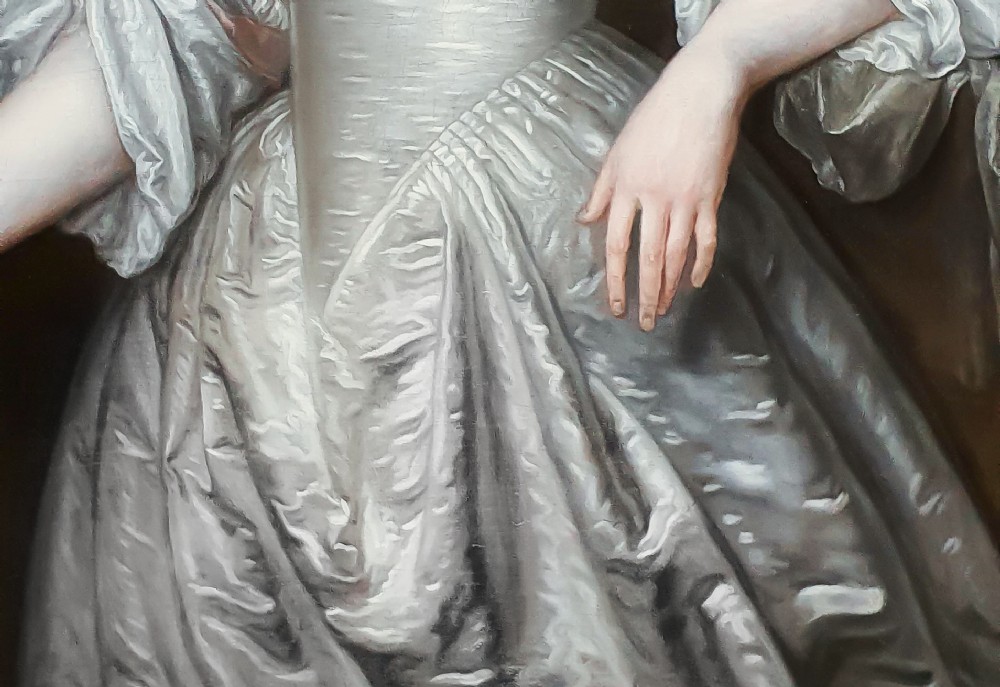
The dress is from the finest material, and it has full, loose sleeves ending just below the elbow and a long-pointed bodice. This, along with the hairstyle pulled back and with set corkscrew locks and short ones framing the face, was fashionable in the 1650s.
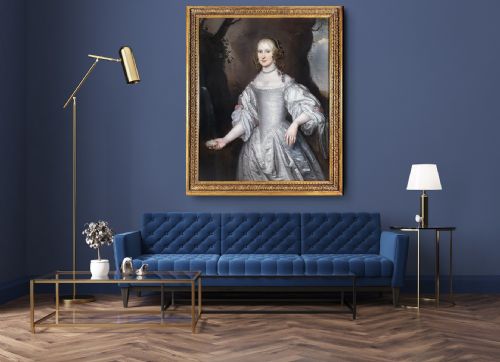
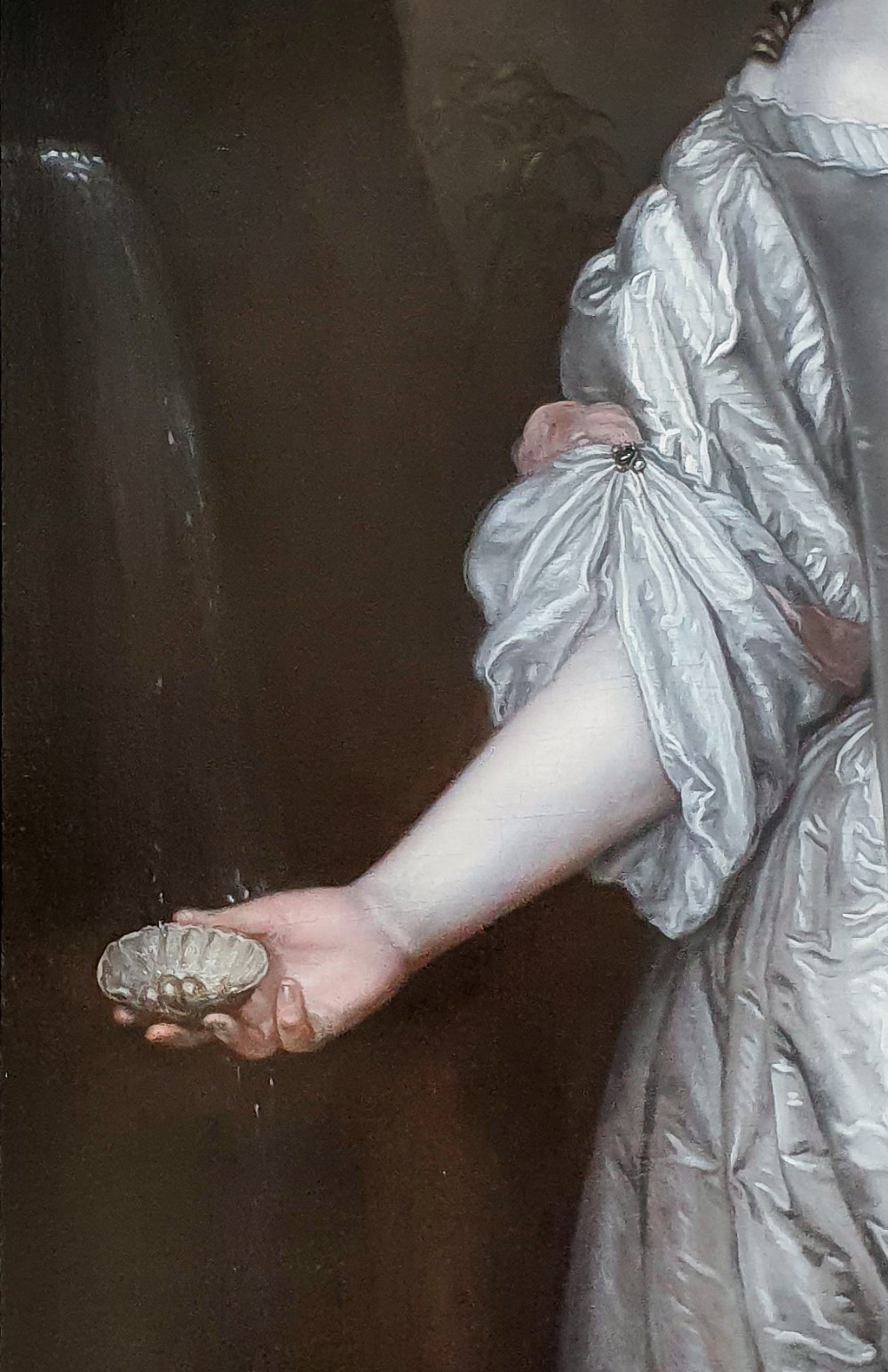
The sitter is holding a shell into which water pours. This compositional devise was often used at the time and it may make an appropriate allusion to her potential as wife and mother, athough it did not always have a hidden meaning and was sometimes simply an embellishment.
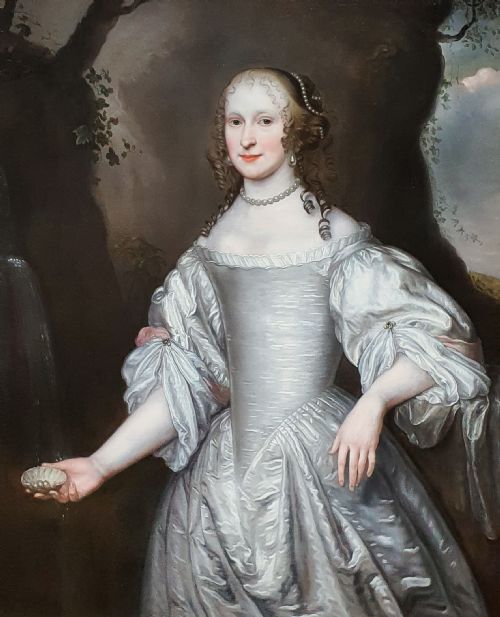
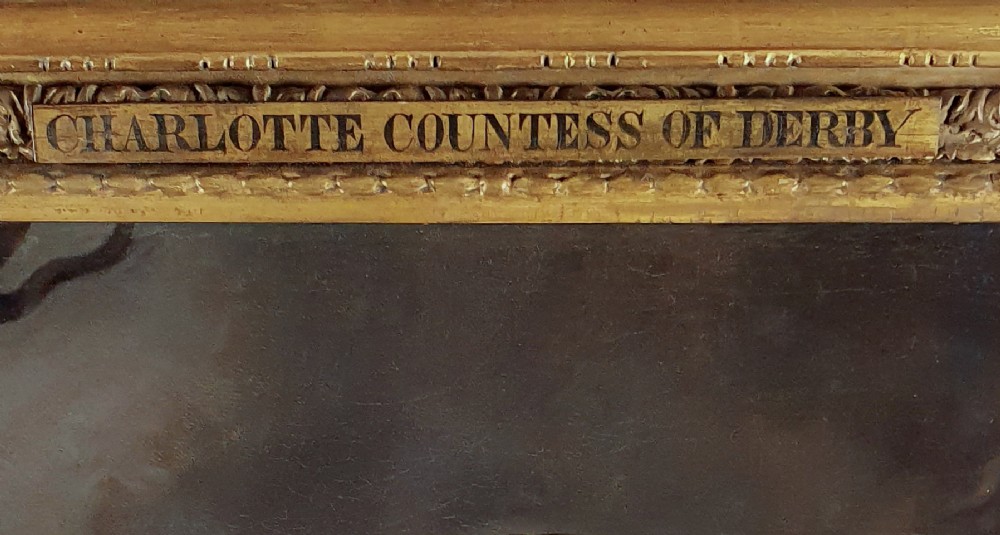
Traditionally, the painting has been thought to represent Charlotte Stanley, Countess of Derby (1599-1664). Born Charlotte de La Trémoille, she was from one of France's oldest and most powerful families, and she was also a legendary figure during the English Civil War. Her father was Claude de la Trémoille, Duke of Thouars (France) and her grandfather was William I, Prince of Orange. Her mother came to England in 1625 as part of the Royal household of Queen Henrietta Maria, Charles I's queen. During this visit she arranged a marriage between Charlotte and James Stanley, 7th Earl of Derby. The couple had nine children. Her husband fought during the civil war and was eventually captured in 1651 and beheaded. When Lathom House was the last remaining Royalist stronghold in Lancashire, the Countess who was in charge of its defence, gallantly held out without surrender. It worth noting that Charlotte Stanley was depicted at different stages of her life (see Van Dyke, Cornelius Johnson, Sir Peter Lely…) but the physiognomy in these images varies.
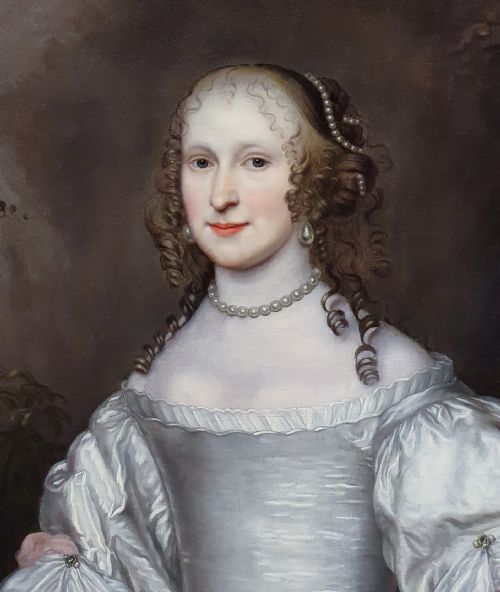
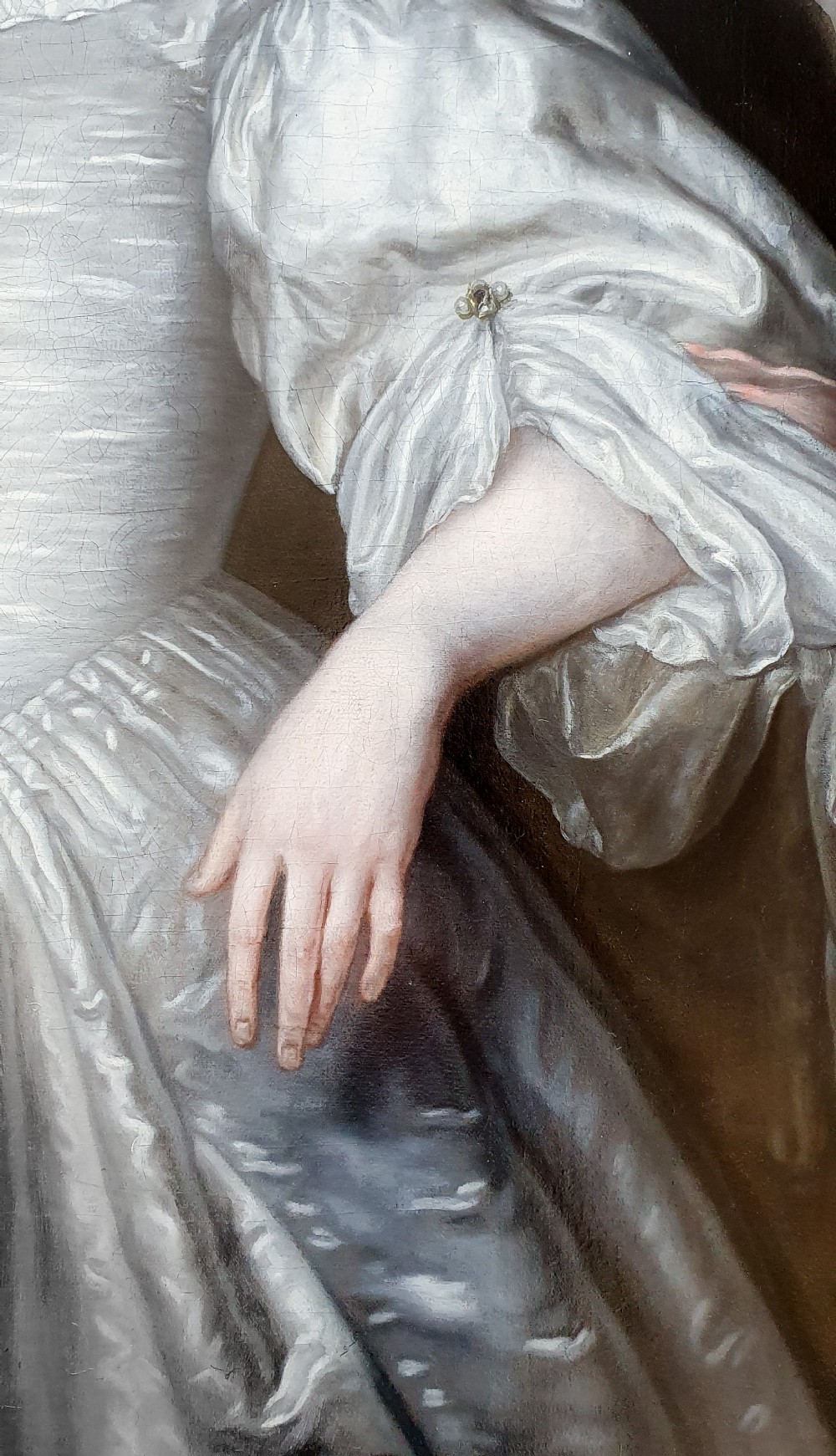
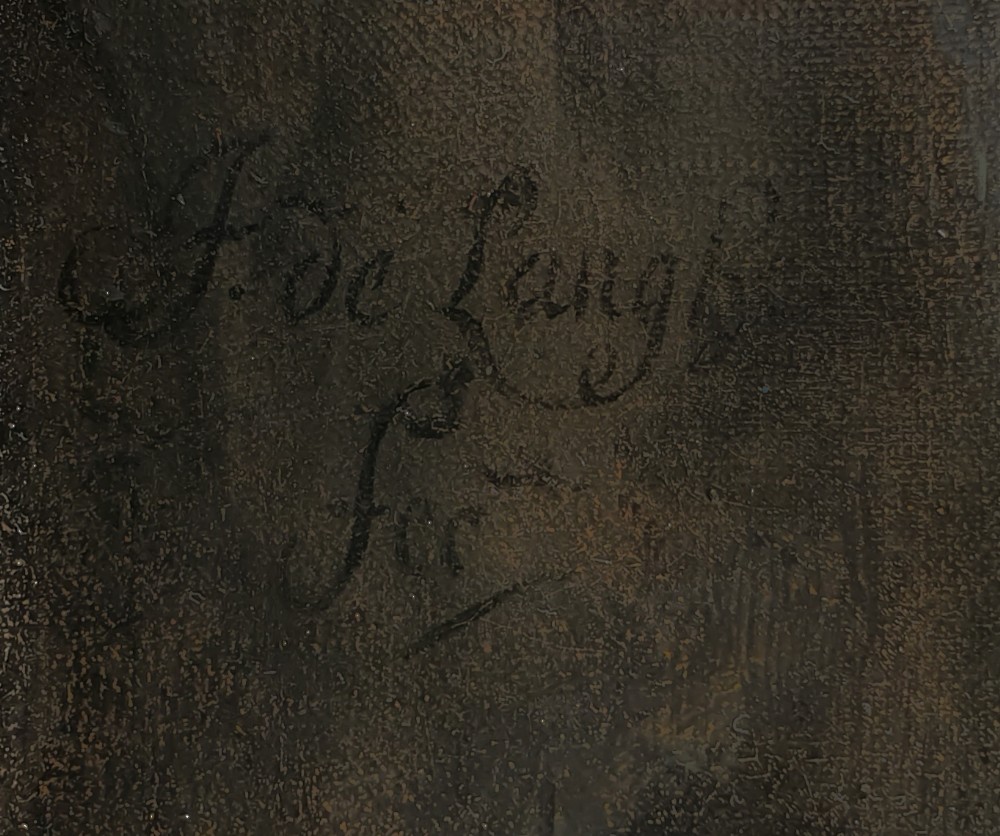
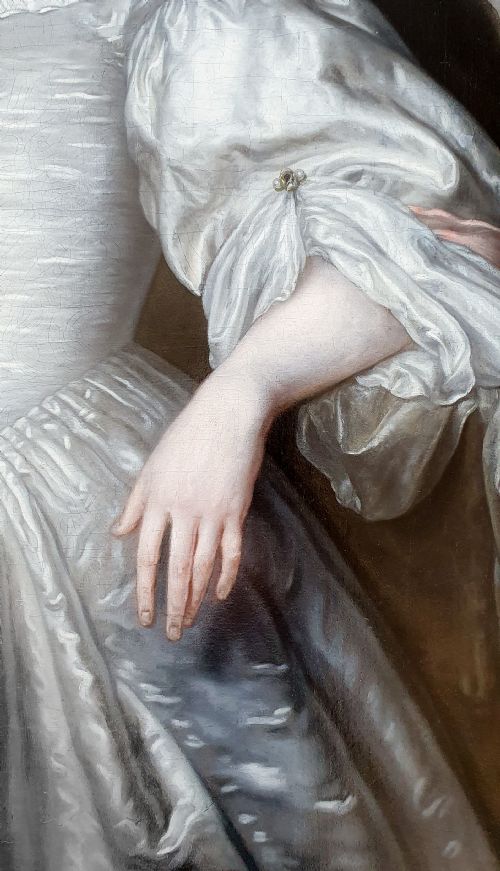
The remarkable skill of the artist is evident. The rendering of the face with the subtitle nuances, the depiction of the curls of hair, the treatment of the fabrics, and the utterly beautiful modelling of the hands – this portrait is on a level with some of the best portraits of the period. It is signed “J de Langhe fec” – the artist was active in Holland from 1674 to 1693 and was probably Jacobus de Langhe who was buried in Amsterdam 26th December 1696. There are at least eight known portraits in extant - all show a remarkable skill in the drawing, colouring and the rendering of flesh and fabrics. Examples are of the Dutch royal family are in the City Hall in 's-Hertogenbosch, Holland.
How could such a talented portrait artist remain relatively unknown today? Of the legions of Dutch artist’s working in the seventeenth century little detail is known of many despite their extreme activity in the art market and the fact that some were very skilled painters. The answer to this is complicated and of the many reasons we must acknowledge that in-depth biographical studies are yet to be carried out on the vast number of artists working in Holland at the time. Considering, by some accounts, more than 1.3 million Dutch pictures were painted between 1640 and 1660 alone it is not surprising that today we know nothing or relatively little about many. The economic depression that held the Republic of the United Netherlands in its grip from 1660 onwards slashed the purchasing power of large segments of the population and the huge demand for paintings evaporated and with it the identities of many of the artists. When a study is eventually carried out it can elevate that artist exponentially - Johannes Vermeer ranks among the most admired of all Dutch artists today was relatively obscure until the end of the nineteenth century. Many other highly desirable seventeenth century artists today were only “rediscovered” during the 19th century.
We are very pleased to offer this signed work by this artist, whose work is rarely available.
Presented in a good quality and condition period gilded frame with presentation plaque.
Titan Fine Art has dated this piece to the 17th Century.
Specialist in 17th & 18thc portraits. Highly curated selection, museum-level research & pro conservation. Exceptional art, expertly vetted.
You can view the stock and full dealer information on the Titan Fine Art Profile Page

Portrait of Charlotte Stanley, Countess of Derby (1599-1664) C.1648; Signed by J. De Langhe (Active 1674-1693), Antique Oil on Canvas Painting