21,771  PAGES BROWSED TODAY PAGES TODAY • 26 ANTIQUES UPLOADED TODAYNEW ARRIVALS
GIFTS
26 ITEMS ADDED TODAY
Sort Order
Items Per Page
Browse Categories
Sort order
Items per page
ID #SA794760
SOLD
Email Phone
Save
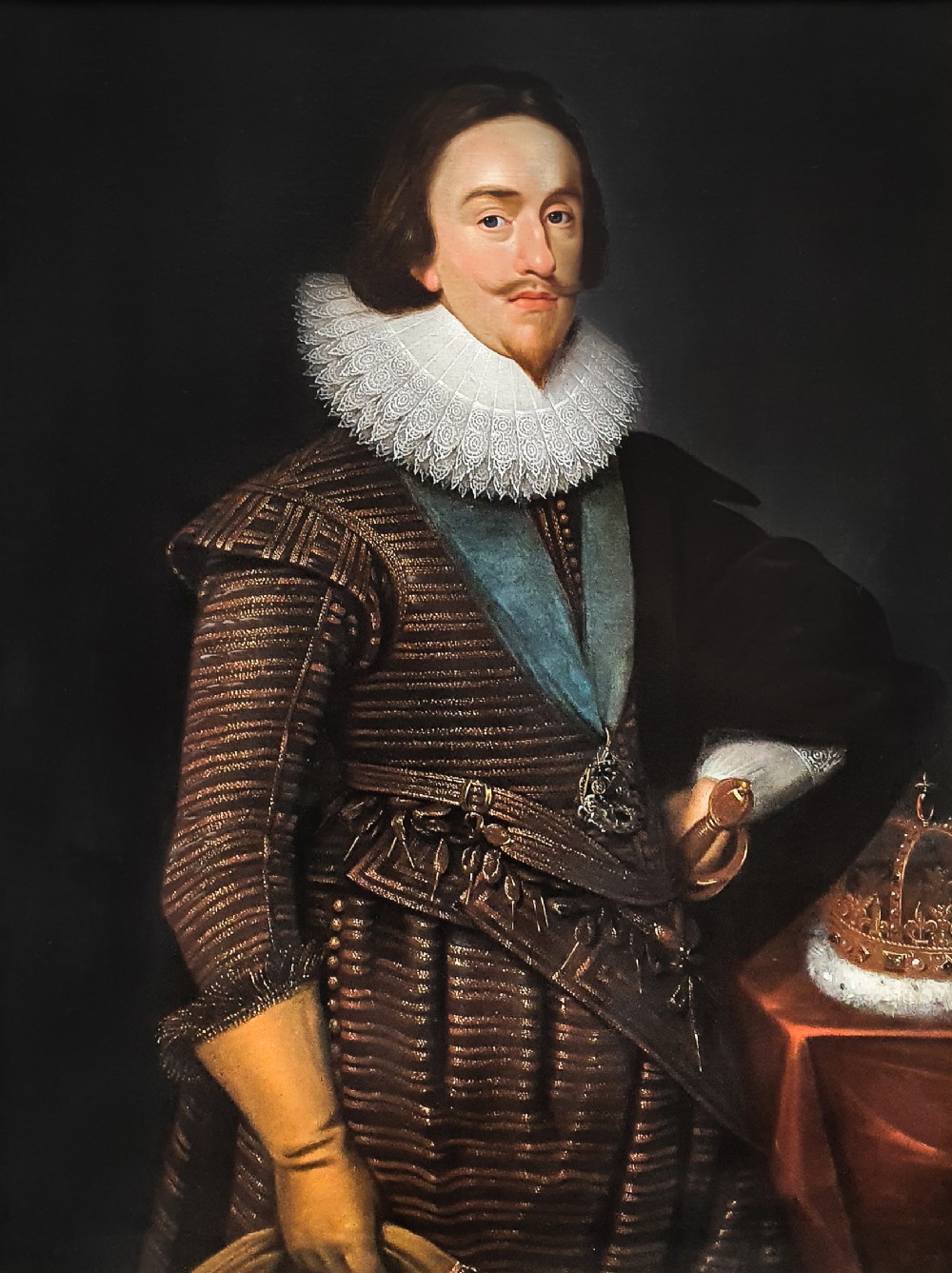
Portrait of King Charles I with the Scottish Royal Crown C.1633; Studio of Daniel Mytens (C.1590-1647/48), Antique Oil Painting on Canvas
Sold by Titan Fine Art
sold SA794760
Sorry, but this item has been sold.
Titan Fine Art

Titan Fine Art

Sellingantiques Verified Since Jul 2016
Browse dealers 24 items
  • About Us
    Specialist in 17th & 18thc portraits. Highly curated selection, museum-level research & pro conservation. Exceptional art, expertly vetted.
Id #SA794760
PDF SHARE
SAVE

Portrait of King Charles I with the Scottish Royal Crown C.1633; Studio of Daniel Mytens (C.1590-1647/48), Antique Oil Painting on Canvas

17th century
Sold 23 May 2021 · Titan Fine Art
This “Portrait of King Charles I with the Scottish Royal Crown C.1633; Studio of Daniel Mytens (C.1590-1647/48), Antique Oil Painting on Canvas” found a buyer.

It was listed by Titan Fine Art. Sold pieces stay on Sellingantiques as a record of what has passed through, and the next one is rarely far away.

Description

Portrait of King Charles I with the Scottish Royal Crown c.1633

Studio of Daniel Mytens (c.1590-1647/48)

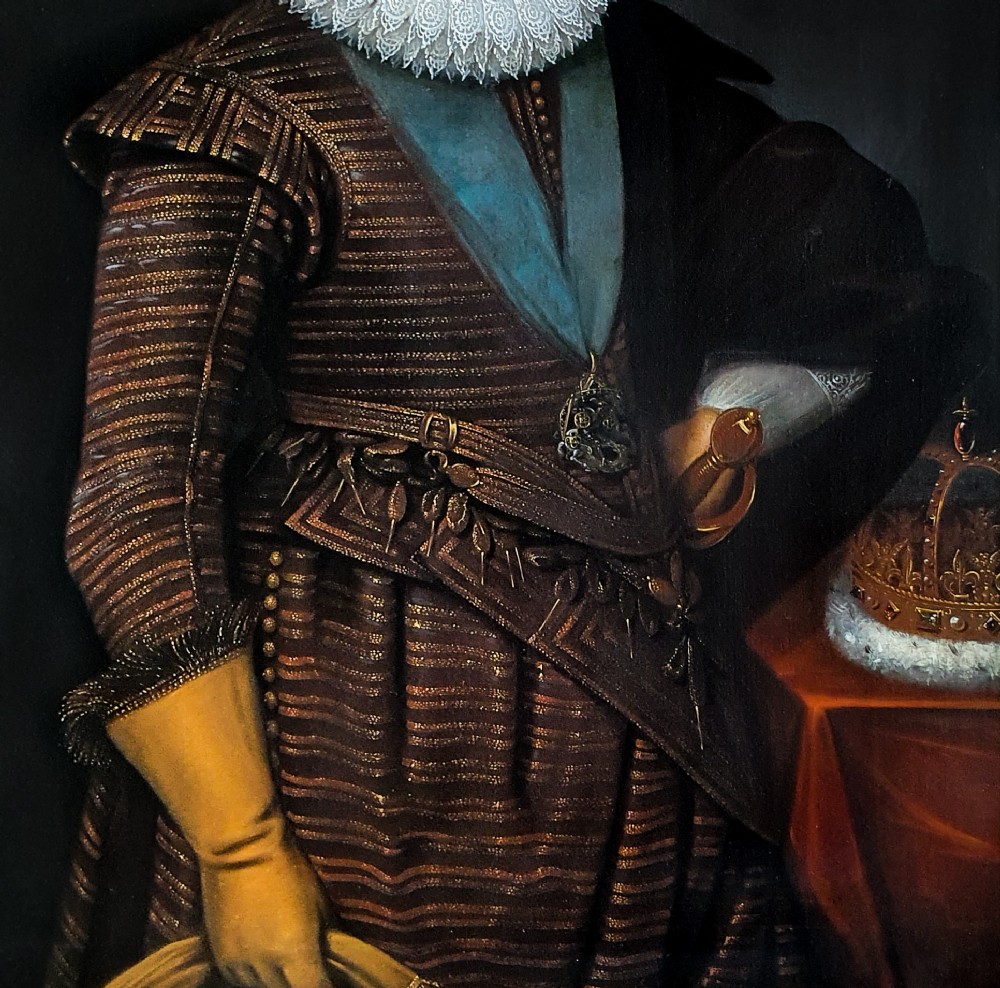
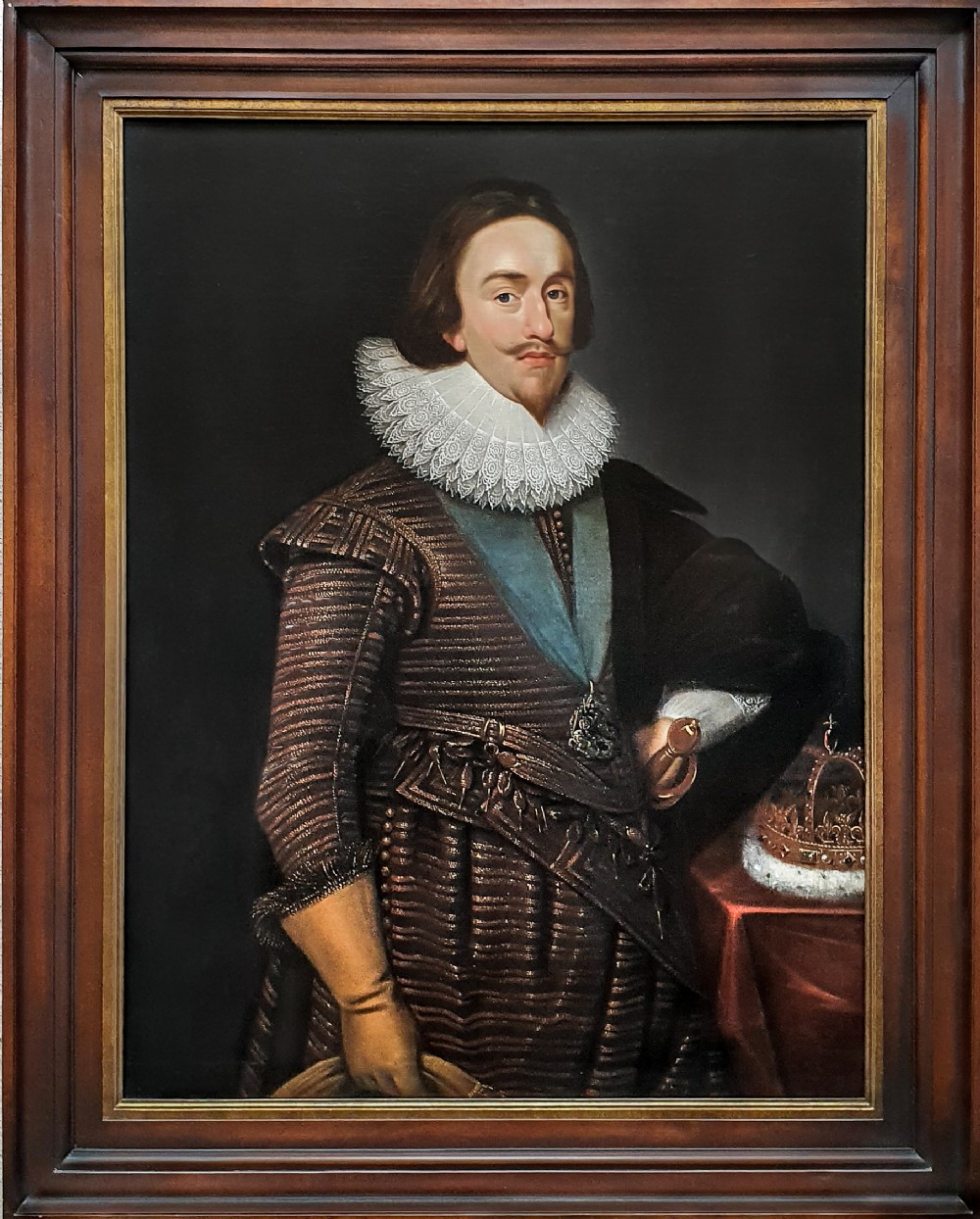
The artist of this portrait was one of the most distinguished Anglo-Dutch court artists of the time and court painter to King Charles I - Daniel Mytens. Even though Mytens’ output of full-length portraits of Charles I and his courtiers was prolific, what is unique to our portrait and is of particular importance, is the presence of what must be a representation of the Scottish royal crown - all other portraits of Charles I that depict him with a crown show him beside the Tudor Crown. Although Charles succeeded his father in 1625, his long-delayed and long-awaited Scottish coronation did not take place until he finally returned to his native Scotland in the early summer of 1633, the first such royal pageant in Edinburgh since 1590. Our portrait is thought to have been commissioned to mark this event, painted between the king's accession to the throne in 1625 and Mytens' departure from England in 1634.
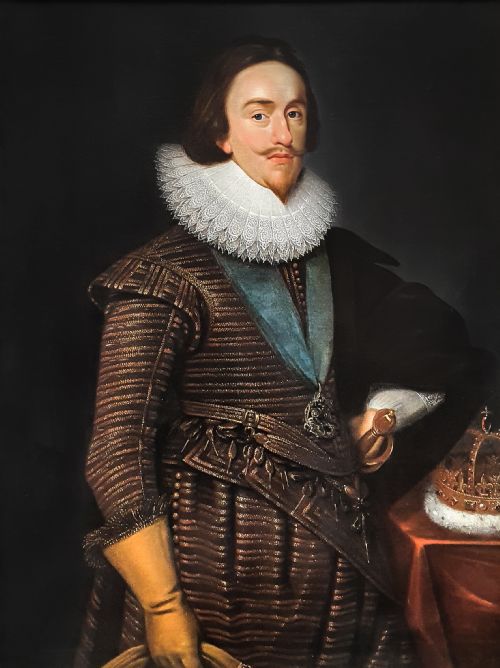
Charles I was the second surviving son of James I. He married Henrietta Maria (1609–1669), sister of the French king Louis XIII, in 1625. His reign was marked by increasing hostility between himself and Parliament. He then ruled for 11 years without a Parliament. It was his relationship with the second of these, the Long Parliament, which led to the English Civil War and to his own eventual capture in 1647. In 1649 he was tried in Westminster Hall, charged with high treason and beheaded on a scaffold erected in Whitehall.
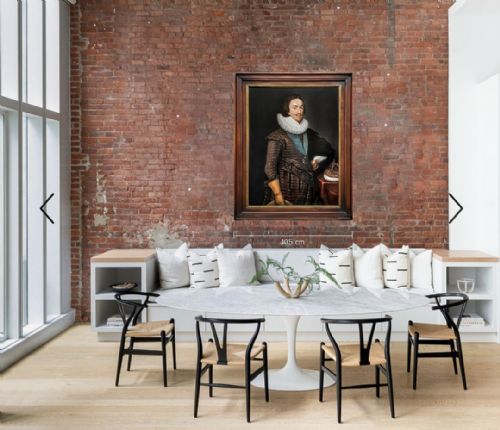
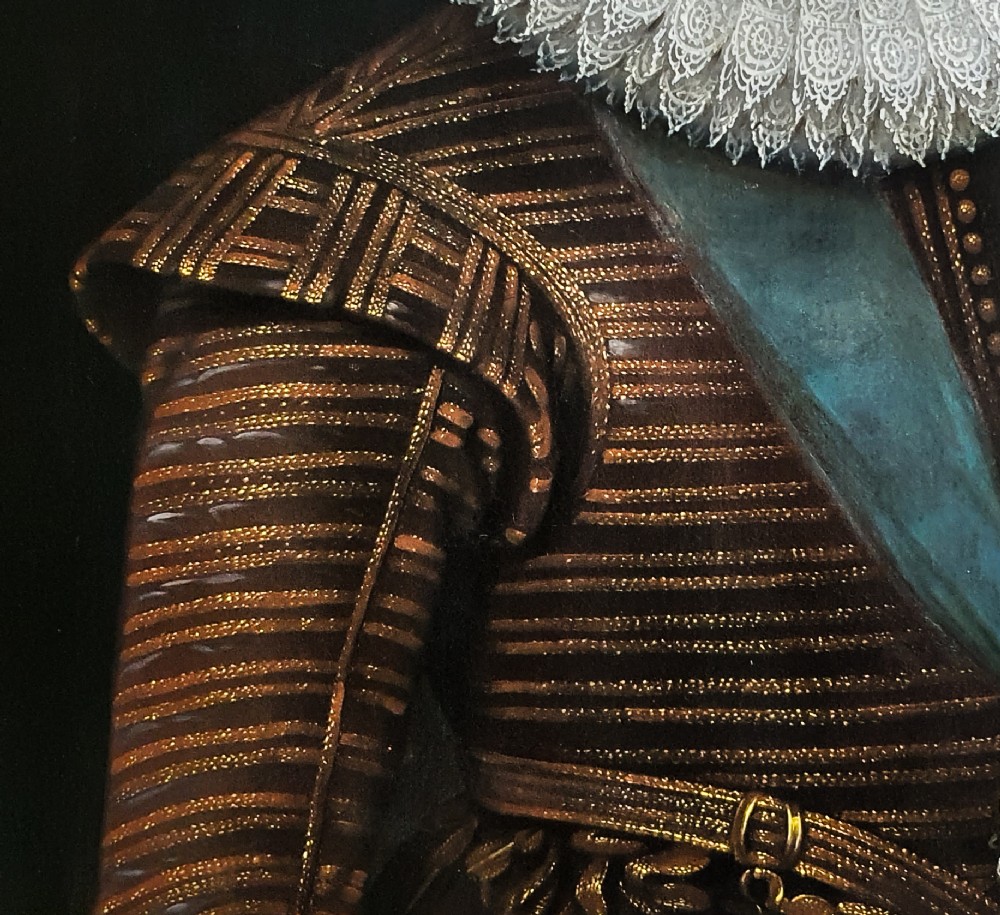
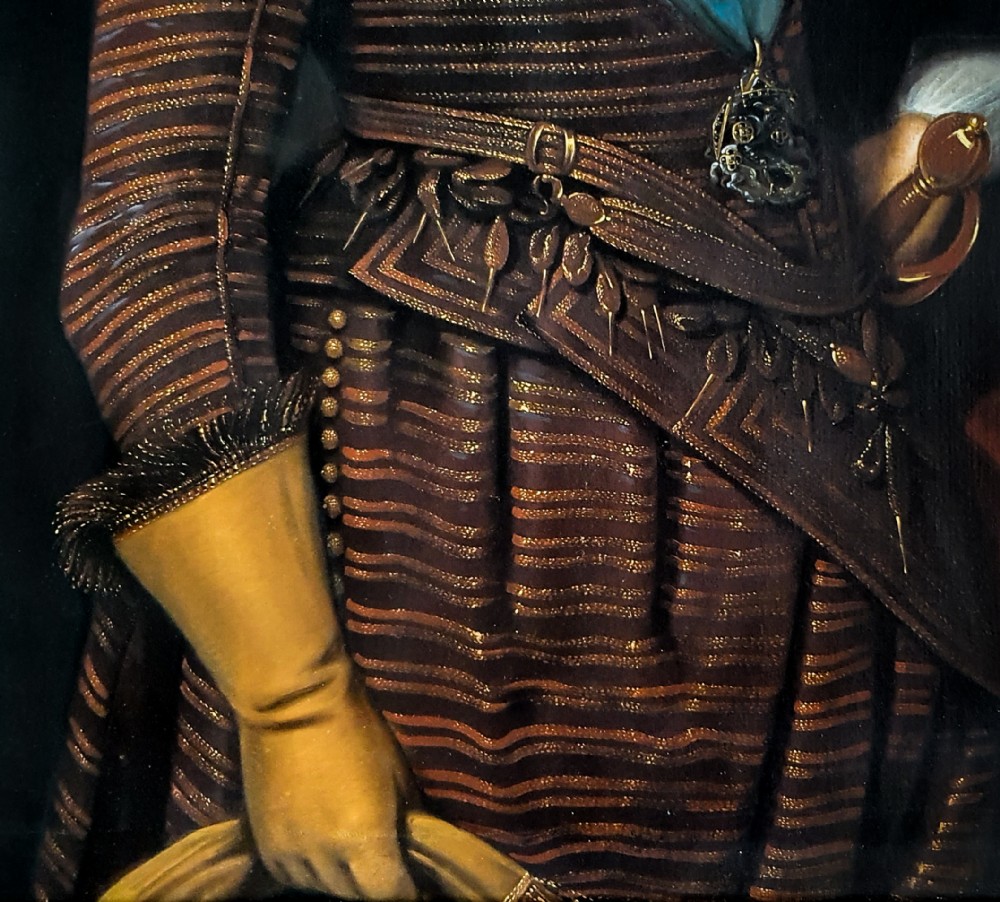
This magnificent portrait depicts Charles wearing a doublet of brownish coloured silk with a sharply pointed V-shaped waistline. Below the waist at the front are six stiffened laps decorated with gold thread. Tightly spaced buttons stretch from neck to waist ensuring the doublet retains its tight fit across the torso. Around the waistline are ribbon bows tipped with metal aglets. By this stage they are probably purely ornamental, a vestigial feature reflecting the earlier fashion for doublet and breeches to be laced together through holes in the waistband. The riband and badge (the Great George) of the Order of the Garter hang down his chest. Although the regalia never lets us forget that we are in the presence of royalty, the costume is that of a fashionable (but not overly so) courtier. Cordovan leather is used for his gloves.
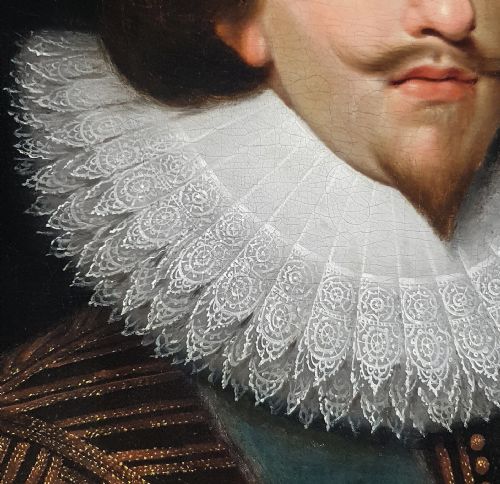
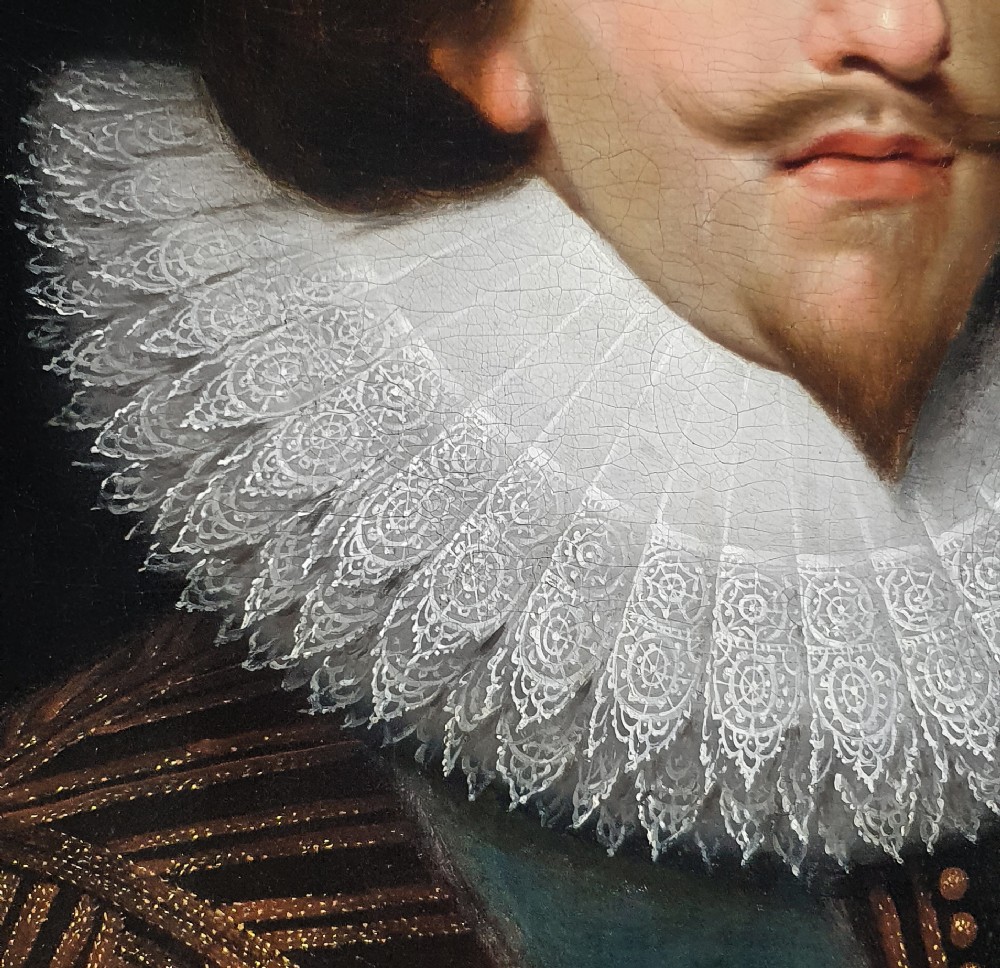
The artist’s Dutch origins are evident in his sensitivity to texture and surface. The overall image is one of luxury and superb rendering of paint, noteworthy in the textiles but also the fine and painstaking depiction of the white lace ruff. Such characteristics are combined with the Elizabethan and Jacobean tradition of formal full-length court portraiture. The present work is clearly consistent in execution with autograph works of the period.
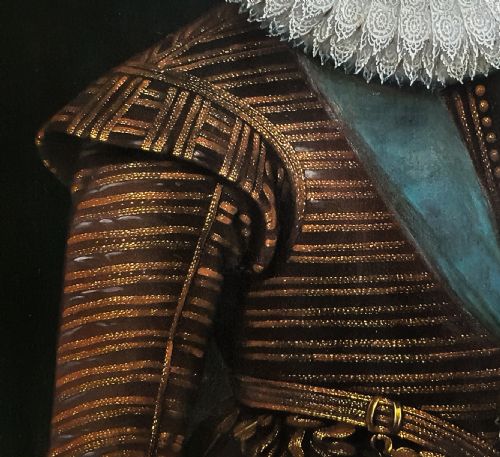
Daniel Mytens (c. 1590-1647/48) was born in Delft into a family of artists. He worked in Delft up to 1602 and then in The Hague between 1602 and 1617 where he was also a member of the guild of Saint Luke's in 1610. He may have been a pupil of either Michiel van Miereveld or Jan Anthonisz van Ravesteyn, or both. By 1618 he was working in London. He painted James I in 1621 and was awarded an annual pension by the King in 1624. Soon after his accession in 1625, Charles I appointed Mytens ‘one of our picture-drawers of our Chamber in ordinairie’ for life. He was so prolific in producing full-length portraits of Charles I and his courtiers, including duplicates of current works and older portraits (of royal sitters, including; James IV of Scotland, his wife Margaret Tudor, and Mary, Queen of Scots) that it is assumed that he had workshop assistance, including from Cornelius Johnson (amongst others) around 1630.

This portrait is an excellent example of royal court portraiture by the leading artist at the time. It is of Scottish interest with the very rare depiction of the Scottish crown.

Physical Dimensions
Height
131cm (51.57")
Width
105cm (41.34")
Depth
6cm (2.36")
Declaration

Titan Fine Art has dated this piece to the 17th Century.

Reference Numbers
Sellingantiques Reference
SA794760
Dealers Notes

Much more info about this item at: www.titanfineart.com

In a market saturated with available paintings, Titan Fine Art offers a specially curated selection. Each piece is meticulously chosen based on technical merit, provenance, and decorative appeal, professionally conserved and researched, ensuring our clients view only the finest examples of British and European art.

With over 20 years of expertise and 1,000+ works placed with collectors and institutions, we are one of the most prolific specialists in 17th and 18th-century portraiture. We combine a scholarly approach with museum-level rigor to replace the uncertainty of the open market with absolute confidence.

Why Buy From Titan Fine Art?

• Expertly Curated Selection

We act as your expert eye, selecting only high-quality works that offer genuine historical and artistic value.

• Museum-Level Research

Each portrait is supported by extensive academic research, often exceeding 40 hours, to establish attribution, sitter identity, and historical context.

• Professional Conservation

All paintings are carefully cleaned and stabilised by professional conservators, and are presented ready to hang.

• Transparent Pricing

No buyer’s premium or hidden fees—unlike auction houses, where additional costs can add 25–35%.

• Export Pricing Advantage

Reduced pricing is available for works exported outside the UK.

• Specialist Global Shipping

We manage the entire process, including custom crating, export documentation, and fully tracked delivery worldwide.

• Buy with Confidence

A 7-day return policy and the option to pay in GBP, USD, or EUR for convenience and transparency.

• Original Period Frames

Many works retain their original carved and gilded frames, which are works of art in their own right and enhance both historical authenticity and decorative impact.

• Personal Advisory Service

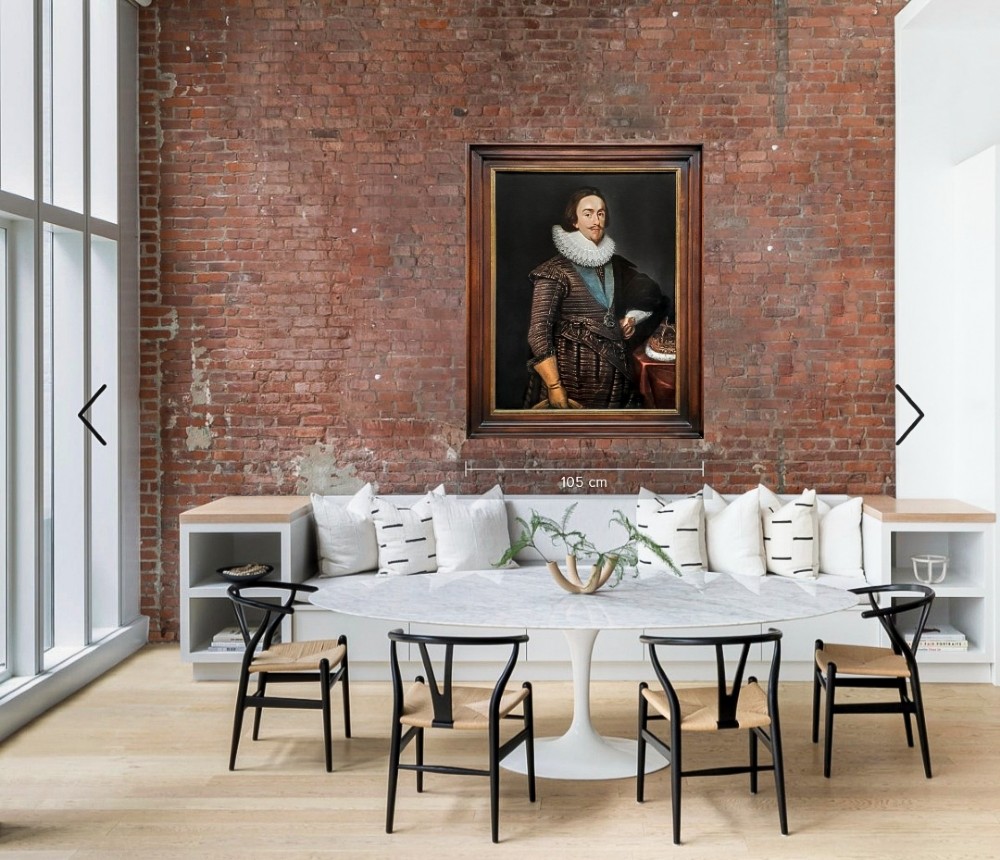
We work directly with collectors and interior designers, offering guidance on selection, scale, and placement—including bespoke room mock-ups on request.

Subscribe to our monthly 'new item alert' to be the first to hear about new works

Description
Portrait of King Charles I with the Scottish Royal Crown c.1633

Studio of Daniel Mytens (c.1590-1647/48)

“
The artist of this portrait was one of the most distinguished Anglo-Dutch court artists of the time and court painter to King Charles I - Daniel Mytens.
Titan Fine Art

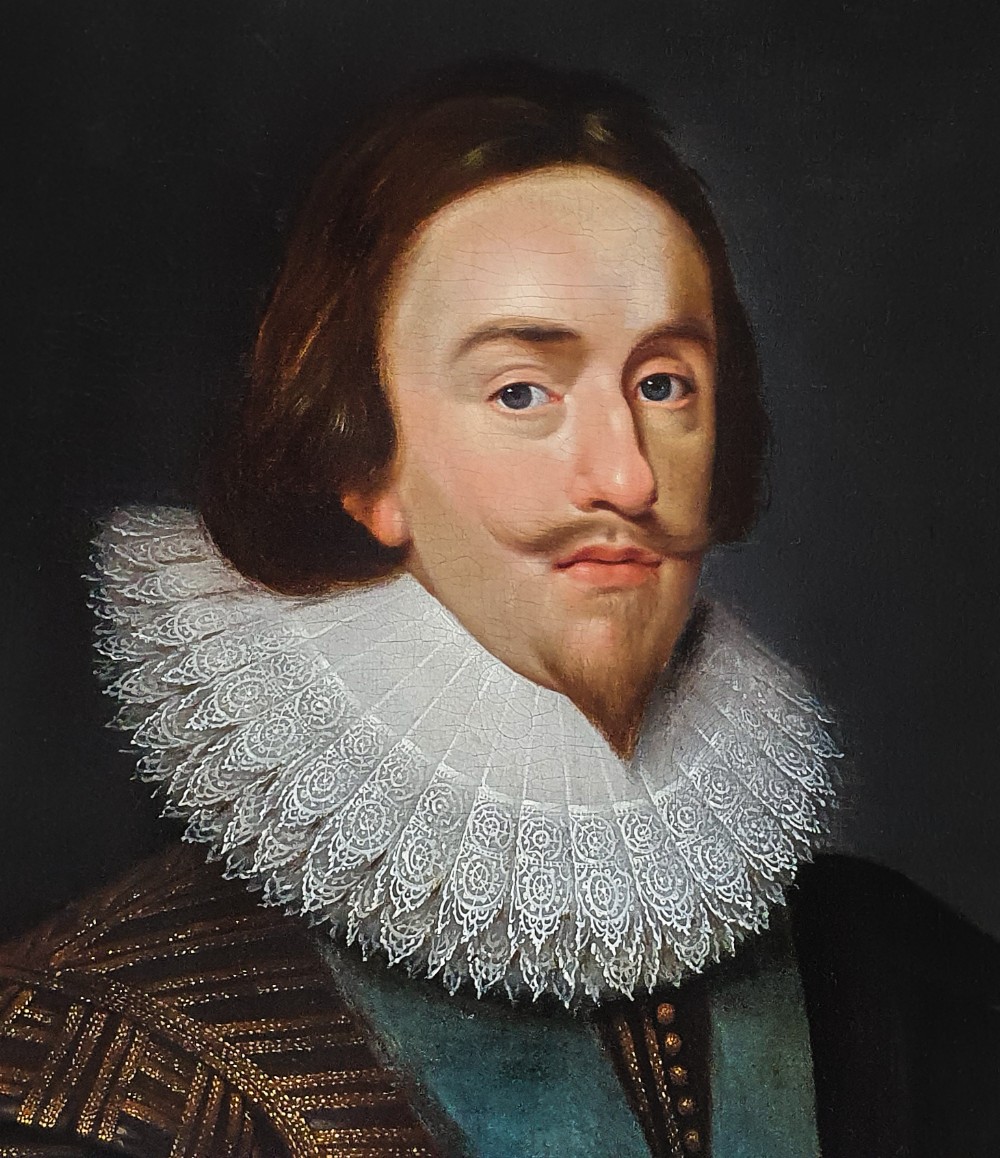
Even though Mytens’ output of full-length portraits of Charles I and his courtiers was prolific, what is unique to our portrait and is of particular importance, is the presence of what must be a representation of the Scottish royal crown - all other portraits of Charles I that depict him with a crown show him beside the Tudor Crown. Although Charles succeeded his father in 1625, his long-delayed and long-awaited Scottish coronation did not take place until he finally returned to his native Scotland in the early summer of 1633, the first such royal pageant in Edinburgh since 1590. Our portrait is thought to have been commissioned to mark this event, painted between the king's accession to the throne in 1625 and Mytens' departure from England in 1634.

fig 1. Portrait of King Charles I with the Scottish Royal Crown c.1633; Studio of Daniel Mytens (c.1590-1647/48), Antique oil painting on canvas
fig 1. Portrait of King Charles I with the Scottish Royal Crown C.1633; Studio of Daniel Mytens (C.1590-1647/48), Antique Oil Painting on Canvas

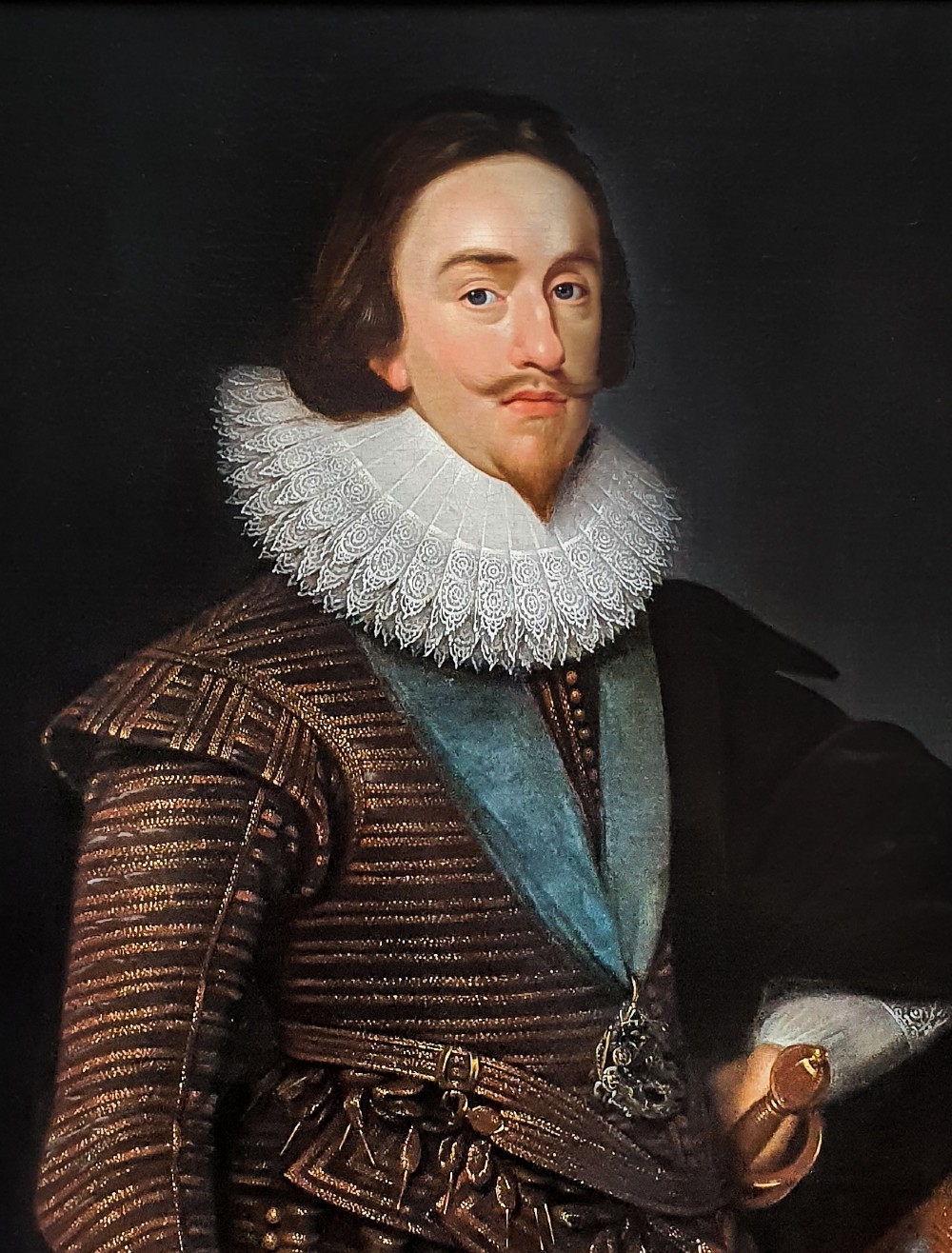
Charles I was the second surviving son of James I. He married Henrietta Maria (1609–1669), sister of the French king Louis XIII, in 1625. His reign was marked by increasing hostility between himself and Parliament. He then ruled for 11 years without a Parliament. It was his relationship with the second of these, the Long Parliament, which led to the English Civil War and to his own eventual capture in 1647. In 1649 he was tried in Westminster Hall, charged with high treason and beheaded on a scaffold erected in Whitehall.

fig 2. Portrait of King Charles I with the Scottish Royal Crown c.1633; Studio of Daniel Mytens (c.1590-1647/48), Antique oil painting on canvas
fig 2. Portrait of King Charles I with the Scottish Royal Crown C.1633; Studio of Daniel Mytens (C.1590-1647/48), Antique Oil Painting on Canvas

This magnificent portrait depicts Charles wearing a doublet of brownish coloured silk with a sharply pointed V-shaped waistline. Below the waist at the front are six stiffened laps decorated with gold thread. Tightly spaced buttons stretch from neck to waist ensuring the doublet retains its tight fit across the torso. Around the waistline are ribbon bows tipped with metal aglets. By this stage they are probably purely ornamental, a vestigial feature reflecting the earlier fashion for doublet and breeches to be laced together through holes in the waistband. The riband and badge (the Great George) of the Order of the Garter hang down his chest. Although the regalia never lets us forget that we are in the presence of royalty, the costume is that of a fashionable (but not overly so) courtier. Cordovan leather is used for his gloves.

fig 3. Portrait of King Charles I with the Scottish Royal Crown c.1633; Studio of Daniel Mytens (c.1590-1647/48), Antique oil painting on canvas
fig 3. Portrait of King Charles I with the Scottish Royal Crown C.1633; Studio of Daniel Mytens (C.1590-1647/48), Antique Oil Painting on Canvas

The artist’s Dutch origins are evident in his sensitivity to texture and surface. The overall image is one of luxury and superb rendering of paint, noteworthy in the textiles but also the fine and painstaking depiction of the white lace ruff. Such characteristics are combined with the Elizabethan and Jacobean tradition of formal full-length court portraiture. The present work is clearly consistent in execution with autograph works of the period.

fig 4. Portrait of King Charles I with the Scottish Royal Crown c.1633; Studio of Daniel Mytens (c.1590-1647/48), Antique oil painting on canvas
fig 4. Portrait of King Charles I with the Scottish Royal Crown C.1633; Studio of Daniel Mytens (C.1590-1647/48), Antique Oil Painting on Canvas

Daniel Mytens (c. 1590-1647/48) was born in Delft into a family of artists. He worked in Delft up to 1602 and then in The Hague between 1602 and 1617 where he was also a member of the guild of Saint Luke's in 1610. He may have been a pupil of either Michiel van Miereveld or Jan Anthonisz van Ravesteyn, or both. By 1618 he was working in London. He painted James I in 1621 and was awarded an annual pension by the King in 1624. Soon after his accession in 1625, Charles I appointed Mytens ‘one of our picture-drawers of our Chamber in ordinairie’ for life. He was so prolific in producing full-length portraits of Charles I and his courtiers, including duplicates of current works and older portraits (of royal sitters, including; James IV of Scotland, his wife Margaret Tudor, and Mary, Queen of Scots) that it is assumed that he had workshop assistance, including from Cornelius Johnson (amongst others) around 1630.

This portrait is an excellent example of royal court portraiture by the leading artist at the time. It is of Scottish interest with the very rare depiction of the Scottish crown.

Height
131cm (51.57")
Width
105cm (41.34")
Depth
6cm (2.36")
Date of Manufacture

Titan Fine Art has dated this piece to the 17th Century.

Reference Numbers
Sellingantiques Ref
SA794760
Titan Fine Art
Titan Fine Art
Sellingantiques verified Since Jul 2016

Specialist in 17th & 18thc portraits. Highly curated selection, museum-level research & pro conservation. Exceptional art, expertly vetted.

Dealer Profile

You can view the stock and full dealer information on the Titan Fine Art Profile Page
PDF SHARE
SAVE
Portrait of King Charles I with the Scottish Royal Crown c.1633; Studio of Daniel Mytens (c.1590-1647/48), Antique oil painting on canvas SOLD6+ MONTHS AGO
1 / 9
Archive I Portrait of King Charles I with the Scottish Royal Crown c.1633; Studio of Daniel Mytens (c.1590-1647/48), Antique oil painting on canvas SOLD6+ MONTHS AGO

Portrait of King Charles I with the Scottish Royal Crown C.1633; Studio of Daniel Mytens (C.1590-1647/48), Antique Oil Painting on Canvas
Archive II Portrait of King Charles I with the Scottish Royal Crown c.1633; Studio of Daniel Mytens (c.1590-1647/48), Antique oil painting on canvas View II
Archive III Portrait of King Charles I with the Scottish Royal Crown c.1633; Studio of Daniel Mytens (c.1590-1647/48), Antique oil painting on canvas View III
Archive IV Portrait of King Charles I with the Scottish Royal Crown c.1633; Studio of Daniel Mytens (c.1590-1647/48), Antique oil painting on canvas View IV
Archive V Portrait of King Charles I with the Scottish Royal Crown c.1633; Studio of Daniel Mytens (c.1590-1647/48), Antique oil painting on canvas View V
Archive VI Portrait of King Charles I with the Scottish Royal Crown c.1633; Studio of Daniel Mytens (c.1590-1647/48), Antique oil painting on canvas View VI
Archive VII Portrait of King Charles I with the Scottish Royal Crown c.1633; Studio of Daniel Mytens (c.1590-1647/48), Antique oil painting on canvas View VII
Archive VIII Portrait of King Charles I with the Scottish Royal Crown c.1633; Studio of Daniel Mytens (c.1590-1647/48), Antique oil painting on canvas View VIII
Archive IX Portrait of King Charles I with the Scottish Royal Crown c.1633; Studio of Daniel Mytens (c.1590-1647/48), Antique oil painting on canvas View IX
Enlarged Archival View
Telephone 07875 412 111
Location
London
United Kingdom
Dealer Profile Page sellingantiques.co.uk/titan
Verified Since Jul 2016
Items For Sale 24
Items Sold 402
Titan Fine Art
Titan Fine Art
Verified Since Jul 2016
View Dealer Info
Location: London, United Kingdom
Verified
Jul 2016
For Sale
24
Sold
402
Portrait of King Charles I with the Scottish Royal Crown c.1633; Studio of Daniel Mytens (c.1590-1647/48), Antique oil painting on canvas
Ref: SA794760
Portrait of King Charles I with the Scottish Royal Crown c.1633; Studio of Daniel Mytens (c.1590-1647/48), Antique oil painting on canvas
Detail View 1
Detail View 2
Detail View 3
Detail View 4
Detail View 5
Detail View 6
Detail View 7
Detail View 8
Archival Detail
Every single antique dealer on our platform is individually approved by our internal team. We verify their professional trade history, ethical standards, and photographic quality to ensure a secure, high-standard buying environment. Upon joining, every dealer agrees to a strict 9-point code of conduct. While issues can occasionally arise, our dealers typically resolve them swiftly and directly with the buyer. In fact, since our founding in 2002, Sellingantiques has only had to step in to help resolve an issue on roughly five occasions—a true testament to the quality of our dealers and their dedication to your happiness.
Our dealers are highly experienced in packing and shipping fragile, high-value antiques. Because you are in direct contact with the dealer, you will be able to easily go through all available shipping and insurance options together to ensure your item arrives safely.
Antiques are the ultimate green purchase. By choosing historical pieces over newly manufactured goods, you completely eliminate the carbon footprint of modern mass production while preserving exceptional, timeless craftsmanship.
Written by Sellingantiques from the dealer’s photographs and listing
  • Period17th century
  • SizeH 131 cm (52 in) x W 105 cm (41 in) x D 6 cm (2 in)
items
Add keywords to the filter
Price
£100
£250000
Era
Period
Style
Material
Origin
Stock Location
Recently Added
Online Payments
Categories