35,714  PAGES BROWSED TODAY PAGES TODAY 264 ANTIQUES UPLOADED TODAYNEW ARRIVALS
264 ITEMS ADDED TODAY
Sort Order
Items Per Page
Browse Categories
Sort order
Items per page
ID #SA689646
SOLD
Email
Save
Portrait of Richard Tomkins (C.1532-1603) Circa 1575; English School
Titan Fine Art
sold SA689646
Sorry, but this item has been sold.
Titan Fine Art

Titan Fine Art

Sellingantiques Verified Since Jul 2016
View Dealers Stock Page
  • About Us
    Specialist in 17th & 18thc portraits. Highly curated selection, museum-level research & pro conservation. Exceptional art, expertly vetted.
Id #SA689646
PDF SHARE
SAVE

Portrait of Richard Tomkins (C.1532-1603) Circa 1575; English School

16th century
Description

This exquisite oil on panel portrait descended from the sitter through the family for almost 450 years, until recent. It is a splendid survival from the Elizabethan era - the golden age in England’s history.

Portraiture occupied a central place in 16th century British painting. Artists portrayed their clients in the manner set out by the terms of the commission. They were almost always intended to convey the sitter’s social status and rank in society. The fundamental principle governing all Tudor and Jacobean portraits is the recording and defining in visual terms the position of a sitter in society. The expensive fabrics, the attire, and the grand coat-of-arms as seen in the present portrait proclaim to every onlooker that this is a superior being. In Elizabethan collections there was a total absence of painter’s names and they were often unrecorded and deemed unimportant. This confirms that to the Elizabethan mind the recording of human likeness was connected with this concept of fame and social rank and the motivation of the great collections of the time was not aesthetic but dynastic; the idea of a painting as a work of art never existed, it was primarily an expression of rank and class. Painting was considered a mechanical skill – a trade – however this began to change at the close of Elizabeth’s reign.

This magnificent portrait was painted during the last quarter of the 16th century. The portrait represents Richard Tomkins who was described by the bishop of Hereford as ‘a man very well affected in religion’. Richard’s was 43 years of age when the portrait was painted according to the inscription.

Richard was born in Herefordshire and was a son of James Tomkins (1490-1561) who was a royal collector of revenue, and his second wife Margaret Kettleby (born 1520). Although Richard’s ancestors were amongst the Herefordshire gentry by 1433, they were not major freeholders until 1535 when his father bought the manor of Monnington, about 16 miles from Leominster (by 1553 the latter also acquired Garnston manor (sold in 1661) in the parish of Weobley). Richard married Catherina de Baskerville, the daughter and coheir of James Baskerville of Kyre Park, Herefordshire. It is thought that the couple had thirteen children.

Richard, like his father, was a royal officer responsible for taking ‘escheats’ from deceased subjects (a law that transfers the property of a person who has died without heirs to the Crown or state so that property is not left without recognised ownership). Richard was made Sherriff on 16th Nov 1592. He died in 1603 and was succeeded by his eldest son James (c.1569-1636), an English politician, who inherited the manors of Monnington and Garnston, a considerable domain south of Weobley. James was hanged in 1643 for raising an army for the King against Parliament.

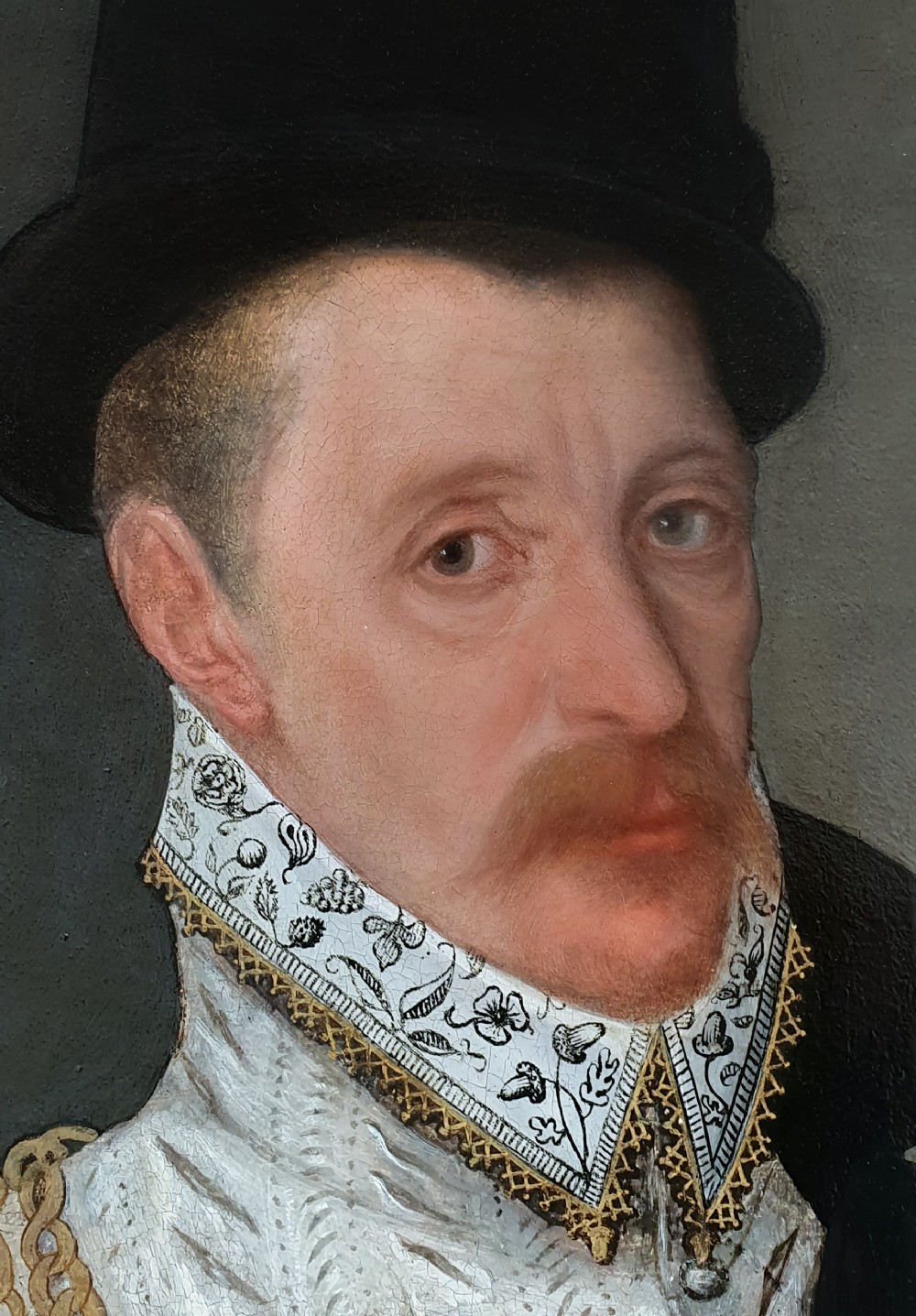
The clothing depicted was fashionable attire for a wealthy gentleman - the small turned-over collar, slashed doublet, capotain hat, and hip length cloak. The collar is embroidered with ‘blackwork’ embroidery featuring large designs of flowers, fruit, and other patterns connected by curvilinear stems – this was a popular motif in England from the 1570’s.

Monnington Court was built in the 14th century but later remodelled. It contains two shields of the arms of Tomkins with the family crest inscribed "Crimini(e) mundatus, semper transire pe(a)ratus" and "Vive Deo gratus, toti mundo tumulatus.". The manor contains a moot hall (completed before 1230) a meeting place traditionally to decide local issues.

The portrait is endowed with an elaborate coat of arms of the Tomkins family. The rapid population growth and the unprecedented opportunities to acquire land and office during the Elizabethan period opened the gateway to individual advancement wider than ever before. With those factors came fierce competition for individual...

See www.titanfineart.com for the full description

Physical Dimensions
Height
107.5cm (42.32")
Width
88cm (34.65")
Depth
7cm (2.76")
Declaration

Titan Fine Art has dated this piece to the 16th Century.

Reference Numbers
Sellingantiques Reference
SA689646
Dealers Notes

Much more info about this item at: www.titanfineart.com

In a market saturated with available paintings, Titan Fine Art offers a distinct advantage: we sift through thousands of works to provide a specially curated selection. Each piece is meticulously chosen based on technical merit, provenance, and decorative appeal, ensuring our clients view only the finest examples of British and European art.

With over 20 years of expertise and 1,000+ works placed with collectors and institutions, we are one of the most prolific specialists in 17th and 18th-century portraiture. We combine a scholarly approach with museum-level rigor to replace the uncertainty of the open market with absolute confidence.

Why Buy From Titan Fine Art?

• Expertly Curated Selection

We act as your expert eye, selecting only high-quality works that offer genuine historical and artistic value.

• Museum-Level Research

Each portrait is supported by extensive academic research, often exceeding 40 hours, to establish attribution, sitter identity, and historical context.

• Professional Conservation

All paintings are carefully cleaned and stabilised by professional conservators, and are presented ready to hang.

• Transparent Pricing

No buyer’s premium or hidden fees—unlike auction houses, where additional costs can add 25–35%.

• Export Pricing Advantage

Reduced pricing is available for works exported outside the UK.

• Specialist Global Shipping

We manage the entire process, including custom crating, export documentation, and fully tracked delivery worldwide.

• Buy with Confidence

A 7-day return policy and the option to pay in GBP, USD, or EUR for convenience and transparency.

• Original Period Frames

Many works retain their original carved and gilded frames, which are works of art in their own right and enhance both historical authenticity and decorative impact.

• Personal Advisory Service

We work directly with collectors and interior designers, offering guidance on selection, scale, and placement—including bespoke room mock-ups on request.

Subscribe to our monthly 'new item alert' to be the first to hear about new works

Description
This exquisite oil on panel portrait descended from the sitter through the family for almost 450 years, until recent. It is a splendid survival from the Elizabethan era - the golden age in England’s history.

Portraiture occupied a central place in 16th century British painting. Artists portrayed their clients in the manner set out by the terms of the commission. They were almost always intended to convey the sitter’s social status and rank in society.

The fundamental principle governing all Tudor and Jacobean portraits is the recording and defining in visual terms the position of a sitter in society.
Titan Fine Art

The expensive fabrics, the attire, and the grand coat-of-arms as seen in the present portrait proclaim to every onlooker that this is a superior being. In Elizabethan collections there was a total absence of painter’s names and they were often unrecorded and deemed unimportant. This confirms that to the Elizabethan mind the recording of human likeness was connected with this concept of fame and social rank and the motivation of the great collections of the time was not aesthetic but dynastic; the idea of a painting as a work of art never existed, it was primarily an expression of rank and class. Painting was considered a mechanical skill – a trade – however this began to change at the close of Elizabeth’s reign.

fig 1. Portrait of Richard Tomkins (c.1532-1603) circa 1575; English School
fig 1. Portrait of Richard Tomkins (C.1532-1603) Circa 1575; English School

This magnificent portrait was painted during the last quarter of the 16th century. The portrait represents Richard Tomkins who was described by the bishop of Hereford as ‘a man very well affected in religion’. Richard’s was 43 years of age when the portrait was painted according to the inscription.

fig 2. Portrait of Richard Tomkins (c.1532-1603) circa 1575; English School
fig 2. Portrait of Richard Tomkins (C.1532-1603) Circa 1575; English School

Richard was born in Herefordshire and was a son of James Tomkins (1490-1561) who was a royal collector of revenue, and his second wife Margaret Kettleby (born 1520). Although Richard’s ancestors were amongst the Herefordshire gentry by 1433, they were not major freeholders until 1535 when his father bought the manor of Monnington, about 16 miles from Leominster (by 1553 the latter also acquired Garnston manor (sold in 1661) in the parish of Weobley). Richard married Catherina de Baskerville, the daughter and coheir of James Baskerville of Kyre Park, Herefordshire. It is thought that the couple had thirteen children.

fig 3. Portrait of Richard Tomkins (c.1532-1603) circa 1575; English School
fig 3. Portrait of Richard Tomkins (C.1532-1603) Circa 1575; English School

Richard, like his father, was a royal officer responsible for taking ‘escheats’ from deceased subjects (a law that transfers the property of a person who has died without heirs to the Crown or state so that property is not left without recognised ownership). Richard was made Sherriff on 16th Nov 1592. He died in 1603 and was succeeded by his eldest son James (c.1569-1636), an English politician, who inherited the manors of Monnington and Garnston, a considerable domain south of Weobley. James was hanged in 1643 for raising an army for the King against Parliament.

fig 4. Portrait of Richard Tomkins (c.1532-1603) circa 1575; English School
fig 4. Portrait of Richard Tomkins (C.1532-1603) Circa 1575; English School

The clothing depicted was fashionable attire for a wealthy gentleman - the small turned-over collar, slashed doublet, capotain hat, and hip length cloak. The collar is embroidered with ‘blackwork’ embroidery featuring large designs of flowers, fruit, and other patterns connected by curvilinear stems – this was a popular motif in England from the 1570’s.

fig 5. Portrait of Richard Tomkins (c.1532-1603) circa 1575; English School
fig 5. Portrait of Richard Tomkins (C.1532-1603) Circa 1575; English School

Monnington Court was built in the 14th century but later remodelled. It contains two shields of the arms of Tomkins with the family crest inscribed "Crimini(e) mundatus, semper transire pe(a)ratus" and "Vive Deo gratus, toti mundo tumulatus.". The manor contains a moot hall (completed before 1230) a meeting place traditionally to decide local issues.

fig 6. Portrait of Richard Tomkins (c.1532-1603) circa 1575; English School
fig 6. Portrait of Richard Tomkins (C.1532-1603) Circa 1575; English School

The portrait is endowed with an elaborate coat of arms of the Tomkins family. The rapid population growth and the unprecedented opportunities to acquire land and office during the Elizabethan period opened the gateway to individual advancement wider than ever before. With those factors came fierce competition for individual...

See www.titanfineart.com for the full description

Height
107.5cm (42.32")
Width
88cm (34.65")
Depth
7cm (2.76")
Date of Manufacture

Titan Fine Art has dated this piece to the 16th Century.

Reference Numbers
Sellingantiques Ref
SA689646
Titan Fine Art
Titan Fine Art
Sellingantiques verified Since Jul 2016

Specialist in 17th & 18thc portraits. Highly curated selection, museum-level research & pro conservation. Exceptional art, expertly vetted.

Dealer Profile

You can view the stock and full dealer information on the Titan Fine Art Profile Page

PDF SHARE
SAVE
Portrait of Richard Tomkins (c.1532-1603) circa 1575; English School
1 / 10
Archive I Portrait of Richard Tomkins (c.1532-1603) circa 1575; English School

Portrait of Richard Tomkins (C.1532-1603) Circa 1575; English School

Archive II Portrait of Richard Tomkins (c.1532-1603) circa 1575; English School View II
Archive III Portrait of Richard Tomkins (c.1532-1603) circa 1575; English School View III
Archive IV Portrait of Richard Tomkins (c.1532-1603) circa 1575; English School View IV
Archive V Portrait of Richard Tomkins (c.1532-1603) circa 1575; English School View V
Archive VI Portrait of Richard Tomkins (c.1532-1603) circa 1575; English School View VI
Archive VII Portrait of Richard Tomkins (c.1532-1603) circa 1575; English School View VII
Archive VIII Portrait of Richard Tomkins (c.1532-1603) circa 1575; English School View VIII
Archive IX Portrait of Richard Tomkins (c.1532-1603) circa 1575; English School View IX
Archive X Portrait of Richard Tomkins (c.1532-1603) circa 1575; English School View X
Enlarged Archival View
Telephone 07875 412 111
Location
London
United Kingdom
Dealer Profile Page sellingantiques.co.uk/titan
Verified Since Jul 2016
Items For Sale 16
Items Sold 401
Titan Fine Art
Titan Fine Art
Verified Since Jul 2016
View Dealer Info
Location: London, United Kingdom
Verified
Jul 2016
For Sale
16
Sold
401
Portrait of Richard Tomkins (c.1532-1603) circa 1575; English School
Ref: SA689646
Portrait of Richard Tomkins (c.1532-1603) circa 1575; English School
Detail View 1
Detail View 2
Detail View 3
Detail View 4
Detail View 5
Detail View 6
Detail View 7
Detail View 8
Detail View 9
Archival Detail
Every single antique dealer on our platform is individually approved by our internal team. We verify their professional trade history, ethical standards, and photographic quality to ensure a secure, high-standard buying environment. Upon joining, every dealer agrees to a strict 9-point code of conduct. While issues can occasionally arise, our dealers typically resolve them swiftly and directly with the buyer. In fact, since our founding in 2002, Sellingantiques has only had to step in to help resolve an issue on roughly five occasions—a true testament to the quality of our dealers and their dedication to your happiness.
Our dealers are highly experienced in packing and shipping fragile, high-value antiques. Because you are in direct contact with the dealer, you will be able to easily go through all available shipping and insurance options together to ensure your item arrives safely.
Antiques are the ultimate green purchase. By choosing historical pieces over newly manufactured goods, you completely eliminate the carbon footprint of modern mass production while preserving exceptional, timeless craftsmanship.
items
Add keywords to the filter
Price
£100
£250000
Era
Movements
Material
Origin
Stock Location
Freshness
Online Payments
Categories