16,667  PAGES BROWSED TODAY PAGES TODAY 96 ANTIQUES UPLOADED TODAYNEW ARRIVALS
96 ITEMS ADDED TODAY
Sort Order
Items Per Page
Browse Categories
Sort order
Items per page
ID #SA485211
SOLD
Email
Save
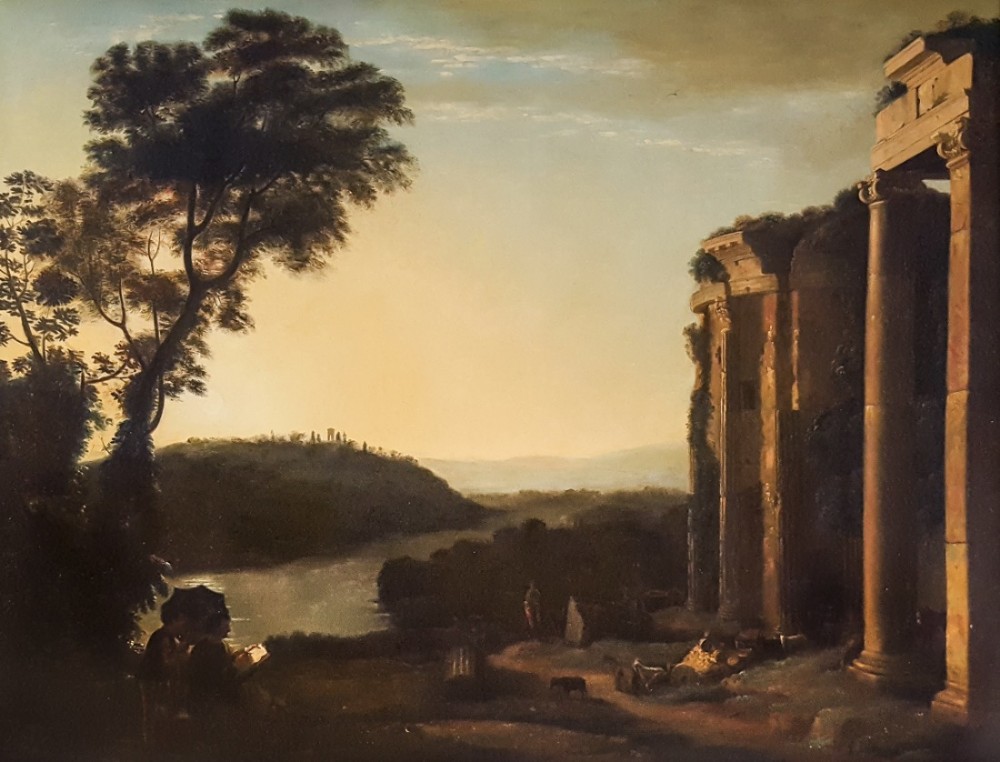
Capriccio with Figures in a Landscape, 18th Century; Follower of Claude Lorrain (C.1600-1682)
Titan Fine Art
sold SA485211
Sorry, but this item has been sold.
Titan Fine Art

Titan Fine Art

Sellingantiques Verified Since Jul 2016
View Dealers Stock Page
  • About Us
    Specialist in 17th & 18thc portraits. Highly curated selection, museum-level research & pro conservation. Exceptional art, expertly vetted.
Id #SA485211
PDF SHARE
SAVE

Capriccio with Figures in a Landscape, 18th Century; Follower of Claude Lorrain (C.1600-1682)

18th century
Description

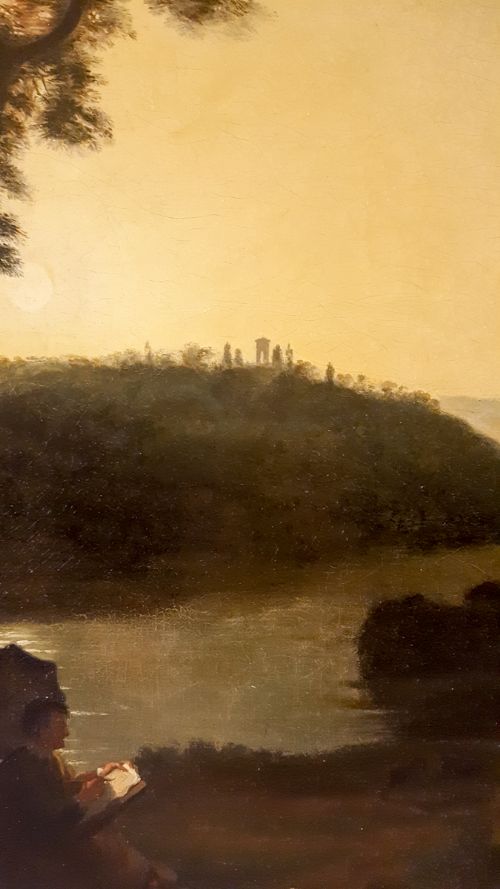
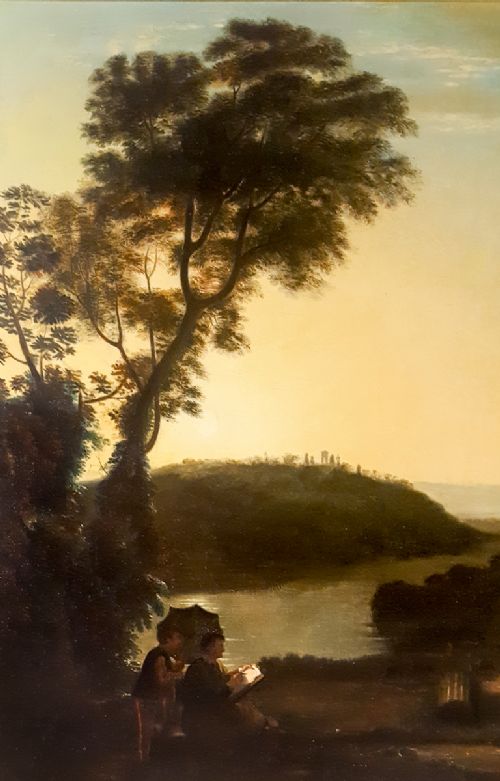
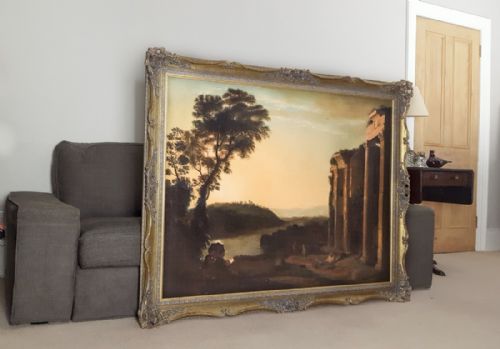
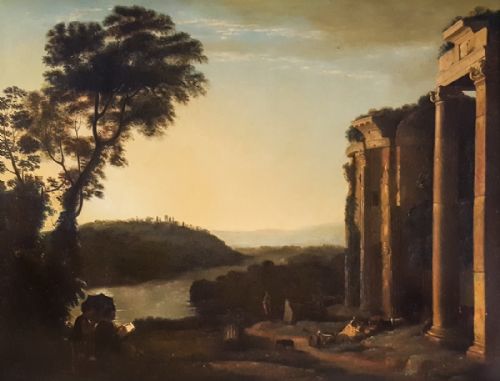
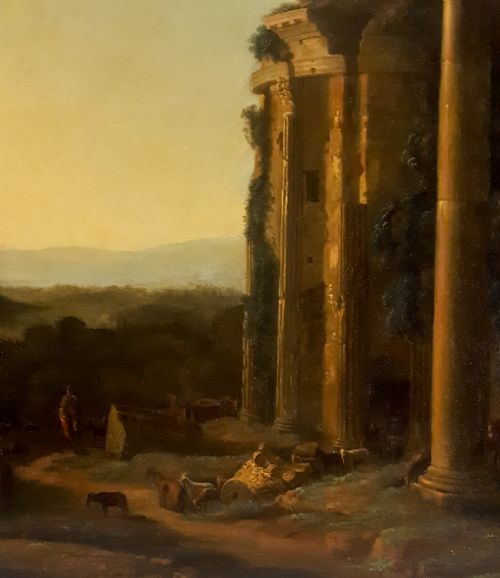
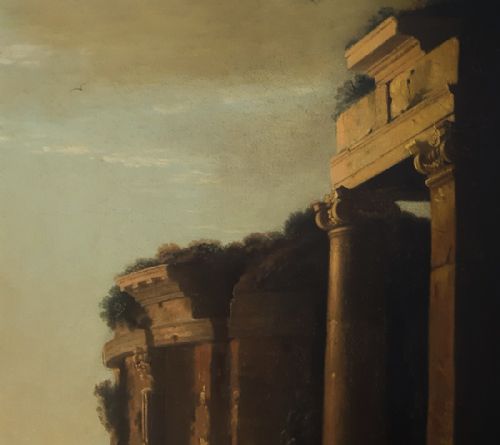
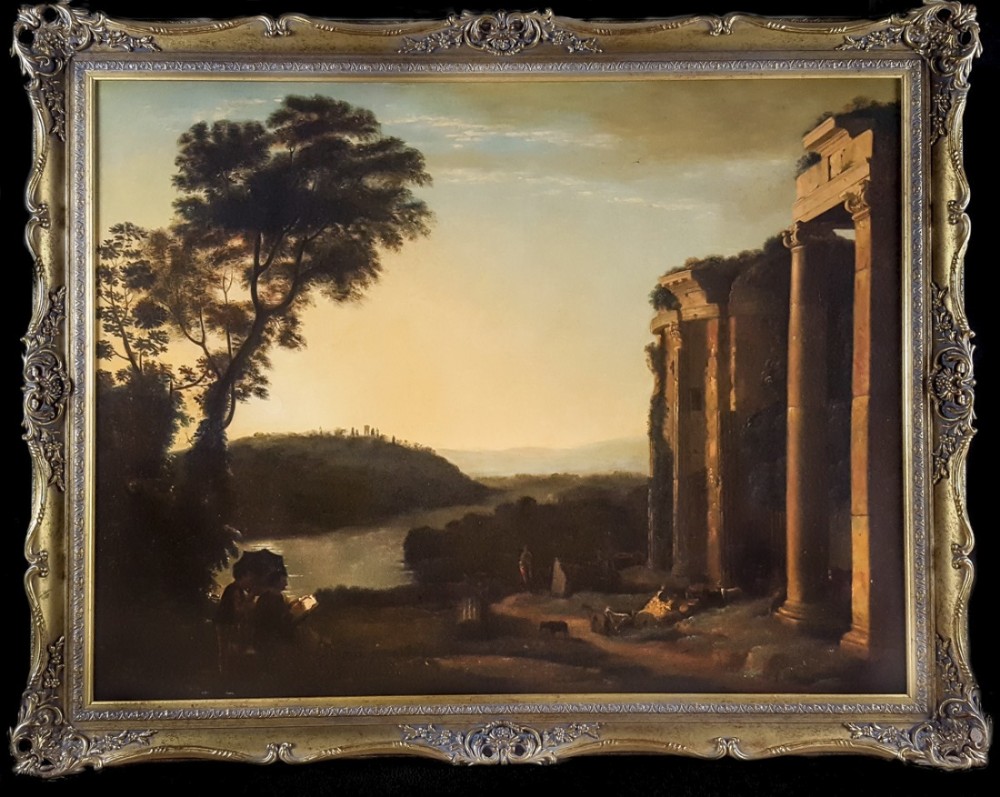
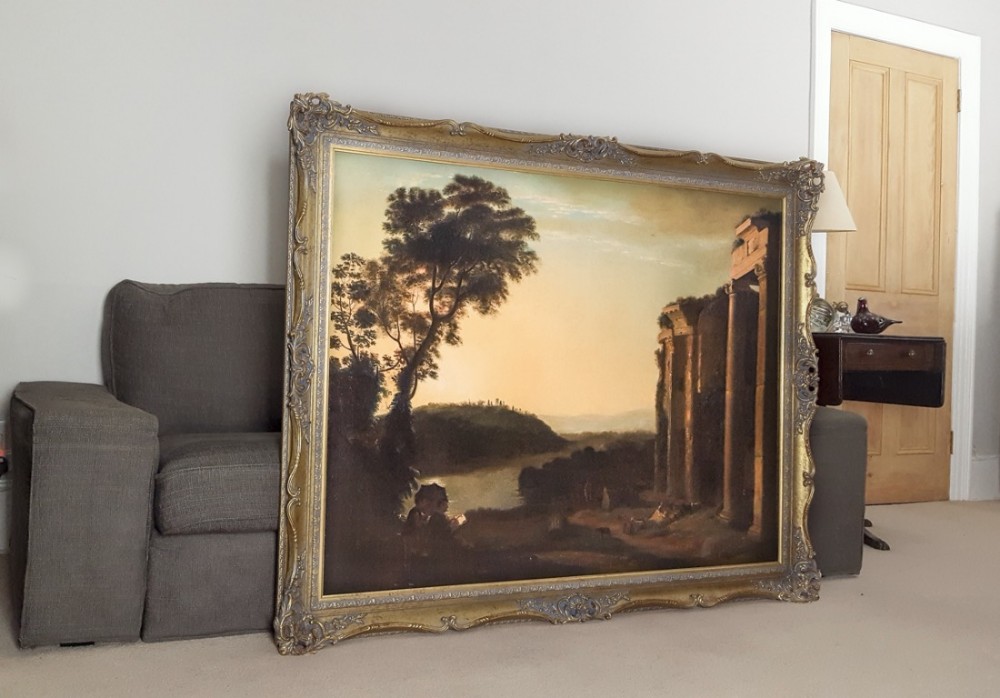
Exquisite capriccio of classical ruins. The work has been painted to a monumental scale and depicts classical ruins in the foreground, with temple ruins on a hill beyond a meandering Italian river. The entire scene is illuminated by a beautiful golden light during a balmy summer eve – a treatment commonly used by the master artist Claude Lorrain. The artist, recorded sitting on a portable stool, is sketching ruins whilst on his Grand Tour and is provided shade by his assistant who is stood nearby. The extensive view has been painted during the 18th century and to a huge scale; it is possible that it was an exhibition entry. It is also possible that the inspiration for this painting was taken from another.
This type of scene was very popular amongst 18th century artists and collectors who wanted to record the topographical settings they visited during their “Grand Tour”. The Grand Tour which is most commonly thought to have occured c.1550 up to 1850, was a journey to primarily France and Italy to improve the sartorial, social and cultural awareness of well-born young men and to enable them to make useful contacts and to introduce them to foreign lands and cultures. It was hugely influential in terms of Britain’s cultural, social, political, architectural, gastronomic, sartorial and artistic evolution. Among its many and far-reaching influences, it fuelled the transformation of Britain’s finest historic houses and provided much of their contents, defined the syllabi of many English preparatory schools, and introduced the authoritative architectural language of neoclassicism to British governmental and institutional buildings. Since there were few museums anywhere in Europe before the close of the eighteenth century, Grand Tourists often saw paintings and sculptures by gaining admission to private collections, and many were eager to acquire examples of Greco-Roman and Italian art for their own collections. Many Scottish and English aristocrats bought the work of Claude Lorrain and Claude exerted considerable influence on landscape artists of the 18th and 19th centuries. Turner was especially indebted to Claude, and tried to outdo his grand compositions.
Most men went for two months but some for many years. This was an expected event in the early lives of the upper classes and viewed as mandatory to a individuals maturity. Grand Tourists were keen to record what they saw and would sketch the sights themselves. This was a period, after all, when all educated English men and women were taught how to draw – the notion of picking up a pencil or pen was a natural one. Ricard Wilson is known for example to have made drawings of Italian places while traveling with the earl of Dartmouth in the mid 18th century. It was also popular for these “tourists” to have their portrait taken and so the employment of local artists to carry this out was common (the Italian vistas were commonly incorporated into the background of them). They were accompanied by a teacher or guardian and usually incorporated Paris, Venice, Florence, Rome, and Naples. After acquiring a coach in Calais, they would ride on to Paris where they would replace their entire wardrobe (in fact they would acquire everything new - cleanliness, clothes, boots, wigs, handkerchiefs, and possibly earrings).
From an inscised stamp on the reverse of the stretcher we know that the painting passed through the studio of the London picture liner, cleaner, and restorer John Jones (c.1842-c.1900) sometime between 1880 (when Jones setup business) and his death c.1900.
Claude Lorrain (or Gellée) was born in the Duchy of Lorraine but left around 1612 for Germany, then Rome, where he became a studio assistant to the landscapist Agostino Tassi. He visited Naples and returned to Nancy before settling permanently in Rome around 1628. He sketched in the Roman countryside with

Physical Dimensions
Height
117cm (46.06")
Width
148cm (58.27")
Depth
8cm (3.15")
Declaration

Titan Fine Art has dated this piece to the 18th Century.

Reference Numbers
Sellingantiques Reference
SA485211
Dealers Notes

Much more info about this item at: www.titanfineart.com

In a market saturated with available paintings, Titan Fine Art offers a distinct advantage: we sift through thousands of works to provide a specially curated selection. Each piece is meticulously chosen based on technical merit, provenance, and decorative appeal, ensuring our clients view only the finest examples of British and European art.

With over 20 years of expertise and 1,000+ works placed with collectors and institutions, we are one of the most prolific specialists in 17th and 18th-century portraiture. We combine a scholarly approach with museum-level rigor to replace the uncertainty of the open market with absolute confidence.

Why Buy From Titan Fine Art?

• Expertly Curated Selection

We act as your expert eye, selecting only high-quality works that offer genuine historical and artistic value.

• Museum-Level Research

Each portrait is supported by extensive academic research, often exceeding 40 hours, to establish attribution, sitter identity, and historical context.

• Professional Conservation

All paintings are carefully cleaned and stabilised by professional conservators, and are presented ready to hang.

• Transparent Pricing

No buyer’s premium or hidden fees—unlike auction houses, where additional costs can add 25–35%.

• Export Pricing Advantage

Reduced pricing is available for works exported outside the UK.

• Specialist Global Shipping

We manage the entire process, including custom crating, export documentation, and fully tracked delivery worldwide.

• Buy with Confidence

A 7-day return policy and the option to pay in GBP, USD, or EUR for convenience and transparency.

• Original Period Frames

Many works retain their original carved and gilded frames, which are works of art in their own right and enhance both historical authenticity and decorative impact.

• Personal Advisory Service

We work directly with collectors and interior designers, offering guidance on selection, scale, and placement—including bespoke room mock-ups on request.

Subscribe to our monthly 'new item alert' to be the first to hear about new works

Description
Exquisite capriccio of classical ruins.
The work has been painted to a monumental scale and depicts classical ruins in the foreground, with temple ruins on a hill beyond a meandering Italian river.
Titan Fine Art

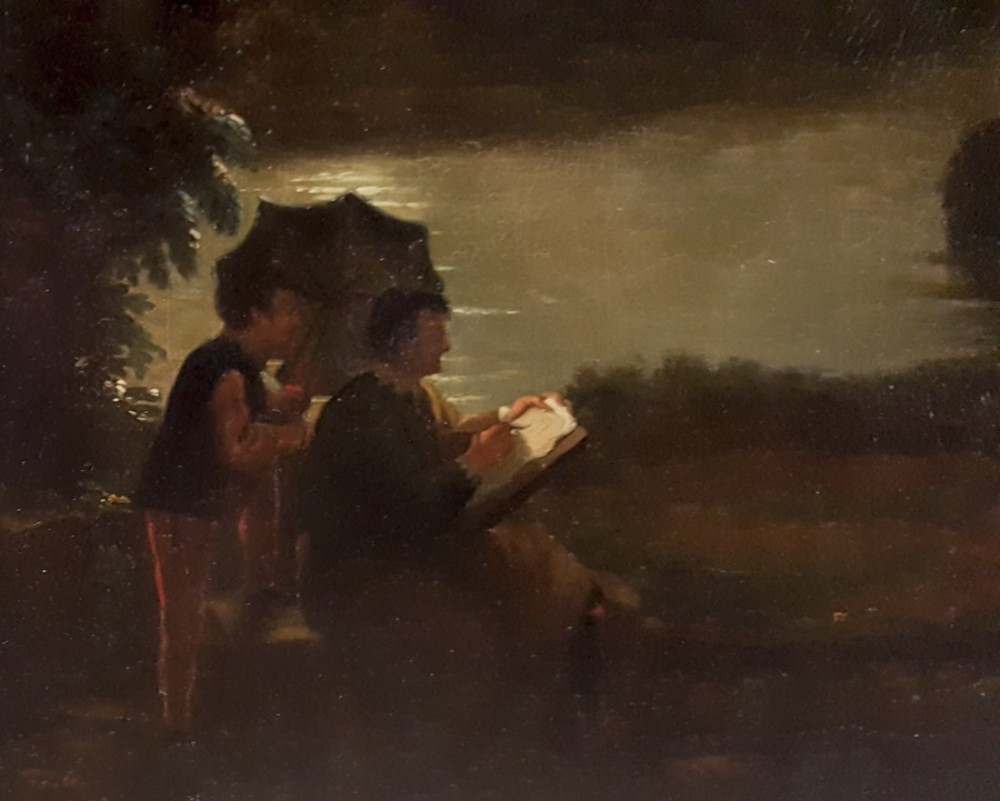
The entire scene is illuminated by a beautiful golden light during a balmy summer eve – a treatment commonly used by the master artist Claude Lorrain. The artist, recorded sitting on a portable stool, is sketching ruins whilst on his Grand Tour and is provided shade by his assistant who is stood nearby. The extensive view has been painted during the 18th century and to a huge scale; it is possible that it was an exhibition entry. It is also possible that the inspiration for this painting was taken from another.

fig 1. Capriccio with Figures in a Landscape, 18th Century; Follower of Claude Lorrain (c.1600-1682)
fig 1. Capriccio with Figures in a Landscape, 18th Century; Follower of Claude Lorrain (C.1600-1682)

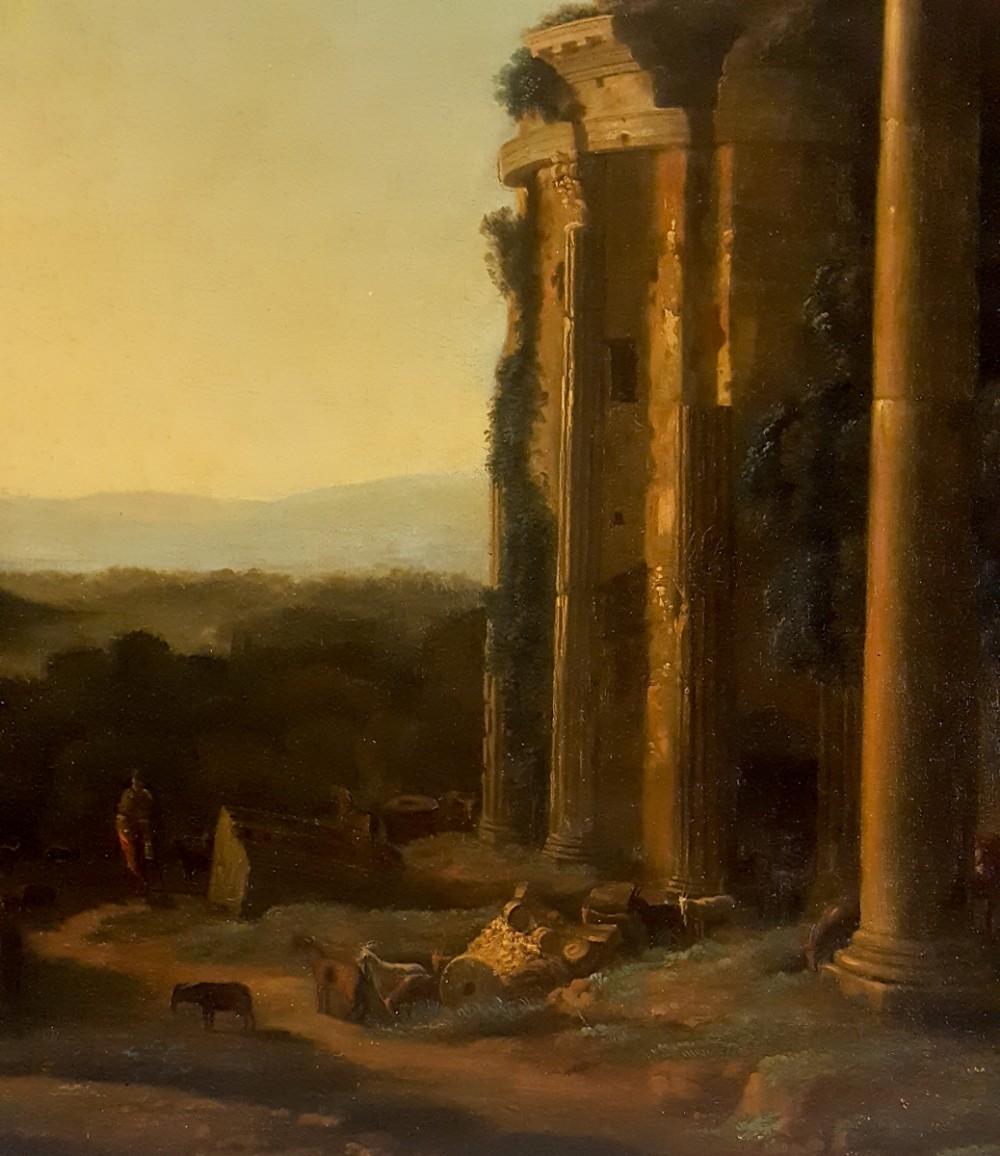
This type of scene was very popular amongst 18th century artists and collectors who wanted to record the topographical settings they visited during their “Grand Tour”. The Grand Tour which is most commonly thought to have occured c.1550 up to 1850, was a journey to primarily France and Italy to improve the sartorial, social and cultural awareness of well-born young men and to enable them to make useful contacts and to introduce them to foreign lands and cultures. It was hugely influential in terms of Britain’s cultural, social, political, architectural, gastronomic, sartorial and artistic evolution. Among its many and far-reaching influences, it fuelled the transformation of Britain’s finest historic houses and provided much of their contents, defined the syllabi of many English preparatory schools, and introduced the authoritative architectural language of neoclassicism to British governmental and institutional buildings. Since there were few museums anywhere in Europe before the close of the eighteenth century, Grand Tourists often saw paintings and sculptures by gaining admission to private collections, and many were eager to acquire examples of Greco-Roman and Italian art for their own collections. Many Scottish and English aristocrats bought the work of Claude Lorrain and Claude exerted considerable influence on landscape artists of the 18th and 19th centuries. Turner was especially indebted to Claude, and tried to outdo his grand compositions.

fig 2. Capriccio with Figures in a Landscape, 18th Century; Follower of Claude Lorrain (c.1600-1682)
fig 2. Capriccio with Figures in a Landscape, 18th Century; Follower of Claude Lorrain (C.1600-1682)

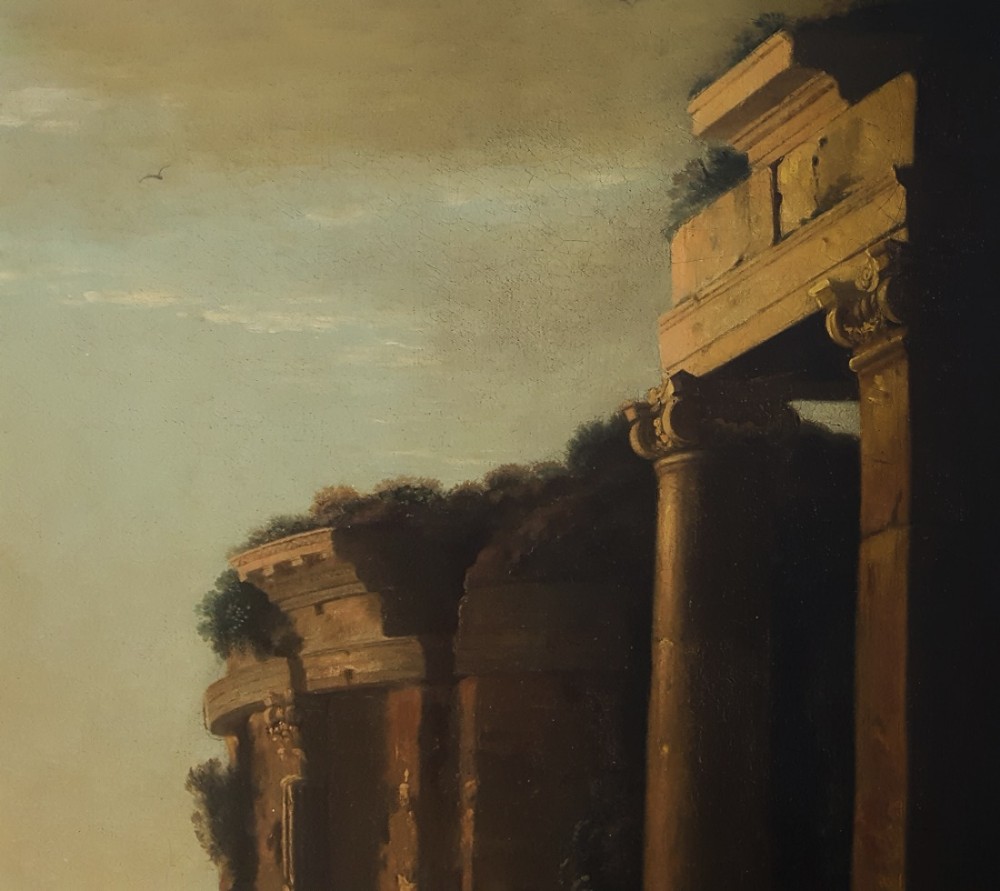
Most men went for two months but some for many years. This was an expected event in the early lives of the upper classes and viewed as mandatory to a individuals maturity. Grand Tourists were keen to record what they saw and would sketch the sights themselves. This was a period, after all, when all educated English men and women were taught how to draw – the notion of picking up a pencil or pen was a natural one. Ricard Wilson is known for example to have made drawings of Italian places while traveling with the earl of Dartmouth in the mid 18th century. It was also popular for these “tourists” to have their portrait taken and so the employment of local artists to carry this out was common (the Italian vistas were commonly incorporated into the background of them). They were accompanied by a teacher or guardian and usually incorporated Paris, Venice, Florence, Rome, and Naples. After acquiring a coach in Calais, they would ride on to Paris where they would replace their entire wardrobe (in fact they would acquire everything new - cleanliness, clothes, boots, wigs, handkerchiefs, and possibly earrings).

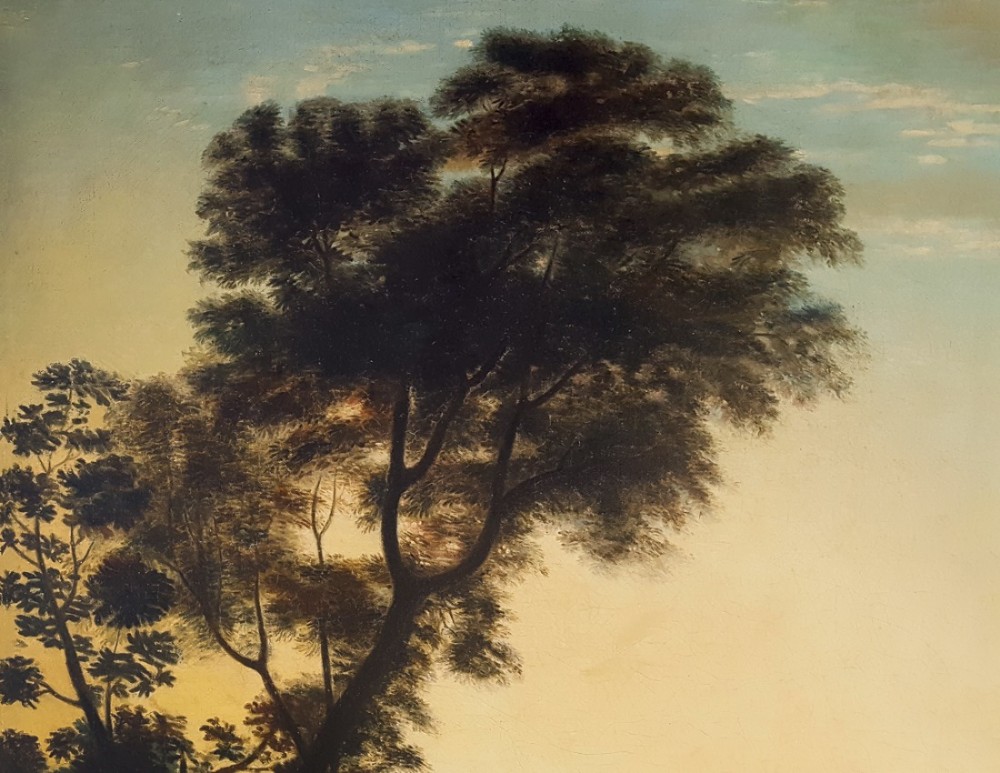
fig 3. Capriccio with Figures in a Landscape, 18th Century; Follower of Claude Lorrain (c.1600-1682)
fig 3. Capriccio with Figures in a Landscape, 18th Century; Follower of Claude Lorrain (C.1600-1682)

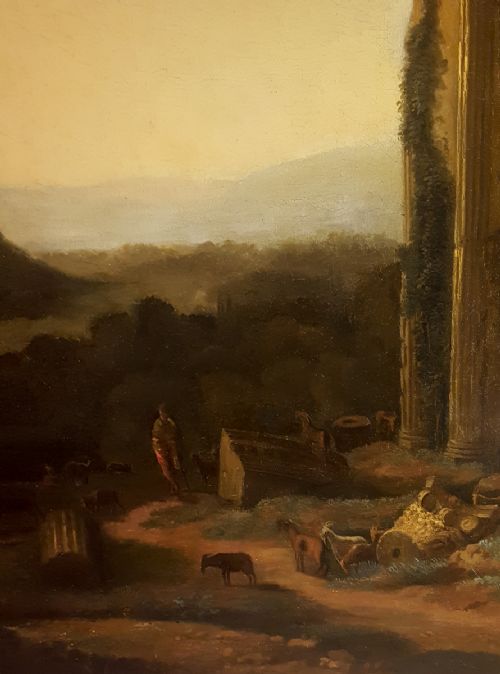
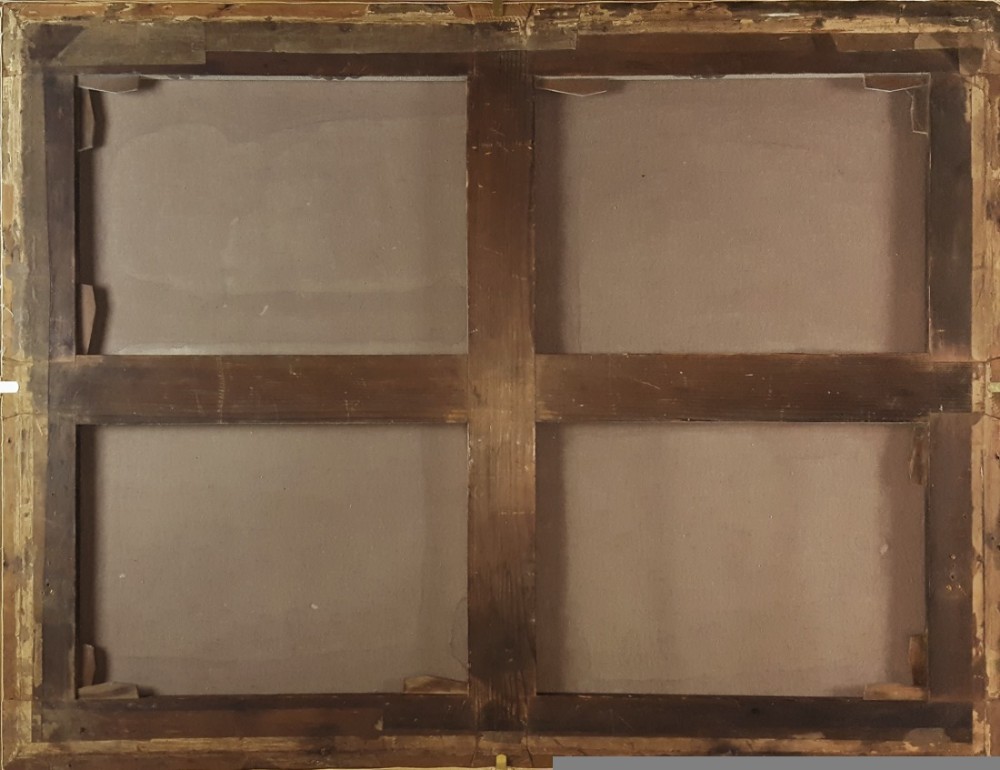
From an inscised stamp on the reverse of the stretcher we know that the painting passed through the studio of the London picture liner, cleaner, and restorer John Jones (c.1842-c.1900) sometime between 1880 (when Jones setup business) and his death c.1900.

fig 4. Capriccio with Figures in a Landscape, 18th Century; Follower of Claude Lorrain (c.1600-1682)
fig 4. Capriccio with Figures in a Landscape, 18th Century; Follower of Claude Lorrain (C.1600-1682)

Claude Lorrain (or Gellée) was born in the Duchy of Lorraine but left around 1612 for Germany, then Rome, where he became a studio assistant to the landscapist Agostino Tassi. He visited Naples and returned to Nancy before settling permanently in Rome around 1628. He sketched in the Roman countryside with

Height
117cm (46.06")
Width
148cm (58.27")
Depth
8cm (3.15")
Date of Manufacture

Titan Fine Art has dated this piece to the 18th Century.

Reference Numbers
Sellingantiques Ref
SA485211
Titan Fine Art
Titan Fine Art
Sellingantiques verified Since Jul 2016

Specialist in 17th & 18thc portraits. Highly curated selection, museum-level research & pro conservation. Exceptional art, expertly vetted.

Dealer Profile

You can view the stock and full dealer information on the Titan Fine Art Profile Page
PDF SHARE
SAVE
Capriccio with Figures in a Landscape, 18th Century; Follower of Claude Lorrain (c.1600-1682)
1 / 11
Archive I Capriccio with Figures in a Landscape, 18th Century; Follower of Claude Lorrain (c.1600-1682)

Capriccio with Figures in a Landscape, 18th Century; Follower of Claude Lorrain (C.1600-1682)
Archive II Capriccio with Figures in a Landscape, 18th Century; Follower of Claude Lorrain (c.1600-1682) View II
Archive III Capriccio with Figures in a Landscape, 18th Century; Follower of Claude Lorrain (c.1600-1682) View III
Archive IV Capriccio with Figures in a Landscape, 18th Century; Follower of Claude Lorrain (c.1600-1682) View IV
Archive V Capriccio with Figures in a Landscape, 18th Century; Follower of Claude Lorrain (c.1600-1682) View V
Archive VI Capriccio with Figures in a Landscape, 18th Century; Follower of Claude Lorrain (c.1600-1682) View VI
Archive VII Capriccio with Figures in a Landscape, 18th Century; Follower of Claude Lorrain (c.1600-1682) View VII
Archive VIII Capriccio with Figures in a Landscape, 18th Century; Follower of Claude Lorrain (c.1600-1682) View VIII
Archive IX Capriccio with Figures in a Landscape, 18th Century; Follower of Claude Lorrain (c.1600-1682) View IX
Archive X Capriccio with Figures in a Landscape, 18th Century; Follower of Claude Lorrain (c.1600-1682) View X
Archive XI Capriccio with Figures in a Landscape, 18th Century; Follower of Claude Lorrain (c.1600-1682) View XI
Enlarged Archival View
Telephone 07875 412 111
Location
London
United Kingdom
Dealer Profile Page sellingantiques.co.uk/titan
Verified Since Jul 2016
Items For Sale 16
Items Sold 401
Titan Fine Art
Titan Fine Art
Verified Since Jul 2016
View Dealer Info
Location: London, United Kingdom
Verified
Jul 2016
For Sale
16
Sold
401
Capriccio with Figures in a Landscape, 18th Century; Follower of Claude Lorrain (c.1600-1682)
Ref: SA485211
Capriccio with Figures in a Landscape, 18th Century; Follower of Claude Lorrain (c.1600-1682)
Detail View 1
Detail View 2
Detail View 3
Detail View 4
Detail View 5
Detail View 6
Detail View 7
Detail View 8
Detail View 9
Detail View 10
Archival Detail
Every single antique dealer on our platform is individually approved by our internal team. We verify their professional trade history, ethical standards, and photographic quality to ensure a secure, high-standard buying environment. Upon joining, every dealer agrees to a strict 9-point code of conduct. While issues can occasionally arise, our dealers typically resolve them swiftly and directly with the buyer. In fact, since our founding in 2002, Sellingantiques has only had to step in to help resolve an issue on roughly five occasions—a true testament to the quality of our dealers and their dedication to your happiness.
Our dealers are highly experienced in packing and shipping fragile, high-value antiques. Because you are in direct contact with the dealer, you will be able to easily go through all available shipping and insurance options together to ensure your item arrives safely.
Antiques are the ultimate green purchase. By choosing historical pieces over newly manufactured goods, you completely eliminate the carbon footprint of modern mass production while preserving exceptional, timeless craftsmanship.
items
Add keywords to the filter
Price
£100
£250000
Era
Movements
Material
Origin
Stock Location
Freshness
Online Payments
Categories