


The Mezzotint Man has dated this Georgian Real Tennis Print to the 18th Century.
It depicts Monsieur Masson whole-length, standing, directed towards and facing the front, holding a tennis racket in his right hand and his left elbow leaning on a large plinth at the right; published state. 1769
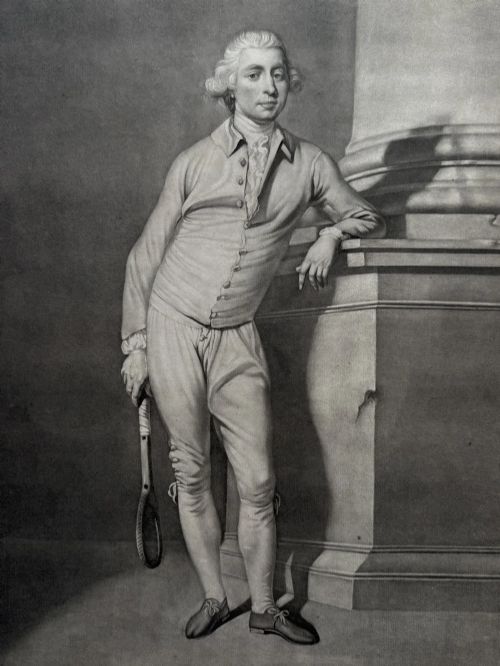
Lettered with title and: "Mortimer Pinxt,,/ Brookshaw Sculpt,,/ Publish'd According to Act Octr. 6. 1769 by I. Wesson in Litchfield Street St. Anns Soho"'Mortimer's painting was exhibited in 'John Hamilton Mortimer ARA 1740-1779', Towner Art Gallery, Eastbourne, and Iveagh Bequest, Kenwood, 1968, cat. 7 (reproduced); it had in fact been bought by Ernest Raphael before the First World War and was owned until the 1990s by his daughter Mrs Guy Snyder, London (who was the lender in 1968). It is now in a private collection, London.'
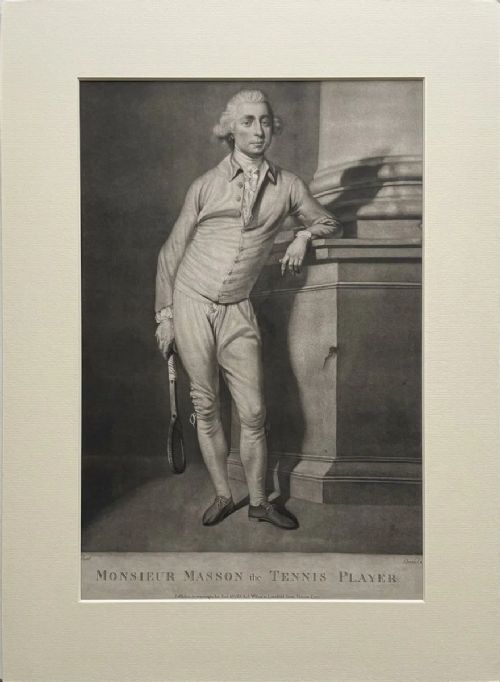
Fine impression, the tonal contrast in the background and velvet shadows is remarkably sharp. Full sheet with plate mark clearly visible all the way around and with generous outer borders (see final image) the tonal contrast in the background and velvet shadows is remarkably sharp.
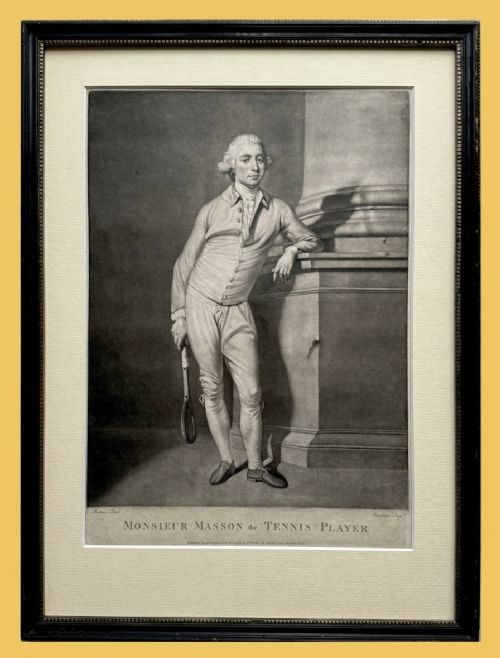
Antoine-Henry Masson, often referred to as Raymond, is depicted here in 1769 at the age of 29. Masson was the first of the great players whose achievements are on record. Born in Paris in 1740, he quickly mastered the game of tennis, and by the age of twenty-two he was appointed paumier du roi. He was also paumier to the duc de Chartres’, the prince de Condé and the “Enfants de France”. Masson has been called the “père des paumiers” and for some thirty years was regarded as champion of the world.His great rival was Charrier the elder. One of his most famous victories was against Charrier and Clergé, giving them half 15, in front of Louis XV and his court at Fontainebleau. De Manevieux relates (pp. 140-41) that he played matches of astonishing difficulty against amateurs, in one case having to jump in and out of a barrel on both the service side and the grille side before playing his shots, and in another being mounted on an unshod donkey which he guided with a bridle; when playing, he wore spectacles.Masson kept two courts in Paris, one in the Rue Grenelle Saint-Honoré, and one in the Rue Mazarine. His wife played tennis, and de Manevieux remarks that at the age of twenty-eight Mme. Masson too was a skilful player. In 1767 the Courrier d’Avignon reports Masson visiting London and defeating the strongest English players. It is thought Masson’s portrait was painted by Mortimer at this time, when it is also likely he was alluded to as “The Frenchman” in Holcroft’s Road to Ruin. Henderson p. 186.
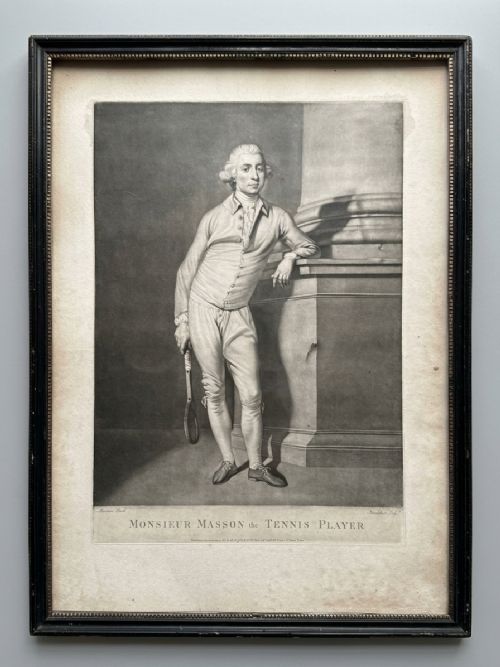
Height: 503 millimetres
Width: 355 millimetres
Framed Height: 595 millimetres
Framed Width: 440 millimetres
Price: £2600
The Mezzotint Man has dated this Georgian Real Tennis Print to the 18th Century.
Dealers in fine antiquarian portrait prints
You can view the stock and full dealer information on the The Mezzotint Man Profile Page
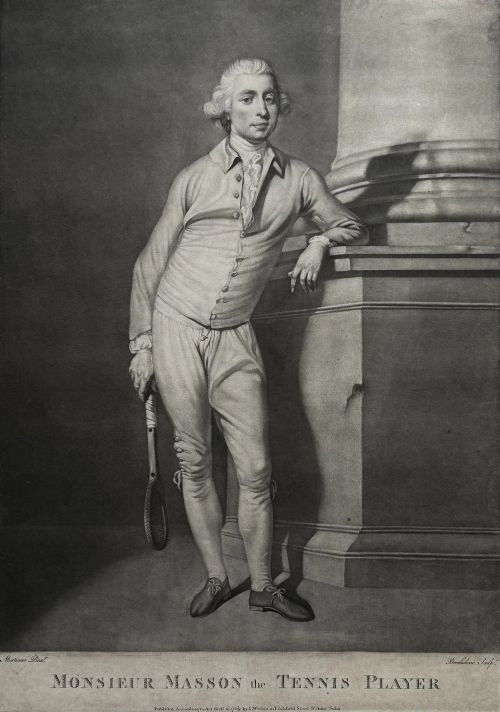
Monsieur Masson the Tennis Player by Richard Brookshaw After John Hamilton Mortimer.