4,005  PAGES BROWSED TODAY PAGES TODAY • 0 ANTIQUES UPLOADED TODAYNEW ARRIVALS
GIFTS
LATEST STOCK
Sort Order
Items Per Page
Browse Categories
Sort order
Items per page
ID #SA1240932
FOR SALE
£390
Email Phone
Save
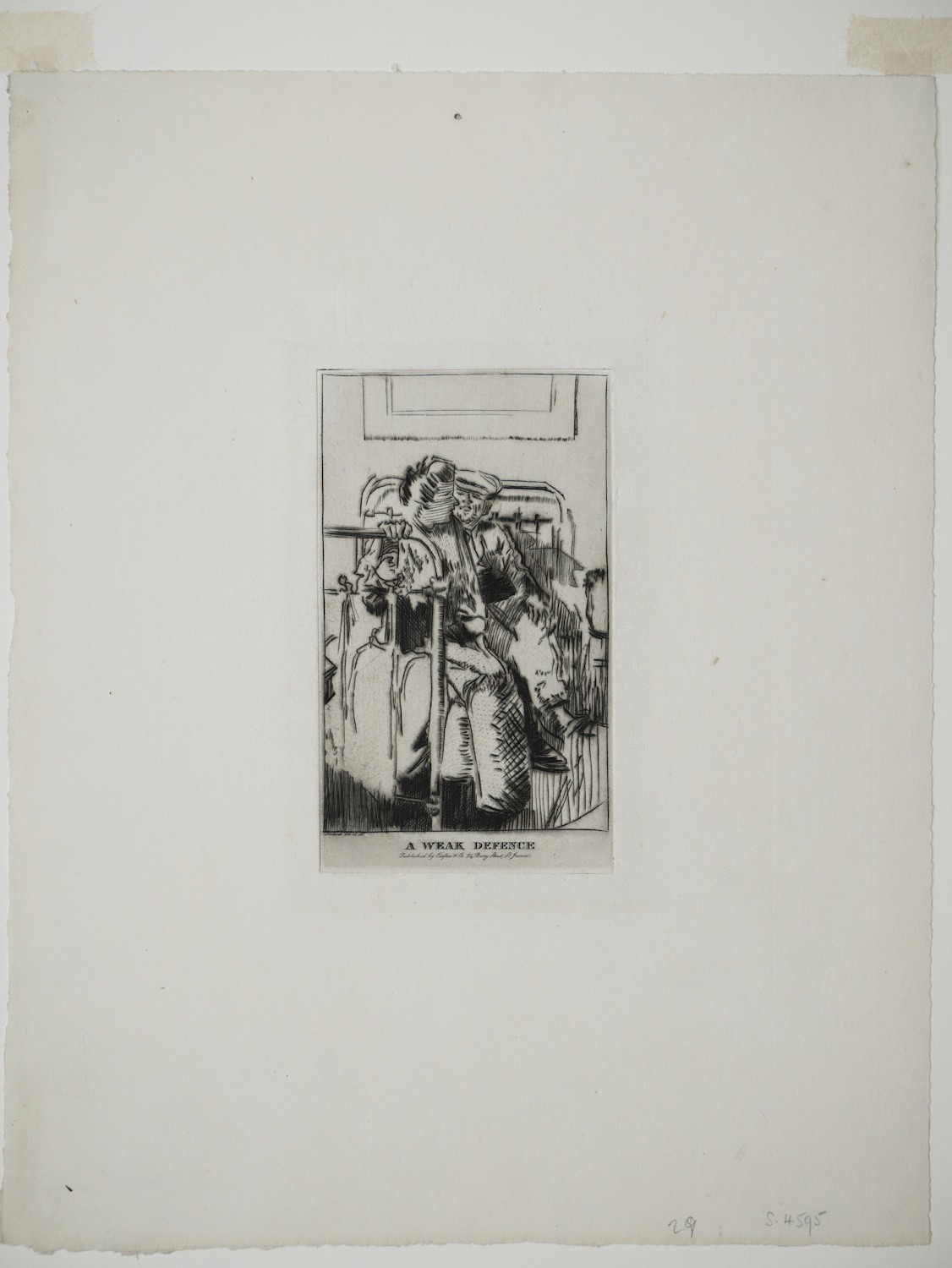
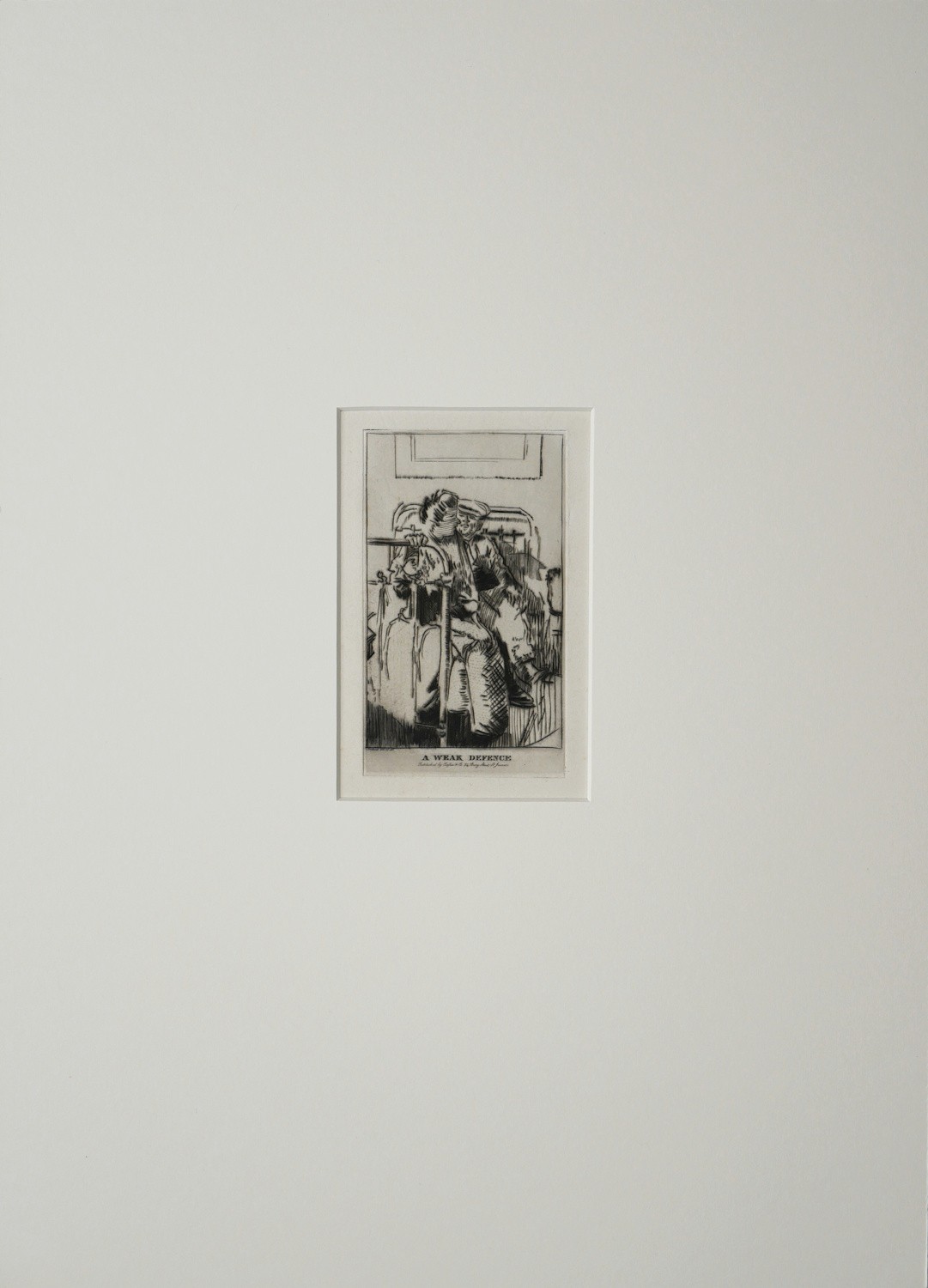
Walter Richard Sickert - Scarce Etching (A Weak Defence) Printed 1915
For sale by Radnorshire Fine Arts Ltd
for sale €456     $495
£390
Radnorshire Fine Arts Ltd

Radnorshire Fine Arts Ltd

Sellingantiques Verified Since Sep 2026
Browse dealers 35 items
  • About Us
    We buy and sell paintings, watercolours, prints and drawings from the 17th to the 20th century
Id #SA1240932
PDF SHARE
SAVE

Walter Richard Sickert - Scarce Etching (A Weak Defence) Printed 1915

1900 - 1920
Description

Walter Richard Sickert (1860-1842) – A Weak Defence (The Small Plate)

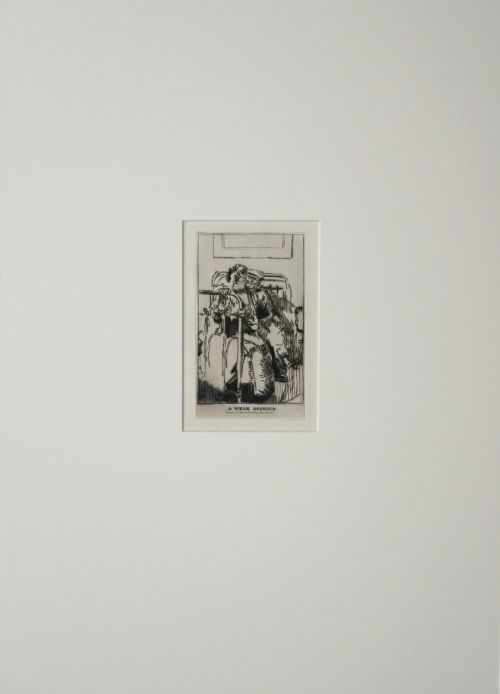
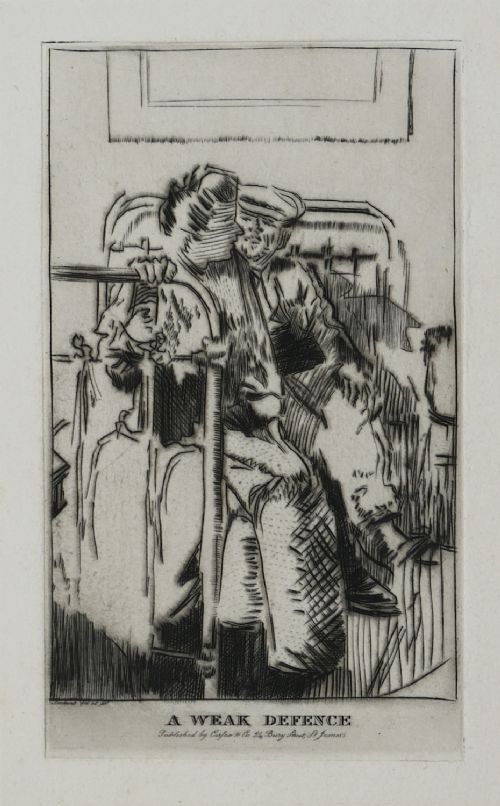
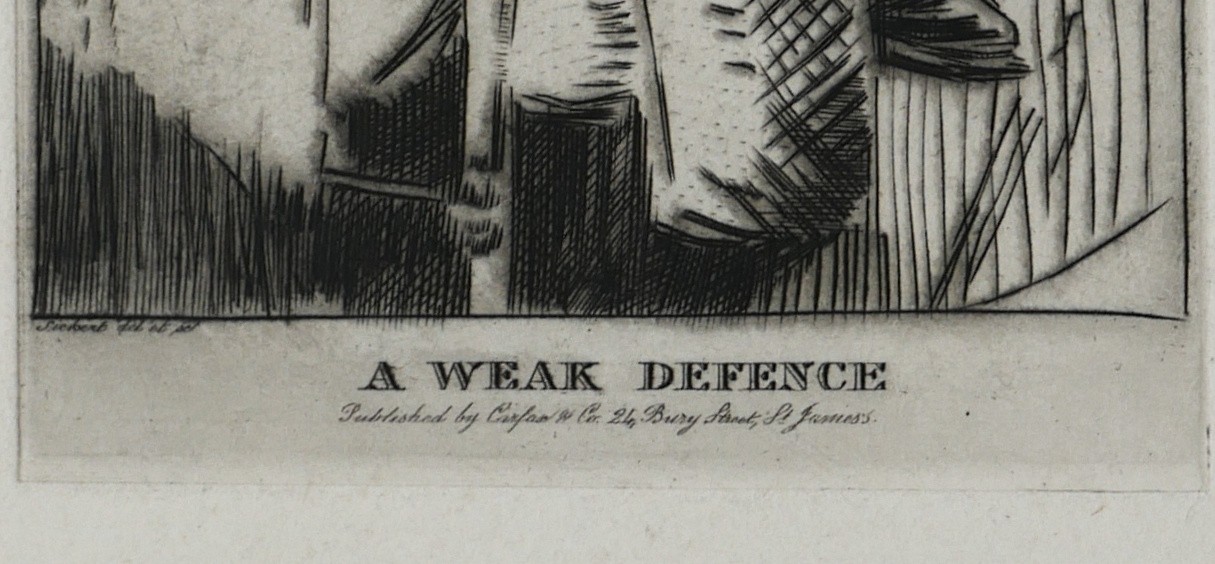
Etching; toned on white laid paper printed in black ink, second state of two c.1911, published 1915 by Carfax & Co. 24 Bury Street St James’s and numbered: 29 5.4595 in pencil (bottom right of sheet). Watermark: Crowned coat of arms with ‘VGZ’ below. Reference: Ruth Bromberg Walter Sickert Prints: A Catalogue Raisonné. Yale University Press, New Haven, 2000, cat. No. 147 ii/ii. A good strong impression with wide margins; hinged and housed in a new conservation standard rag board mount. Excellent condition.

Plate: 5 13/16 x 3 7/16 in. (14.8 x 8.6 cm.)

Sheet: 13 5/8 x 10 5/8 in. (34.5 x 27 cm.)

Mount: 21 5/8 x 15 5/8 in. (55 x 39.8 cm.)

This small version of A WEAK DEFENCE is based on the preparatory drawing signed and dated 1911 made specifically for transformation into a print. A large plate similar in subject although with some differences was presented by the artist to the British Museum in 1914. It was registered under the title: Attack and Defence.
Sickert was the son of Oswald Adalbert Sickert, a Danish-born German draftsman who settled in England in 1868. After several years working as an actor, in 1881 the younger Sickert attended the Slade School of Art in London. In 1882 he became an assistant to James McNeill Whistler, and the following year he met the French Impressionist Edgar Degas in Paris; these artists greatly influenced his work. In particular, Sickert was indebted to Degas for the ability to establish a situation merely through the attitudes of his figures. His first pictures of London music-hall interiors, which became one of his most typical subjects, appeared in 1888 at the New English Art Club. Such works helped introduce Impressionism’s subject matter of everyday life to the British public. After making a living as a portrait painter throughout the 1890s, from 1898 to 1905 Sickert lived in Dieppe, France, and in Venice, often painting landscapes.
In 1905 Sickert returned to London, where he joined the painters Augustus John and Lucien Pissarro, the son of Impressionist master Camille Pissarro, in advocating advanced ideas in British painting. During the latter part of the decade he began to depict disturbing subject matter, such as a series of chilling, ambiguous works entitled Camden Town Murder. By 1911 Sickert became the leader of the Camden Town Group, an association of artists who advocated an unromanticised vision of the urban scene; the rough quality of the group’s aesthetic is apparent in paintings by Sickert such as Ennui (c. 1913). The group also organized exhibitions of French and British Impressionism and Post-Impressionism that exposed the British public to important developments in European avant-garde art.
From the mid-1920s to the end of his life, Sickert lived in a variety of locales, including Dieppe and, in England, Bath and Kent. In his later work he increasingly used photographs, rather than live models, as the basis for his work. He also occasionally wrote art criticism for the leading journals of the day.

Declaration

Radnorshire Fine Arts Ltd has dated this piece to the Edwardian era.

Reference Numbers
Sellingantiques Reference
SA1240932
Dealers Notes

All our prices include FREE packing and delivery within the UK.

Our website accepts payments from the UK. Buyers outside the UK are required to "CONTACT US" for delivery options and prices. Please include the detail of the item you wish to purchase and your shipping address.

'Stripe' has recently been introduced to our website, offering more choices for secure payments, including 'Apple Pay' and 'Google Pay'. You can also pay 3 monthly 'interest free' instalments with 'Klarna' at 'Checkout'.

Other information including terms and conditions can be found on our website @ Radnorshire Fine Arts Ltd.

Description
Walter Richard Sickert (1860-1842) – A Weak Defence (The Small Plate)

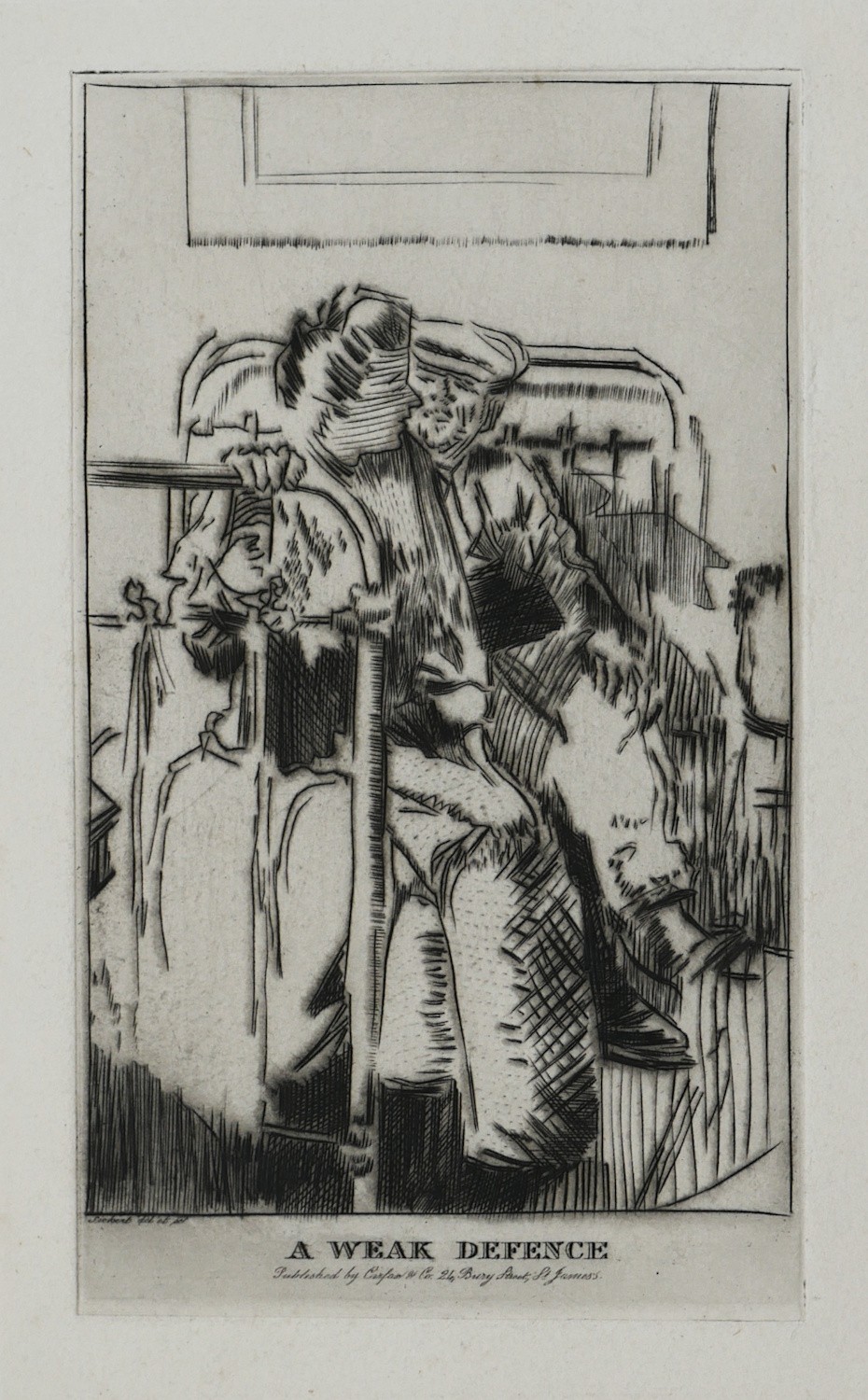
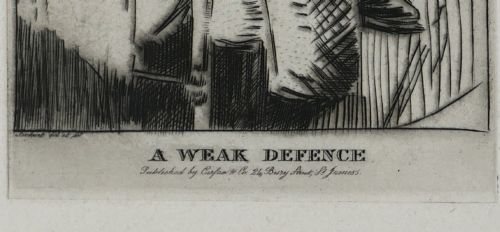
Etching; toned on white laid paper printed in black ink, second state of two c.1911, published 1915 by Carfax & Co. 24 Bury Street St James’s and numbered: 29 5.4595 in pencil (bottom right of sheet). Watermark: Crowned coat of arms with ‘VGZ’ below. Reference: Ruth Bromberg Walter Sickert Prints: A Catalogue Raisonné. Yale University Press, New Haven, 2000, cat. No. 147 ii/ii.

“
A good strong impression with wide margins; hinged and housed in a new conservation standard rag board mount.
Radnorshire Fine Arts Ltd

Excellent condition.

fig 1. Walter Richard Sickert - Scarce Etching (A Weak Defence) Printed 1915

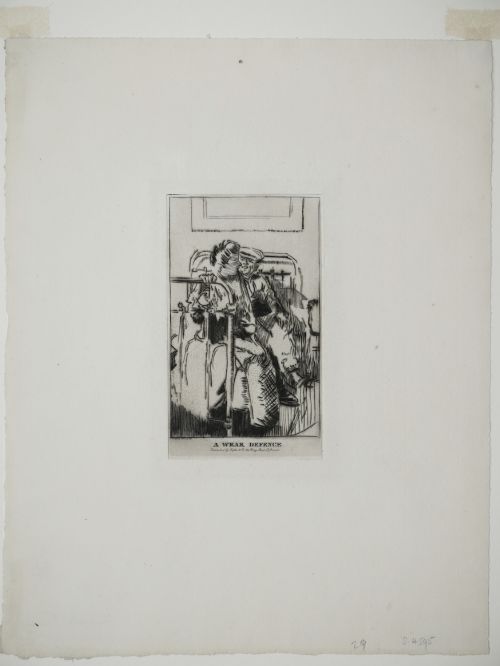
Plate: 5 13/16 x 3 7/16 in. (14.8 x 8.6 cm.)

Sheet: 13 5/8 x 10 5/8 in. (34.5 x 27 cm.)

Mount: 21 5/8 x 15 5/8 in. (55 x 39.8 cm.)

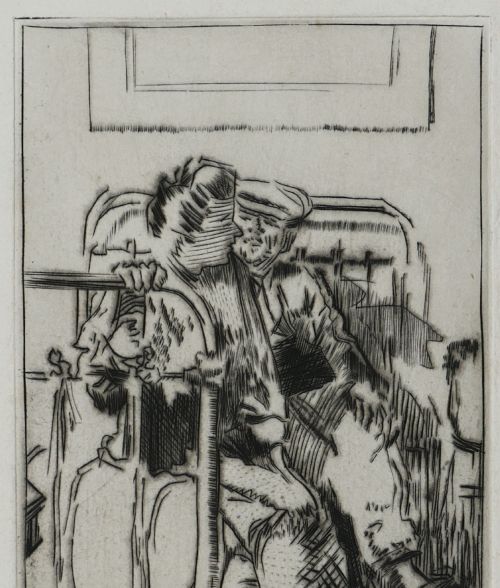
This small version of A WEAK DEFENCE is based on the preparatory drawing signed and dated 1911 made specifically for transformation into a print. A large plate similar in subject although with some differences was presented by the artist to the British Museum in 1914. It was registered under the title: Attack and Defence.

fig 2. Walter Richard Sickert - Scarce Etching (A Weak Defence) Printed 1915

Sickert was the son of Oswald Adalbert Sickert, a Danish-born German draftsman who settled in England in 1868. After several years working as an actor, in 1881 the younger Sickert attended the Slade School of Art in London. In 1882 he became an assistant to James McNeill Whistler, and the following year he met the French Impressionist Edgar Degas in Paris; these artists greatly influenced his work. In particular, Sickert was indebted to Degas for the ability to establish a situation merely through the attitudes of his figures. His first pictures of London music-hall interiors, which became one of his most typical subjects, appeared in 1888 at the New English Art Club. Such works helped introduce Impressionism’s subject matter of everyday life to the British public. After making a living as a portrait painter throughout the 1890s, from 1898 to 1905 Sickert lived in Dieppe, France, and in Venice, often painting landscapes.

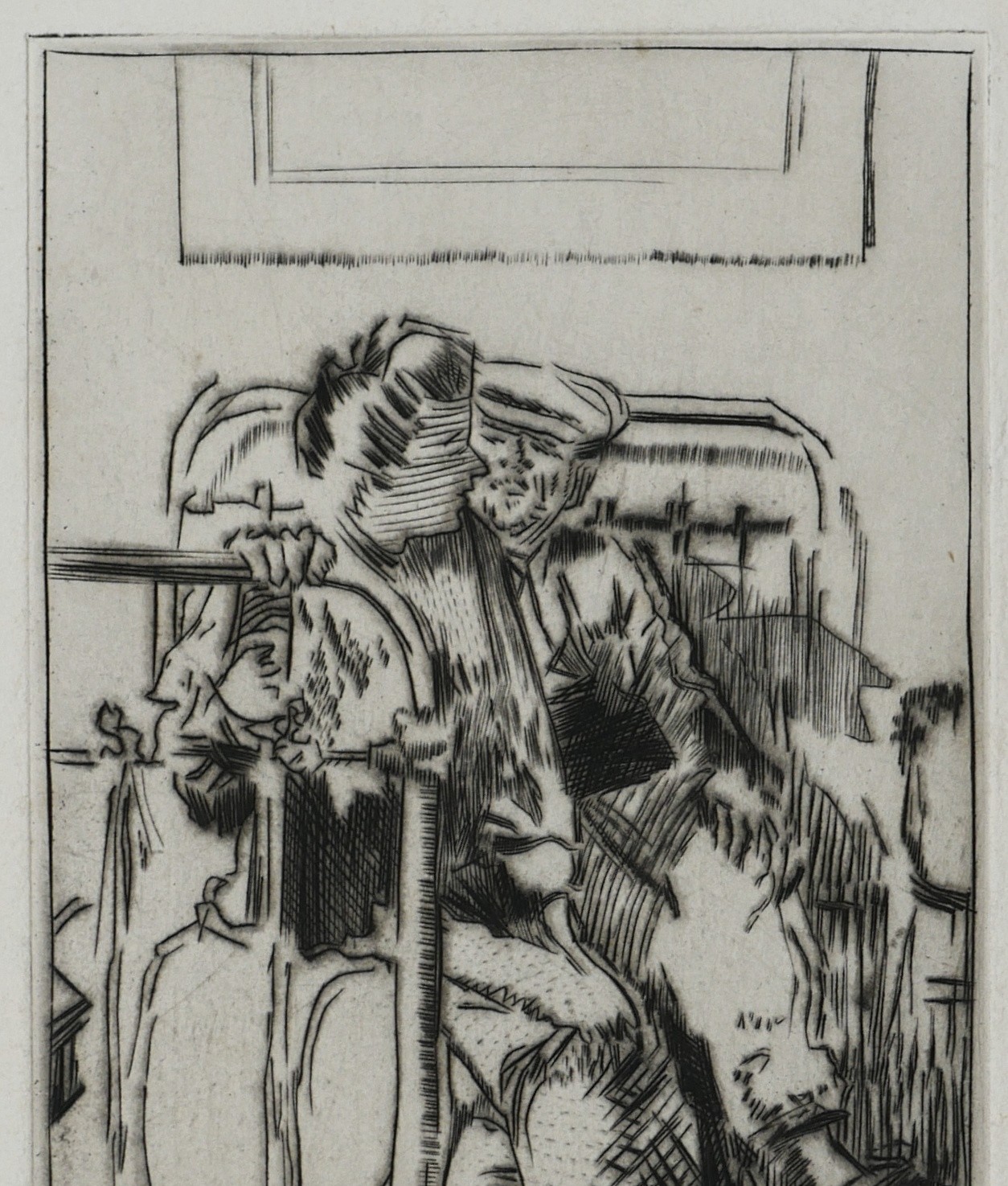
fig 3. Walter Richard Sickert - Scarce Etching (A Weak Defence) Printed 1915

In 1905 Sickert returned to London, where he joined the painters Augustus John and Lucien Pissarro, the son of Impressionist master Camille Pissarro, in advocating advanced ideas in British painting. During the latter part of the decade he began to depict disturbing subject matter, such as a series of chilling, ambiguous works entitled Camden Town Murder. By 1911 Sickert became the leader of the Camden Town Group, an association of artists who advocated an unromanticised vision of the urban scene; the rough quality of the group’s aesthetic is apparent in paintings by Sickert such as Ennui (c. 1913). The group also organized exhibitions of French and British Impressionism and Post-Impressionism that exposed the British public to important developments in European avant-garde art.

fig 4. Walter Richard Sickert - Scarce Etching (A Weak Defence) Printed 1915

From the mid-1920s to the end of his life, Sickert lived in a variety of locales, including Dieppe and, in England, Bath and Kent. In his later work he increasingly used photographs, rather than live models, as the basis for his work. He also occasionally wrote art criticism for the leading journals of the day.

Date of Manufacture

Radnorshire Fine Arts Ltd has dated this piece to the Edwardian era.

Reference Numbers
Sellingantiques Ref
SA1240932
Radnorshire Fine Arts Ltd
Sellingantiques verified Since Sep 2026

We buy and sell paintings, watercolours, prints and drawings from the 17th to the 20th century

Dealer Profile

You can view the stock and full dealer information on the Radnorshire Fine Arts Ltd Profile Page
PDF SHARE
SAVE
Walter Richard Sickert - Scarce Etching (A Weak Defence) Printed 1915
1 / 5
Archive I Walter Richard Sickert - Scarce Etching (A Weak Defence) Printed 1915
Walter Richard Sickert - Scarce Etching (A Weak Defence) Printed 1915
Archive II Walter Richard Sickert - Scarce Etching (A Weak Defence) Printed 1915 View II
Archive III Walter Richard Sickert - Scarce Etching (A Weak Defence) Printed 1915 View III
Archive IV Walter Richard Sickert - Scarce Etching (A Weak Defence) Printed 1915 View IV
Archive V Walter Richard Sickert - Scarce Etching (A Weak Defence) Printed 1915 View V
Enlarged Archival View
Telephone 07790 208712
Location
Powys
Wales
United Kingdom

By appointment.
Dealer Profile Page sellingantiques.co.uk/rfa
Verified Since Sep 2026
Items For Sale 35
Items Sold 1
Radnorshire Fine Arts Ltd
Verified Since Sep 2026
View Dealer Info
Location: Powys, Wales, United Kingdom, , By appointment.
Verified
Sep 2026
For Sale
35
Sold
1
Walter Richard Sickert - Scarce Etching (A Weak Defence) Printed 1915
Ref: SA1240932
Walter Richard Sickert - Scarce Etching (A Weak Defence) Printed 1915
Detail View 1
Detail View 2
Detail View 3
Detail View 4
Archival Detail
Every single antique dealer on our platform is individually approved by our internal team. We verify their professional trade history, ethical standards, and photographic quality to ensure a secure, high-standard buying environment. Upon joining, every dealer agrees to a strict 9-point code of conduct. While issues can occasionally arise, our dealers typically resolve them swiftly and directly with the buyer. In fact, since our founding in 2002, Sellingantiques has only had to step in to help resolve an issue on roughly five occasions—a true testament to the quality of our dealers and their dedication to your happiness.
Our dealers are highly experienced in packing and shipping fragile, high-value antiques. Because you are in direct contact with the dealer, you will be able to easily go through all available shipping and insurance options together to ensure your item arrives safely.
Antiques are the ultimate green purchase. By choosing historical pieces over newly manufactured goods, you completely eliminate the carbon footprint of modern mass production while preserving exceptional, timeless craftsmanship.
Written by Sellingantiques from the dealer’s photographs and listing
  • Period1900 - 1920

This Edwardian etching, titled A Weak Defence, is an original print on white laid paper in black ink, housed in a conservation standard rag board mount. The work displays wide margins, a watermark featuring a crowned coat of arms with letters below, and publication text along the lower margin. The plate measures 14.8 x 8.6 cm, the sheet measures 34.5 x 27 cm, and the mount measures 55 x 39.8 cm. In a home today, this framed work would be displayed on a wall in a study, library, or living room. The composition depicts two figures seated indoors, with parallel vertical lines in the background and bold linear marks shaping the interior scene and clothing.

items
Add keywords to the filter
Price
£100
£250000
Era
Period
Style
Material
Origin
Stock Location
Recently Added
Online Payments
Categories