9,067  PAGES BROWSED TODAY PAGES TODAY 36  ANTIQUES UPLOADED TODAY NEW ARRIVALS
ID #SA1226544
FOR SALE
£3,000
Email
Save
David Roberts Colossal Figures in Front of Aboo-simbel
Darnley Fine Art
for sale €3,510     $3,810
£3,000

Darnley Fine Art

Sellingantiques Verified Since Jul 2026
View Dealers Stock Page
Id #SA1226544
PDF SHARE
SAVE

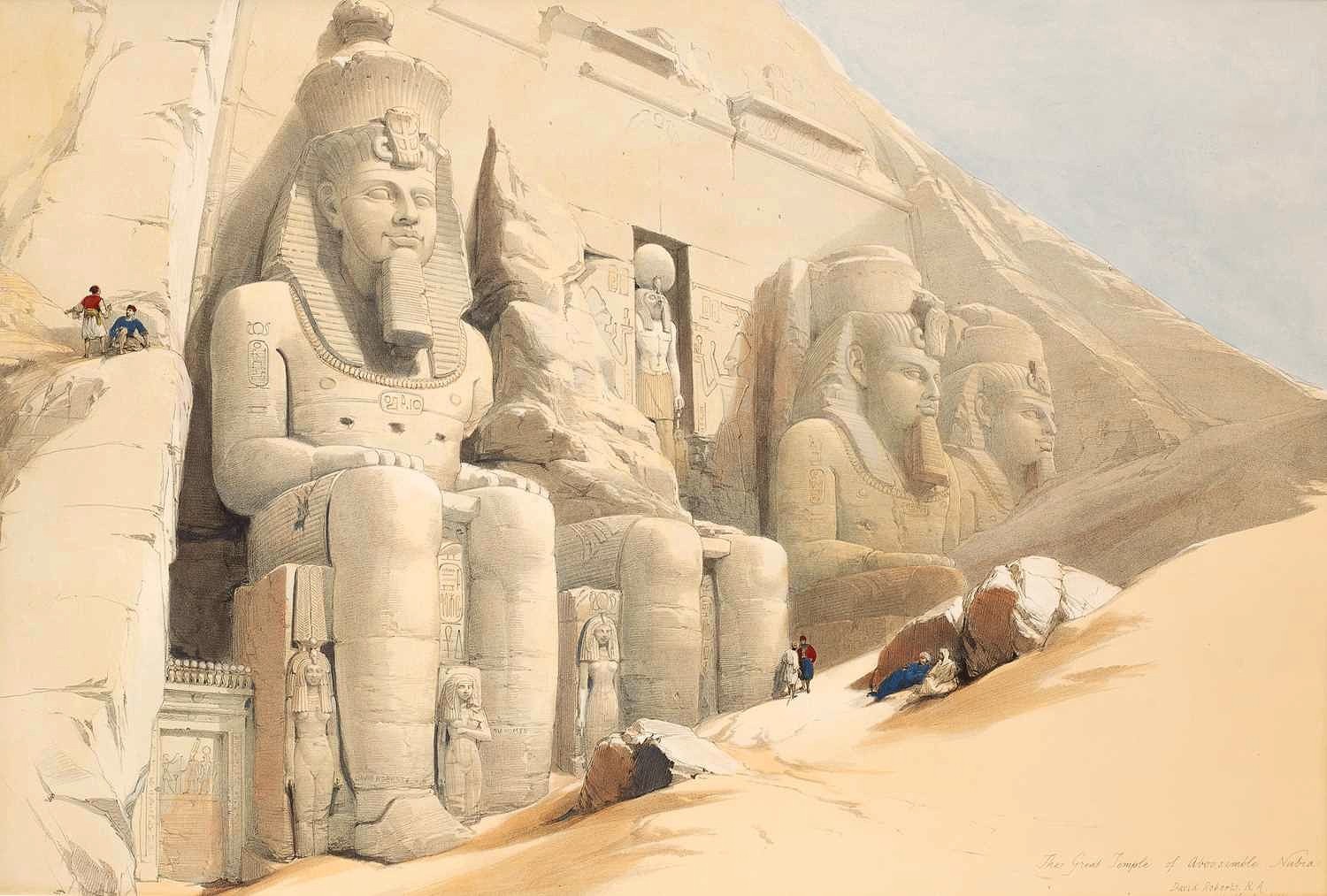
David Roberts Colossal Figures in Front of Aboo-simbel

19th century
For Sale by Darnley Fine Art
Description

First edition lithograph in stock

Full plate: 133

Presented in a acid free mount

The first discovery of this extraordinary Temple was made by the celebrated Jacob Burckhardt on his return from Mahass, after an ineffectual attempt to reach Dongola in the spring of 1813. He had visited the Temple of Isis, the lesser Temple of Aboo-Simbel; and having, as he supposed, seen all the antiquities here, he was about to ascend the sandy side of the mountain by the same path that he had descended, when “having,” he says, “luckily turned more to the southward, I fell in with what is still visible of four immense colossal statues, cut out of the rock, at a distance of about two hundred yards from the lesser Temple'

In 1816 Giovanni Belzoni ascended the Nile into Nubia, with the intention of opening the great Temple of Aboo-Simbel, and commenced his undertaking; but the chiefs of the country threw so many obstacles in his way, that at length his funds failed, and he was obliged to discontinue, but not until he had cleared downwards twenty feet in the front of the Temple. It is remarkable that this is the first time the natives learnt the use of money as a recompense for labour.

In the spring of 1817 he returned to his  excavations at Aboo-Simbel, accompanied by Mr. Beechy. At Philæ they had the good fortune to be joined by Captains Irby and Mangles, then on their journey in the East. The united exertions of these gentlemen accomplished the entrance to the Great Temple in defiance of the dangers and difficulties thrown in their way, and which are most interestingly narrated in Irby and Mangles’ Travels. Belzoni and his friends removed forty feet of sand, which had accumulated above the top of the door before the recent excavations;  but they carried them no farther  than three feet below the top of the entrance,  when they effected their passage into this Temple, and saw the most extraordinary work that remains to us of the age of Rameses II.

Belzoni describes its facade as one hundred and seventeen feet wide and eighty-six feet high (Wilkinson says, ninety to one hundred feet), the height from the top of the cornice to the top of the door being sixty-six feet six inches, and the height of the door twenty feet. Each of these enormous statues – the largest in Egypt or Nubia, except the Sphinx of the Pyramids – measures from the shoulder to the elbow fifteen feet six inches,  the face seven feet, the ears three feet six inches, across the shoulders twenty-five feet four inches. Their height as they sit is about fifty-one feet, not including the caps, which are about fourteen feet. These, the most beautiful colossi yet found in any of the Egyptian ruins, represent Rameses II.; they are seated on thrones attached to the rock.

On the sides, and on the front angles of the thrones, and between the legs of the statues, are sculptured female figures, supposed to be of his wife and children; they are well preserved, though the material is a coarse, friable gritstone. During the execution, defects in the stone were filled and smoothed with stucco, and afterwards painted, of which traces yet remain. The upper part of the second figure has fallen, but the faces of these colossi exhibit a beauty of expression the more striking as it is unlooked for in statues of such dimensions.

Roberts, in his Journal, complains indignantly of the way in which “Cockney tourists and Yankee travellers” have knocked off a toe or a finger of these magnificent statues. “The hand,” he says, “of the finest of them has been destroyed (not an easy matter, since Wilkinson says the forefinger is three feet long) by these contemptible relic-hunters, who have also been led by their vanity to smear their vulgar names on the very foreheads of the Egyptian deities.”

Declaration

Darnley Fine Art has dated this David Roberts Abu Simbel Print to the Victorian era.

Reference Numbers
Sellingantiques Reference
SA1226544
Description
First edition lithograph in stock

Full plate: 133

Presented in a acid free mount

The first discovery of this extraordinary Temple was made by the celebrated Jacob Burckhardt on his return from Mahass, after an ineffectual attempt to reach Dongola in the spring of 1813.
Darnley Fine Art

He had visited the Temple of Isis, the lesser Temple of Aboo-Simbel; and having, as he supposed, seen all the antiquities here, he was about to ascend the sandy side of the mountain by the same path that he had descended, when “having,” he says, “luckily turned more to the southward, I fell in with what is still visible of four immense colossal statues, cut out of the rock, at a distance of about two hundred yards from the lesser Temple'

In 1816 Giovanni Belzoni ascended the Nile into Nubia, with the intention of opening the great Temple of Aboo-Simbel, and commenced his undertaking; but the chiefs of the country threw so many obstacles in his way, that at length his funds failed, and he was obliged to discontinue, but not until he had cleared downwards twenty feet in the front of the Temple. It is remarkable that this is the first time the natives learnt the use of money as a recompense for labour.

In the spring of 1817 he returned to his  excavations at Aboo-Simbel, accompanied by Mr. Beechy. At Philæ they had the good fortune to be joined by Captains Irby and Mangles, then on their journey in the East. The united exertions of these gentlemen accomplished the entrance to the Great Temple in defiance of the dangers and difficulties thrown in their way, and which are most interestingly narrated in Irby and Mangles’ Travels. Belzoni and his friends removed forty feet of sand, which had accumulated above the top of the door before the recent excavations;  but they carried them no farther  than three feet below the top of the entrance,  when they effected their passage into this Temple, and saw the most extraordinary work that remains to us of the age of Rameses II.

Belzoni describes its facade as one hundred and seventeen feet wide and eighty-six feet high (Wilkinson says, ninety to one hundred feet), the height from the top of the cornice to the top of the door being sixty-six feet six inches, and the height of the door twenty feet. Each of these enormous statues – the largest in Egypt or Nubia, except the Sphinx of the Pyramids – measures from the shoulder to the elbow fifteen feet six inches,  the face seven feet, the ears three feet six inches, across the shoulders twenty-five feet four inches. Their height as they sit is about fifty-one feet, not including the caps, which are about fourteen feet. These, the most beautiful colossi yet found in any of the Egyptian ruins, represent Rameses II.; they are seated on thrones attached to the rock.

On the sides, and on the front angles of the thrones, and between the legs of the statues, are sculptured female figures, supposed to be of his wife and children; they are well preserved, though the material is a coarse, friable gritstone. During the execution, defects in the stone were filled and smoothed with stucco, and afterwards painted, of which traces yet remain. The upper part of the second figure has fallen, but the faces of these colossi exhibit a beauty of expression the more striking as it is unlooked for in statues of such dimensions.

Roberts, in his Journal, complains indignantly of the way in which “Cockney tourists and Yankee travellers” have knocked off a toe or a finger of these magnificent statues. “The hand,” he says, “of the finest of them has been destroyed (not an easy matter, since Wilkinson says the forefinger is three feet long) by these contemptible relic-hunters, who have also been led by their vanity to smear their vulgar names on the very foreheads of the Egyptian deities.”

Date of Manufacture

Darnley Fine Art has dated this David Roberts Abu Simbel Print to the Victorian era.

Reference Numbers
Sellingantiques Ref
SA1226544
Darnley Fine Art
Sellingantiques verified Since Jul 2026
Dealer Profile

You can view the stock and full dealer information on the Darnley Fine Art Profile Page
PDF SHARE
SAVE
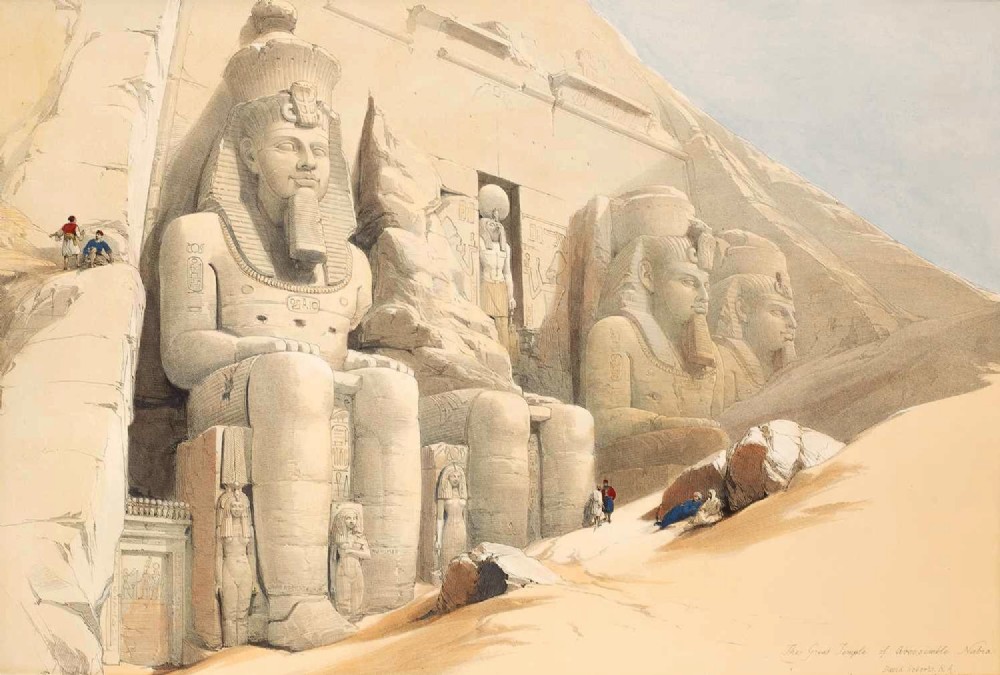
A 19th-century lithograph illustrating the monumental rock-cut temple statues of Ramesses II at Abu Simbel surrounded by sand dunes and figures.
1 / 1
Archive I A 19th-century lithograph illustrating the monumental rock-cut temple statues of Ramesses II at Abu Simbel surrounded by sand dunes and figures.

David Roberts Colossal Figures in Front of Aboo-simbel

Enlarged Archival View
Telephone 0207 379 0499
Location
2-4 Cecil Court
London
WC2N 4HE
United Kingdom

Opening Times
Monday to Saturday: 10:30 - 5:30
(excluding Bank Holidays)
Dealer Profile Page sellingantiques.co.uk/dfa
Verified Since Jul 2026
Items For Sale 76
Darnley Fine Art
Verified Since Jul 2026
View Dealer Info
Location: 2-4 Cecil Court, London, WC2N 4HE, United Kingdom, , Opening Times, Monday to Saturday: 10:30 - 5:30, (excluding Bank Holidays)
Verified
Jul 2026
For Sale
76
A 19th-century lithograph illustrating the monumental rock-cut temple statues of Ramesses II at Abu Simbel surrounded by sand dunes and figures.
David Roberts Colossal Figures in Front of Aboo-Simbel
Ref: SA1226544
A 19th-century lithograph illustrating the monumental rock-cut temple statues of Ramesses II at Abu Simbel surrounded by sand dunes and figures.
Archival Detail
Every single antique dealer on our platform is individually approved by our internal team. We verify their professional trade history, ethical standards, and photographic quality to ensure a secure, high-standard buying environment. Upon joining, every dealer agrees to a strict 9-point code of conduct. While issues can occasionally arise, our dealers typically resolve them swiftly and directly with the buyer. In fact, since our founding in 2002, Sellingantiques has only had to step in to help resolve an issue on roughly five occasions—a true testament to the quality of our dealers and their dedication to your happiness.
Our dealers are highly experienced in packing and shipping fragile, high-value antiques. Because you are in direct contact with the dealer, you will be able to easily go through all available shipping and insurance options together to ensure your item arrives safely.
Antiques are the ultimate green purchase. By choosing historical pieces over newly manufactured goods, you completely eliminate the carbon footprint of modern mass production while preserving exceptional, timeless craftsmanship.

Popularised in the 19th century, Orientalist topographical printmaking involved European artists travelling to the Middle East and North Africa to document ancient monuments, landscapes, and architecture for publication in detailed lithographic folios.

These prints were produced using stone lithography, often hand-tinted or printed using multiple tinted stones by master lithographers such as Louis Haghe onto heavy rag paper.

Authentic folio impressions feature crisp stone-lithograph lines, publisher inscriptions from F.G. Moon or Day & Son, fine paper watermarks, and evidence of original plate lines or binder trimming.

Frame the artwork in a simple dark wood or gilded frame with an acid-free mat, placing it in a study, library, or hallway alongside classical ceramics or mahogany furniture.

Mount prints behind UV-protective glass using acid-free, museum-grade matting materials, and display them away from direct sunlight, high humidity, and heat sources.
items
Add keywords to the filter
Price
£100
£250000
Era
Movements
Material
Origin
Stock Location
Freshness
Online Payments
Categories