18,688  PAGES BROWSED TODAY PAGES TODAY 70  ANTIQUES UPLOADED TODAY NEW ARRIVALS
ID #SA1226505
FOR SALE
£7,000
Email
Save
James Stroudley a Triptych: The Olympic Games
Darnley Fine Art
for sale €8,190     $8,890
£7,000

Darnley Fine Art

Sellingantiques Verified Since Jul 2026
View Dealers Stock Page
Relevant Links
Id #SA1226505
PDF SHARE
SAVE

James Stroudley a Triptych: The Olympic Games

1920 - 1940
For Sale by Darnley Fine Art
Description

Graphite on paper

Image size of rectangular works: 33 x 43 inches (84 x 109 cm)

Image size of arched central work: 38 1/4 x 29 inches (97 x 73.5 cm)

Provenance

Private Collection of Seymour Stein, Vice President of Warner Bros Records
Sotheby’s ‘Modern British and Irish Art,’ London, 19 May 2004, lot 92

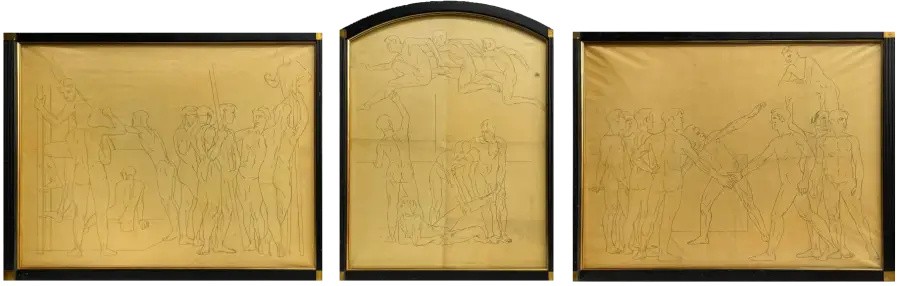
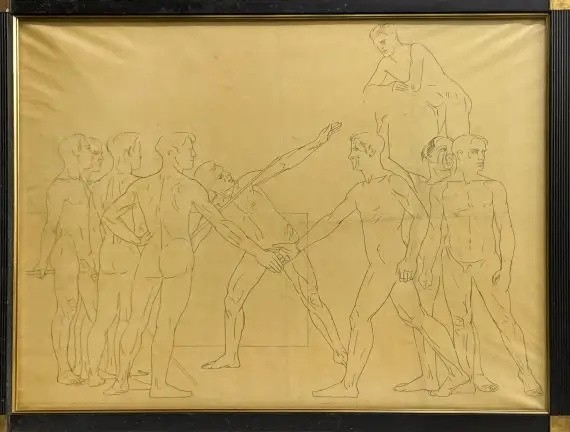
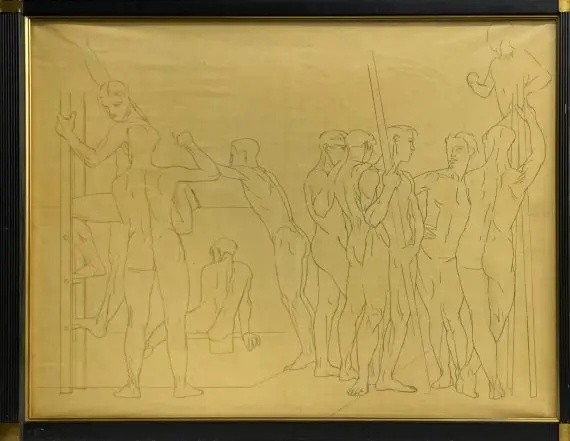
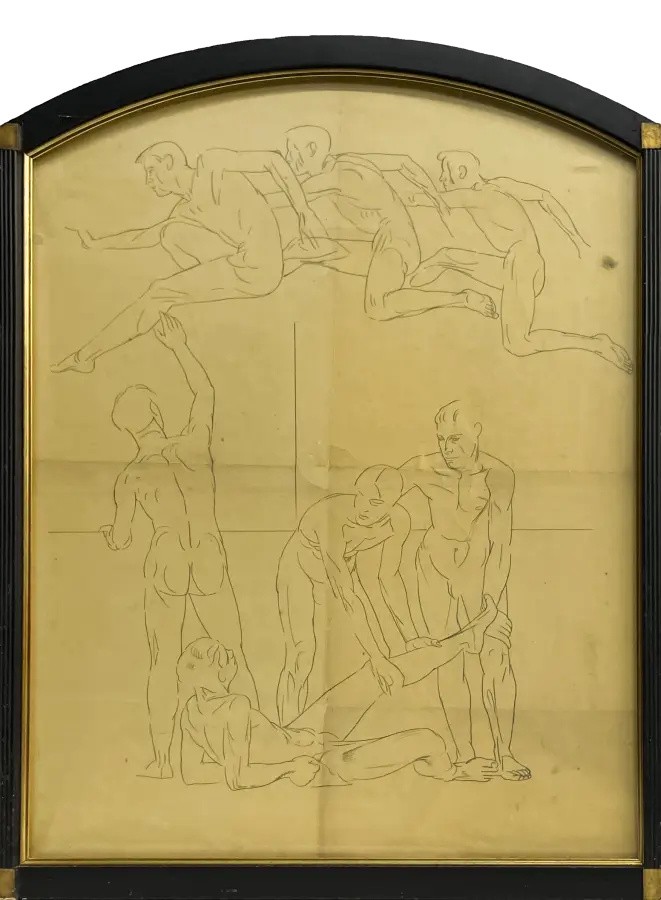
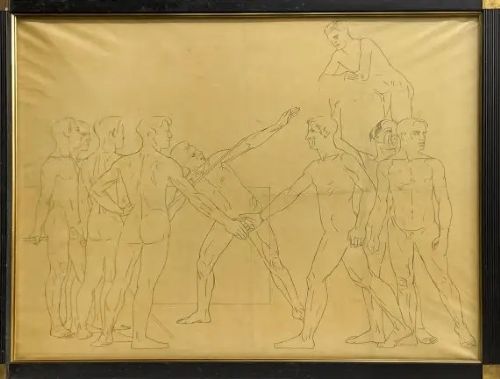
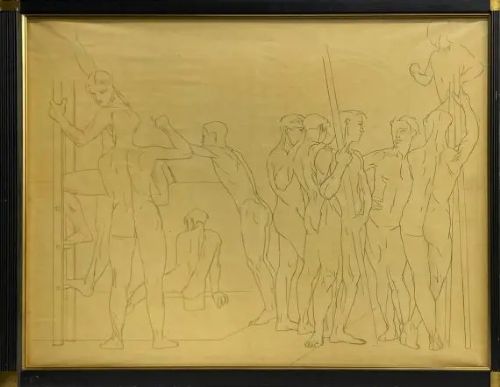
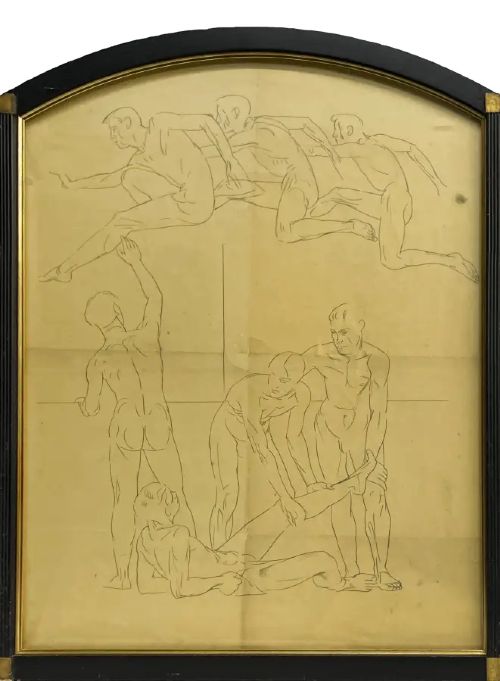
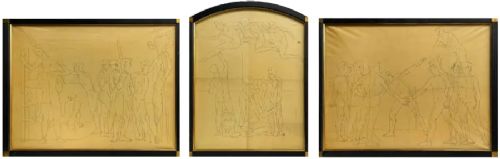
The three impressive drawings are studies for Stroudley’s ‘Olympic Games in a Demi-Lune’. From left to right the studies depict groups of athletes practising diving, a conversing crowd of oarsmen, hurdlers mid jump and a collection of javelin throwers. This study was created in 1930 when Stroudley practised in the British School in Rome.
There are few surviving works from Stroudley’s short stay in Rome, with the compositions from his Rome period being among the last wholly successful decorative cycles produced by a Rome Scholar prior to World War II. Indeed, as can be seen here, his drawings from this period are technically brilliant and even bear comparison with those of Eric Kennington. 
James Stroudley

Stroudley was born in London on 17 June 1906, the son of James Stroudley, showcard and ticket writer. He studied at Clapham School of Art (1923-27) and then at the Royal College of Art (1927-30), where his teachers included Alan Gwynne-Jones and William Rothenstein. As a recipient of the first Abbey Scholarship he was able to spend three years in Italy from 1930, where he absorbed the influences of Giotto and Piero della Francesca, and produced one of the last wholly satisfying decorative cycles by a Rome Scholar of the period. From 1934, he exhibited at the Royal Society of British Artists, and was elected to its membership in the following year.

From the Second World War – in which he worked with the Camouflage Unit – Stroudley taught at St Martin’s School of Art and was a visiting lecturer at the Royal Academy Schools. Though he continued to live in London, his later work, exhibited at the Royal Academy from 1955, indicated regular painting trips to Kent and Sussex coasts. However, much of his later work was abstract. In 1971, his former student, Peter Coker, paid homage to Stroudley by including his work in the exhibition ‘Pupil & Masters’, held at Westgate House, Long Melford, Suffolk.

Stroudley married three times, and his wives included the fashion artist to the Sun newspaper, designer and writer, Phyllis Neuland, with whom he had one son; and the painter and printmaker, Gillian Thain, with whom he had two sons and one daughter. Stroudley died in Wandsworth, London, in May 1985.

Seymour Stein

Legendary Sire Records co-founder, Seymour Stein, kick-started the era of punk and new wave music in the 1970s and ‘80s, by signing to the label such iconic artists as the Ramones, The Smiths, Talking Heads, Depeche Mode, Ice-T, and famously, in 1982, Madonna. He was inducted into the Rock and Roll Hall of Fame in 2005.

Beginning in the early 1970s, while travelling as a young businessman throughout Europe, Stein developed an enthusiasm for early 20th-century art. Wherever he went, he sought out antique stores, art fairs, and major auction houses — ultimately forging a vast collection.

The Collecting Eye of Seymour Stein, Sotheby’s 2003 auction showcased Stein’s interest in Art Deco furniture and porcelain, metalwork and glassware, European Symbolist and Pre-Raphaelite paintings. Works from the distinguished collection were also included in Sotheby’s 2018, Victorian, Pre-Raphaelite & British Impressionist Art, auction.

Seymour Stein passed on April 2nd, 2023.

Declaration

Darnley Fine Art has dated this James Stroudley Triptych Drawing to the 1930s.

Reference Numbers
Sellingantiques Reference
SA1226505
Description
Graphite on paper

Image size of rectangular works: 33 x 43 inches (84 x 109 cm)

Image size of arched central work: 38 1/4 x 29 inches (97 x 73.5 cm)

Provenance

Private Collection of Seymour Stein, Vice President of Warner Bros Records

fig 1. A three-panel triptych drawing featuring athletic figures in fine line art against a gold background, framed in black with gold corner details.
fig 1. James Stroudley a Triptych: The Olympic Games

Sotheby’s ‘Modern British and Irish Art,’ London, 19 May 2004, lot 92

The three impressive drawings are studies for Stroudley’s ‘Olympic Games in a Demi-Lune’.

From left to right the studies depict groups of athletes practising diving, a conversing crowd of oarsmen, hurdlers mid jump and a collection of javelin throwers.
Darnley Fine Art

This study was created in 1930 when Stroudley practised in the British School in Rome.

fig 2. A three-panel triptych drawing featuring athletic figures in fine line art against a gold background, framed in black with gold corner details.
fig 2. James Stroudley a Triptych: The Olympic Games

There are few surviving works from Stroudley’s short stay in Rome, with the compositions from his Rome period being among the last wholly successful decorative cycles produced by a Rome Scholar prior to World War II. Indeed, as can be seen here, his drawings from this period are technically brilliant and even bear comparison with those of Eric Kennington. 

fig 3. A three-panel triptych drawing featuring athletic figures in fine line art against a gold background, framed in black with gold corner details.
fig 3. James Stroudley a Triptych: The Olympic Games

James Stroudley

Stroudley was born in London on 17 June 1906, the son of James Stroudley, showcard and ticket writer. He studied at Clapham School of Art (1923-27) and then at the Royal College of Art (1927-30), where his teachers included Alan Gwynne-Jones and William Rothenstein. As a recipient of the first Abbey Scholarship he was able to spend three years in Italy from 1930, where he absorbed the influences of Giotto and Piero della Francesca, and produced one of the last wholly satisfying decorative cycles by a Rome Scholar of the period. From 1934, he exhibited at the Royal Society of British Artists, and was elected to its membership in the following year.

From the Second World War – in which he worked with the Camouflage Unit – Stroudley taught at St Martin’s School of Art and was a visiting lecturer at the Royal Academy Schools. Though he continued to live in London, his later work, exhibited at the Royal Academy from 1955, indicated regular painting trips to Kent and Sussex coasts. However, much of his later work was abstract. In 1971, his former student, Peter Coker, paid homage to Stroudley by including his work in the exhibition ‘Pupil & Masters’, held at Westgate House, Long Melford, Suffolk.

Stroudley married three times, and his wives included the fashion artist to the Sun newspaper, designer and writer, Phyllis Neuland, with whom he had one son; and the painter and printmaker, Gillian Thain, with whom he had two sons and one daughter. Stroudley died in Wandsworth, London, in May 1985.

Seymour Stein

Legendary Sire Records co-founder, Seymour Stein, kick-started the era of punk and new wave music in the 1970s and ‘80s, by signing to the label such iconic artists as the Ramones, The Smiths, Talking Heads, Depeche Mode, Ice-T, and famously, in 1982, Madonna. He was inducted into the Rock and Roll Hall of Fame in 2005.

Beginning in the early 1970s, while travelling as a young businessman throughout Europe, Stein developed an enthusiasm for early 20th-century art. Wherever he went, he sought out antique stores, art fairs, and major auction houses — ultimately forging a vast collection.

The Collecting Eye of Seymour Stein, Sotheby’s 2003 auction showcased Stein’s interest in Art Deco furniture and porcelain, metalwork and glassware, European Symbolist and Pre-Raphaelite paintings. Works from the distinguished collection were also included in Sotheby’s 2018, Victorian, Pre-Raphaelite & British Impressionist Art, auction.

Seymour Stein passed on April 2nd, 2023.

Date of Manufacture

Darnley Fine Art has dated this James Stroudley Triptych Drawing to the 1930s.

Reference Numbers
Sellingantiques Ref
SA1226505
Darnley Fine Art
Sellingantiques verified Since Jul 2026
Dealer Profile

You can view the stock and full dealer information on the Darnley Fine Art Profile Page
Relevant Links
PDF SHARE
SAVE
A three-panel triptych drawing featuring athletic figures in fine line art against a gold background, framed in black with gold corner details.
1 / 4
Archive I A three-panel triptych drawing featuring athletic figures in fine line art against a gold background, framed in black with gold corner details.

James Stroudley A Triptych: The Olympic Games

Archive II A three-panel triptych drawing featuring athletic figures in fine line art against a gold background, framed in black with gold corner details. View II
Archive III A three-panel triptych drawing featuring athletic figures in fine line art against a gold background, framed in black with gold corner details. View III
Archive IV A three-panel triptych drawing featuring athletic figures in fine line art against a gold background, framed in black with gold corner details. View IV
Enlarged Archival View
Telephone 0207 379 0499
Location
2-4 Cecil Court
London
WC2N 4HE
United Kingdom

Opening Times
Monday to Saturday: 10:30 - 5:30
(excluding Bank Holidays)
Dealer Profile Page sellingantiques.co.uk/dfa
Verified Since Jul 2026
Items For Sale 76
Darnley Fine Art
Verified Since Jul 2026
View Dealer Info
Location: 2-4 Cecil Court, London, WC2N 4HE, United Kingdom, , Opening Times, Monday to Saturday: 10:30 - 5:30, (excluding Bank Holidays)
Verified
Jul 2026
For Sale
76
A three-panel triptych drawing featuring athletic figures in fine line art against a gold background, framed in black with gold corner details.
James Stroudley A Triptych: The Olympic Games
Ref: SA1226505
A three-panel triptych drawing featuring athletic figures in fine line art against a gold background, framed in black with gold corner details.
Detail View 1
Detail View 2
Detail View 3
Archival Detail
Every single antique dealer on our platform is individually approved by our internal team. We verify their professional trade history, ethical standards, and photographic quality to ensure a secure, high-standard buying environment. Upon joining, every dealer agrees to a strict 9-point code of conduct. While issues can occasionally arise, our dealers typically resolve them swiftly and directly with the buyer. In fact, since our founding in 2002, Sellingantiques has only had to step in to help resolve an issue on roughly five occasions—a true testament to the quality of our dealers and their dedication to your happiness.
Our dealers are highly experienced in packing and shipping fragile, high-value antiques. Because you are in direct contact with the dealer, you will be able to easily go through all available shipping and insurance options together to ensure your item arrives safely.
Antiques are the ultimate green purchase. By choosing historical pieces over newly manufactured goods, you completely eliminate the carbon footprint of modern mass production while preserving exceptional, timeless craftsmanship.

A triptych is an artwork composed of three distinct panels meant to be displayed together. Historically used for religious altarpieces, 20th-century artists adapted the three-part format to explore narrative sequence, movement, and figurative variation across multiple panels.

Mid-century artists frequently utilised graphite, ink, or gouache on heavy paper or card stock, sometimes incorporating metallic leaf accents. Frames were typically constructed from carved or painted hardwood, occasionally finished with brass edge mounts for protection and emphasis.

Authentic pieces from this period often display signatures, dates, or gallery labels on the lower corners or rear backing board. Inspecting paper age, natural surface patination, linear draftsmanship styles typical of post-war art schools, and period framing hardware helps verify authenticity.

A multi-panel triptych creates a natural focal point when hung centrally over architectural features like a fireplace mantel or long credenza. Allow balanced spacing between each paneltypically two to three inchesto maintain fluid continuity across the entire composition.

Keep works on paper away from direct sunlight and high humidity to prevent discolouration and foxing. Frame under UV-filtering protective glass with acid-free matting to ensure the paper and medium remain preserved over time.
items
Add keywords to the filter
Price
£100
£250000
Era
Movements
Material
Origin
Stock Location
Freshness
Online Payments
Categories