42,352  PAGES BROWSED TODAY PAGES TODAY 179  ANTIQUES UPLOADED TODAY NEW ARRIVALS
ID #SA1226322
FOR SALE
£2,000
Email
Save
Beatrice Saunders Printed Fabrics
Darnley Fine Art
for sale €2,340     $2,540
£2,000

Darnley Fine Art

Sellingantiques Verified Since Jul 2026
View Dealers Stock Page
Id #SA1226322
PDF SHARE
SAVE

Beatrice Saunders Printed Fabrics

1920 - 1940
For Sale by Darnley Fine Art
Description

Watercolour on paper

Image size: 15 ¼ x 19 inches (38.5 x 48.3 cm)

Modern frame

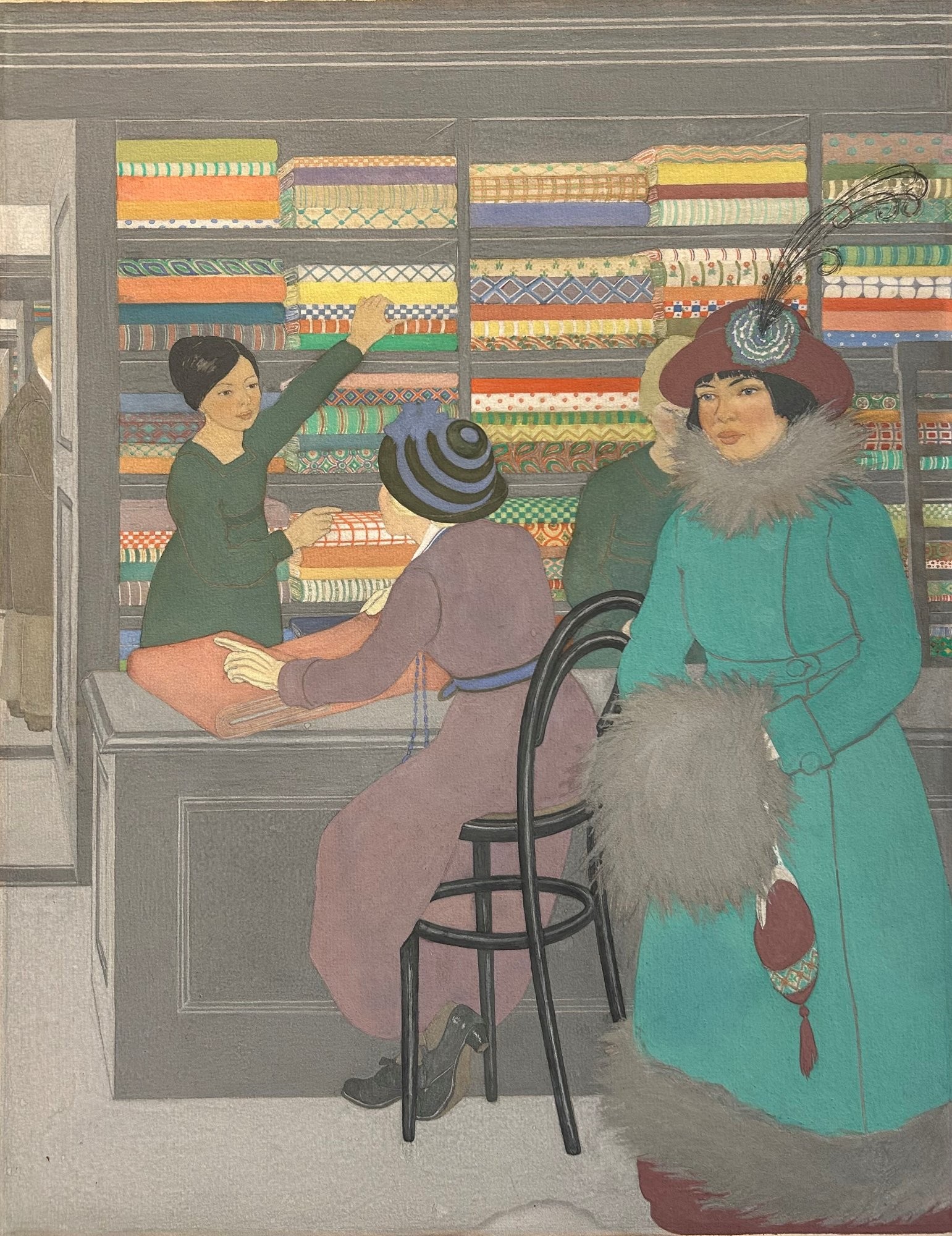
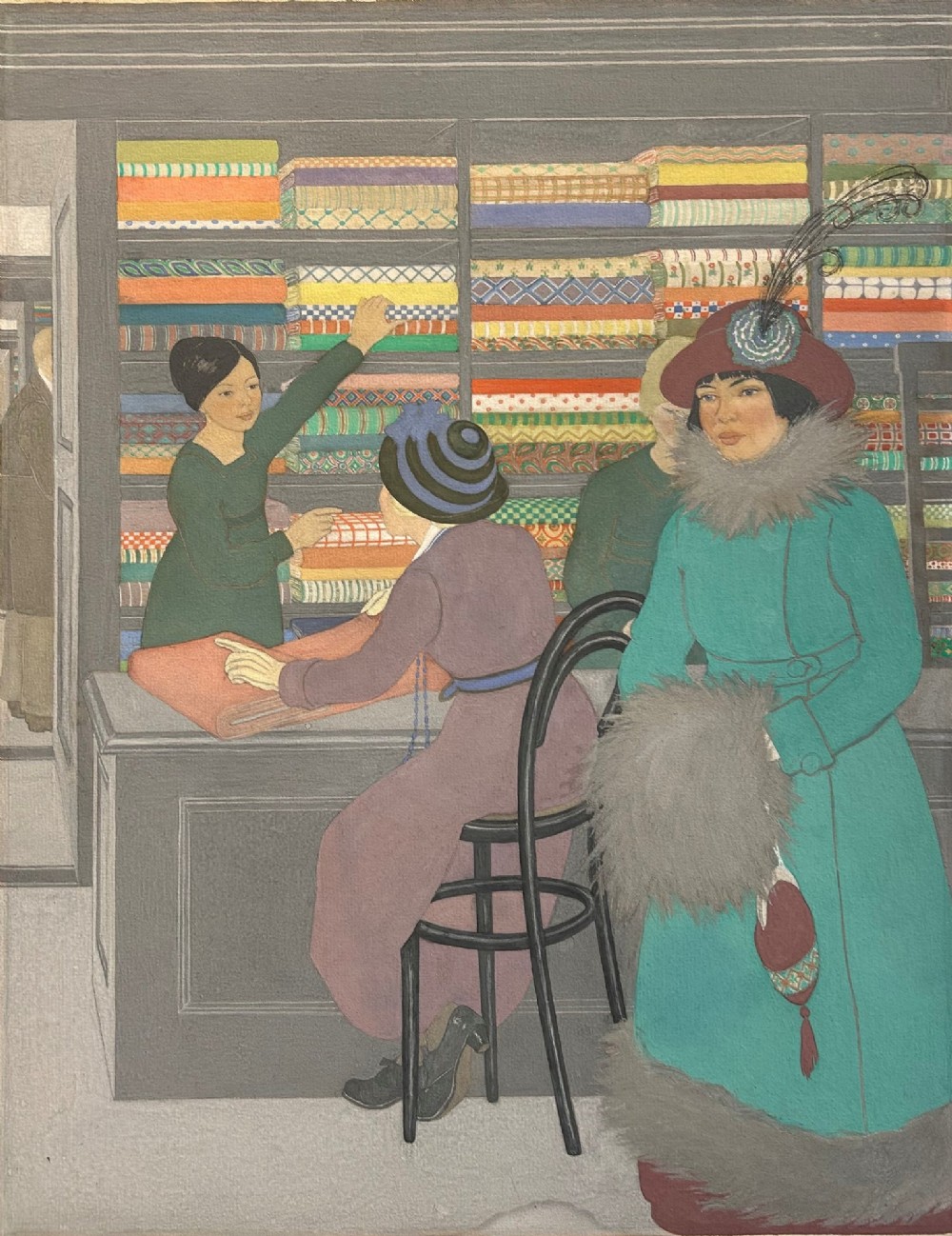
Saunders’ painting depicts the inside of a fabric shop, with two shop assistants behind the desk, one assisting a customer, and a well dressed woman who appears to be on her way out. Saunders uses a flat, print-like style to emphasise the bright and boldly patterned fabrics lining the wall of the shop. The brightness of the fabrics are further contrasted by the more muted colours used for the workbench, the shop assistants’ uniforms and the dress of the seated customer. Only the eye-catching turquoise fur-lined coat of the lady leaving the shop rivals the fabrics in boldness. 

Fabric shops were the realm of women, emphasised here by the only male present in the painting being the anonymous back of a man visible beyond the open door on the left of the composition. ‘Ready-to-wear’ clothing was only just becoming more mainstream so many women continued to create their own garments or repair, update and adjust clothing they already owned to keep up with the latest fashion trends. Saunders shows the process of going to a fabric shop to pick out new material which was part of almost every woman’s routine at this time. Sewing was also considered ‘feminine’ labour and seamstress was one of the few jobs considered acceptable for a woman, in the same way that watercolour was seen as a suitable artistic medium for women. Saunders conforms to societal expectations of a woman artist in her choice of medium and subject, however, she also takes ownership by having the only male figure excluded and relegated to the background.

Beatrice H Saunders 

Little is known about Beatrice H Saunders other than that her career flourished between 1918 and 1940 and that she exhibited at the Royal Academy in 1939 with a work entitled Passengers which hung in the South Rooms. This reflects how, despite the growing number of women artists being able to establish themselves professionally and gain recognition, many still faced significant challenges and continued to be overlooked. Being active as an artist in the interwar years meant that Saunders would have had to navigate a shifting cultural landscape and societal change-  women were given the right to vote, could enter professions like law and civil service and more and more young, working-class women experienced financial independence. However, these changes were met with opposition, with women encouraged to return to their domestic roles after working in factories during the war. Perhaps these tensions are reflected in how little we know about Saunders. Was she just establishing herself as an artist by the end of the 1930s but sacrificed this to perform a more domestic role? Were her choices of subject matter, medium and style not considered revolutionary enough to earn her a place alongside the likes of Winifred Knight and Edith Rimmington in the Art History books? Though we may never know the details of her life, the beauty and skill of Saunders’ work can still very much be appreciated. 

Physical Dimensions
Height
48.3cm (19.02")
Width
38.5cm (15.16")
Declaration

Darnley Fine Art has dated this Vintage Fabric Shop Artwork to the 1930s.

Reference Numbers
Sellingantiques Reference
SA1226322
Description
Watercolour on paper

Image size: 15 ¼ x 19 inches (38.5 x 48.3 cm)

Modern frame

Saunders’ painting depicts the inside of a fabric shop, with two shop assistants behind the desk, one assisting a customer, and a well dressed woman who appears to be on her way out.
Darnley Fine Art

Saunders uses a flat, print-like style to emphasise the bright and boldly patterned fabrics lining the wall of the shop. The brightness of the fabrics are further contrasted by the more muted colours used for the workbench, the shop assistants’ uniforms and the dress of the seated customer. Only the eye-catching turquoise fur-lined coat of the lady leaving the shop rivals the fabrics in boldness. 

Fabric shops were the realm of women, emphasised here by the only male present in the painting being the anonymous back of a man visible beyond the open door on the left of the composition. ‘Ready-to-wear’ clothing was only just becoming more mainstream so many women continued to create their own garments or repair, update and adjust clothing they already owned to keep up with the latest fashion trends. Saunders shows the process of going to a fabric shop to pick out new material which was part of almost every woman’s routine at this time. Sewing was also considered ‘feminine’ labour and seamstress was one of the few jobs considered acceptable for a woman, in the same way that watercolour was seen as a suitable artistic medium for women. Saunders conforms to societal expectations of a woman artist in her choice of medium and subject, however, she also takes ownership by having the only male figure excluded and relegated to the background.

Beatrice H Saunders 

Little is known about Beatrice H Saunders other than that her career flourished between 1918 and 1940 and that she exhibited at the Royal Academy in 1939 with a work entitled Passengers which hung in the South Rooms. This reflects how, despite the growing number of women artists being able to establish themselves professionally and gain recognition, many still faced significant challenges and continued to be overlooked. Being active as an artist in the interwar years meant that Saunders would have had to navigate a shifting cultural landscape and societal change-  women were given the right to vote, could enter professions like law and civil service and more and more young, working-class women experienced financial independence. However, these changes were met with opposition, with women encouraged to return to their domestic roles after working in factories during the war. Perhaps these tensions are reflected in how little we know about Saunders. Was she just establishing herself as an artist by the end of the 1930s but sacrificed this to perform a more domestic role? Were her choices of subject matter, medium and style not considered revolutionary enough to earn her a place alongside the likes of Winifred Knight and Edith Rimmington in the Art History books? Though we may never know the details of her life, the beauty and skill of Saunders’ work can still very much be appreciated. 

Height
48.3cm (19.02")
Width
38.5cm (15.16")
Date of Manufacture

Darnley Fine Art has dated this Vintage Fabric Shop Artwork to the 1930s.

Reference Numbers
Sellingantiques Ref
SA1226322
Darnley Fine Art
Sellingantiques verified Since Jul 2026
Dealer Profile

You can view the stock and full dealer information on the Darnley Fine Art Profile Page
PDF SHARE
SAVE
An illustration depicting women browsing rolls of patterned textiles inside a traditional fabric shop interior.
1 / 1
Archive I An illustration depicting women browsing rolls of patterned textiles inside a traditional fabric shop interior.

Beatrice Saunders Printed Fabrics

Enlarged Archival View
Telephone 0207 379 0499
Location
2-4 Cecil Court
London
WC2N 4HE
United Kingdom

Opening Times
Monday to Saturday: 10:30 - 5:30
(excluding Bank Holidays)
Dealer Profile Page sellingantiques.co.uk/dfa
Verified Since Jul 2026
Items For Sale 76
Darnley Fine Art
Verified Since Jul 2026
View Dealer Info
Location: 2-4 Cecil Court, London, WC2N 4HE, United Kingdom, , Opening Times, Monday to Saturday: 10:30 - 5:30, (excluding Bank Holidays)
Verified
Jul 2026
For Sale
76
An illustration depicting women browsing rolls of patterned textiles inside a traditional fabric shop interior.
Beatrice Saunders Printed Fabrics
Ref: SA1226322
An illustration depicting women browsing rolls of patterned textiles inside a traditional fabric shop interior.
Archival Detail
Every single antique dealer on our platform is individually approved by our internal team. We verify their professional trade history, ethical standards, and photographic quality to ensure a secure, high-standard buying environment. Upon joining, every dealer agrees to a strict 9-point code of conduct. While issues can occasionally arise, our dealers typically resolve them swiftly and directly with the buyer. In fact, since our founding in 2002, Sellingantiques has only had to step in to help resolve an issue on roughly five occasions—a true testament to the quality of our dealers and their dedication to your happiness.
Our dealers are highly experienced in packing and shipping fragile, high-value antiques. Because you are in direct contact with the dealer, you will be able to easily go through all available shipping and insurance options together to ensure your item arrives safely.
Antiques are the ultimate green purchase. By choosing historical pieces over newly manufactured goods, you completely eliminate the carbon footprint of modern mass production while preserving exceptional, timeless craftsmanship.

Early twentieth-century commercial illustration art often combines graphic block printing techniques with figurative representation, capturing modern interior settings, fashion, and commerce of the period.

Artwork from this era was typically executed on high-grade woven paper using gouache, watercolour, or lithographic printing techniques before being mounted in timber frames.

Authentic period prints display characteristic paper aging, subtle plate marks or stone lithography traits, precise period clothing details, and original artist signatures or press marks.

Display figurative prints in neutral-toned frames to highlight the subject matter, positioning them above consoles, sideboards, or within gallery wall arrangements alongside complementary architectural studies.

Mount paper artwork using acid-free matting under UV-protective glass, maintaining a stable ambient humidity and keeping the piece away from direct sunlight to avoid pigment fading.
items
Add keywords to the filter
Price
£100
£250000
Era
Movements
Material
Origin
Stock Location
Freshness
Online Payments
Categories