32,089  PAGES BROWSED TODAY PAGES TODAY • 120 ANTIQUES UPLOADED TODAYNEW ARRIVALS
GIFTS
120 ITEMS ADDED TODAY
Sort Order
Items Per Page
Antiques dealer?
Join as a Seller
Browse Categories
Sort order
Relevant Links
Items per page
sold SA1167525
Sorry, but this item has been sold.
W.R. Harvey & Co. (Antiques) Ltd

W.R. Harvey & Co. (Antiques) Ltd

Sellingantiques Verified Since Sep 2016
Browse dealers 122 items
  • About Us
    Specialists in 17th-18th and early 19th century fine english furniture, art, clocks and other objets d'art
  • Trade Associations
    W.R. Harvey & Co. (Antiques) Ltd is a registered member of LAPADA 
Id #SA1167525
SHARE
SAVE

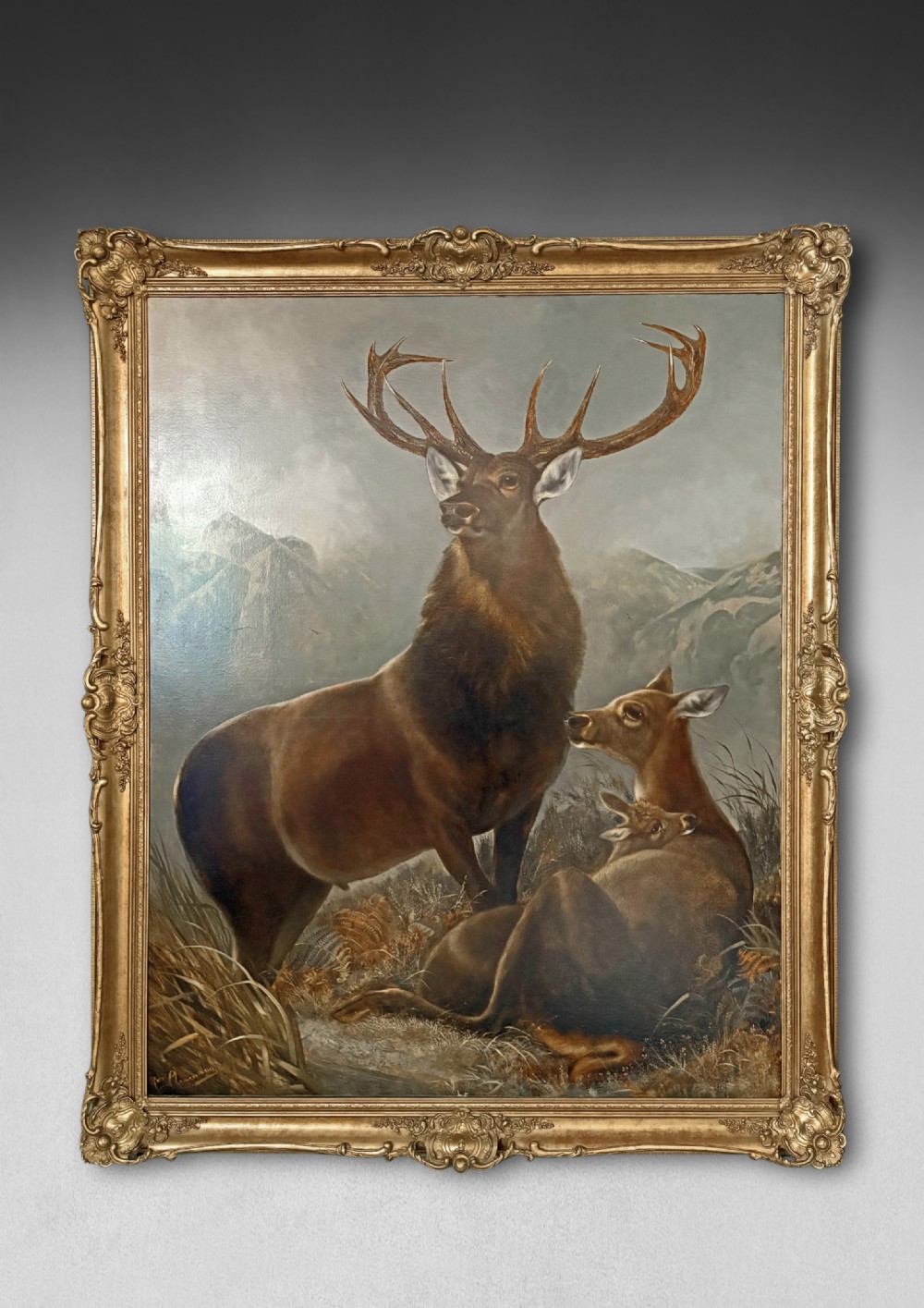
Oil on Canvas Painting by Robert Cleminson, Royal Stag, Hind and Fawn in a Highland Landscape

19th century
Sold 11 March 2026 · W.R. Harvey & Co. (Antiques) Ltd
This “Oil on Canvas Painting by Robert Cleminson, Royal Stag, Hind and Fawn in a Highland Landscape” found a buyer.

It was listed by W.R. Harvey & Co. (Antiques) Ltd. Sold pieces stay on Sellingantiques as a record of what has passed through, and the next one is rarely far away.

Description

No: 11184

Royal Stag, Hind and Fawn in a Highland landscape

A stunning original oil on canvas painting signed by Robert Cleminson, in its original carved, gilt frame. Robert Cleminson was a painter in oils of landscapes, Highland game and sporting dog pictures and it his animal and dog paintings for which he is best known. He was a follower of Sir Edwin Landseer (1802-1873) and this painting of a Royal stag, hind and fawn is derivative of Landseer’s original Monarch of the Glen oil painting. Landseer was Queen Victoria’s most admired artist.

Cleminson was such a good artist that one can almost feel the heat emanating from the Stag’s nostrils. His attention to detail is superb and if one looks carefully he has included details such as the birds on the wing and the snow caps on the mountains. His treatment of both the grass and heather to give the picture that slightly purple Highland feel is apparent.

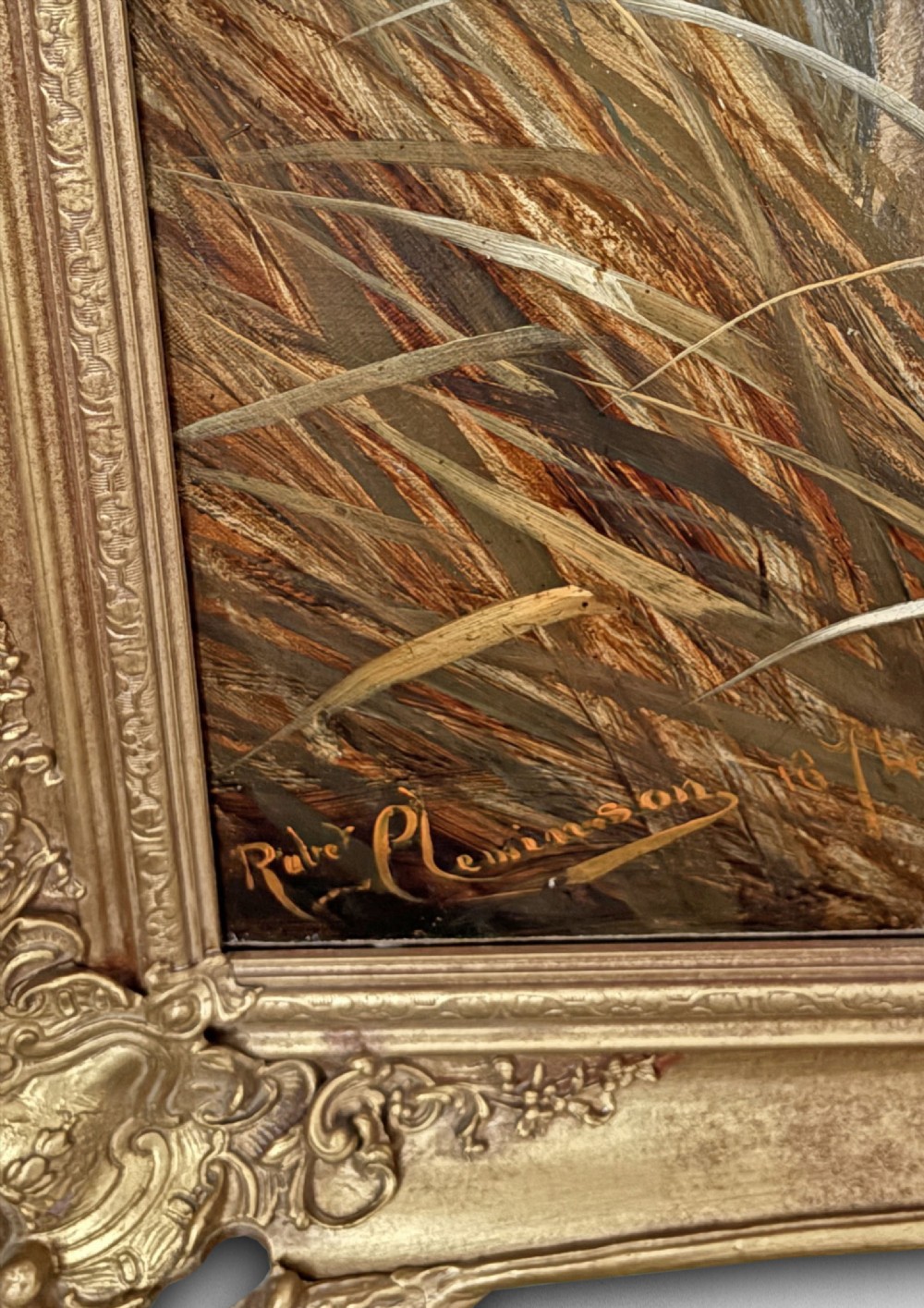
Dated 1871 and signed lower left corner

Price :£ 5,000

Inc Frame: Height: 56 ¼”, (143cm), Width: 46 ½”, (118 cm), Depth: 2 ¾”, (7cm).

Note: Taken from the National Gallery write up on Landseer’s Monarch of the Glen:

“Landseer’s greatest enjoyment was to wander in the lonely glens, or climb to the steep mountain-top, in search of that nature, animate or inanimate, with which his heart was in accord and there it was that he derived the inspiration which prompted the greater part of his noblest production.” (Obituary from The Report of the Council of the Royal Scottish Academy of Painting, Sculpture and Architecture, 1873)

No British painting of the 19th century is as immediately recognisable as ‘The Monarch of the Glen’. It has so often been reproduced that it is part of our shared visual memory; however, this means that it can be hard to look at it with fresh eyes. Today Landseer is not a household name; however, he was one of Victorian Britain’s most renowned artists. He was Queen Victoria’s favourite artist (she bought dozens of paintings from him) and prints of his works could be found on walls of homes across the globe. During the 20th century, when some aspects of Victorian culture were dismissed as old-fashioned,’ The Monarch of the Glen’ intriguingly survived this shift in taste, assuming a new purpose as an extremely popular marketing image. Today, the story of how it was originally created is long forgotten.

It was the great fire of 1834 that destroyed the Palace of Westminster which resulted in Landseer receiving the commission for his most famous painting. Plans to rebuild included the establishment of a ‘Fine Arts Commission’ – which included Sir Charles Eastlake, who would go on to become the National Gallery’s first Director in 1843 – to commission works of art to decorate the new building. One of these was ‘The Monarch of the Glen’. The painting of a life-size stag was first exhibited at the Royal Academy in 1851, which was then housed in the National Gallery building.

Christopher Baker, Director of European and Scottish Art and Portraiture at National Galleries of Scotland, says in his book , “Landseer’s life and career encompassed soaring talent, public adulation, and private tragedy. The drama, sentimentality, and often sophisticated exploration of the complex interaction between people and animals found in his works struck a chord with millions. What distinguishes The Monarch of the Glen from other works by the artist is its euphoric, triumphal quality; it shows an animal in command of its environment, not – as yet – at the mercy of pursuers.”

Landseer’s connection to the tradition of Old Master painting, demonstrates his strong interest in another great animal painter’s study of anatomy – George Stubbs, Landseer owned Stubbs’s collection of anatomical drawings of the horse and imitated his study of animal anatomy.

Landseer’s The Monarch of the Glen also highlights the artis

Date of Manufacture

W.R. Harvey & Co. (Antiques) Ltd has dated this Robert Cleminson Oil Painting to the 1870s.

Physical Dimensions
Height
143cm (56.30")
Width
118cm (46.46")
Depth
7cm (2.76")
Reference Numbers
Sellingantiques Reference
SA1167525
Dealers Internal Reference
11184
Dealers Notes

We offer free delivery within the UK. For deliveries Worldwide, please contact us for a quote and we will get back to you within 12 hours.

If you would like to view the item in person, our showrooms are open Monday to Saturday 9.30 - 5.30 and by appointment on Sunday.

Any questions, please contact us as soon as possible. We will endeavour to get you an answer within 24 hours - and hopefully much quicker!

An oil painting on canvas by Robert Cleminson depicting a stag, hind and fawn in a Highland landscape, set within an ornate gilded frame.Detail view 1
SOLD6+ MONTHS AGO
1 / 2
1870s · SA1167525
Oil on Canvas Painting by Robert Cleminson, Royal Stag, Hind and Fawn in a Highland Landscape
Sorry, but this item has been sold.
Description
No: 11184

Royal Stag, Hind and Fawn in a Highland landscape

A stunning original oil on canvas painting signed by Robert Cleminson, in its original carved, gilt frame. Robert Cleminson was a painter in oils of landscapes, Highland game and sporting dog pictures and it his animal and dog paintings for which he is best known. He was a follower of Sir Edwin Landseer (1802-1873) and this painting of a Royal stag, hind and fawn is derivative of Landseer’s original Monarch of the Glen oil painting. Landseer was Queen Victoria’s most admired artist.

Cleminson was such a good artist that one can almost feel the heat emanating from the Stag’s nostrils. His attention to detail is superb and if one looks carefully he has included details such as the birds on the wing and the snow caps on the mountains. His treatment of both the grass and heather to give the picture that slightly purple Highland feel is apparent.

Dated 1871 and signed lower left corner

Price :£ 5,000

Inc Frame: Height: 56 ¼”, (143cm), Width: 46 ½”, (118 cm), Depth: 2 ¾”, (7cm).

Note: Taken from the National Gallery write up on Landseer’s Monarch of the Glen:

“Landseer’s greatest enjoyment was to wander in the lonely glens, or climb to the steep mountain-top, in search of that nature, animate or inanimate, with which his heart was in accord and there it was that he derived the inspiration which prompted the greater part of his noblest production.” (Obituary from The Report of the Council of the Royal Scottish Academy of Painting, Sculpture and Architecture, 1873)

No British painting of the 19th century is as immediately recognisable as ‘The Monarch of the Glen’. It has so often been reproduced that it is part of our shared visual memory; however, this means that it can be hard to look at it with fresh eyes. Today Landseer is not a household name; however, he was one of Victorian Britain’s most renowned artists. He was Queen Victoria’s favourite artist (she bought dozens of paintings from him) and prints of his works could be found on walls of homes across the globe. During the 20th century, when some aspects of Victorian culture were dismissed as old-fashioned,’ The Monarch of the Glen’ intriguingly survived this shift in taste, assuming a new purpose as an extremely popular marketing image. Today, the story of how it was originally created is long forgotten.

It was the great fire of 1834 that destroyed the Palace of Westminster which resulted in Landseer receiving the commission for his most famous painting. Plans to rebuild included the establishment of a ‘Fine Arts Commission’ – which included Sir Charles Eastlake, who would go on to become the National Gallery’s first Director in 1843 – to commission works of art to decorate the new building. One of these was ‘The Monarch of the Glen’. The painting of a life-size stag was first exhibited at the Royal Academy in 1851, which was then housed in the National Gallery building.

Christopher Baker, Director of European and Scottish Art and Portraiture at National Galleries of Scotland, says in his book , “Landseer’s life and career encompassed soaring talent, public adulation, and private tragedy. The drama, sentimentality, and often sophisticated exploration of the complex interaction between people and animals found in his works struck a chord with millions. What distinguishes The Monarch of the Glen from other works by the artist is its euphoric, triumphal quality; it shows an animal in command of its environment, not – as yet – at the mercy of pursuers.”

Landseer’s connection to the tradition of Old Master painting, demonstrates his strong interest in another great animal painter’s study of anatomy – George Stubbs, Landseer owned Stubbs’s collection of anatomical drawings of the horse and imitated his study of animal anatomy.

Landseer’s The Monarch of the Glen also highlights the artis
Date1870s
Height143cm (56.30")
Width118cm (46.46")
Depth7cm (2.76")
ReferenceSA1167525
Dealer's reference11184
W.R. Harvey & Co. (Antiques) Ltd
W.R. Harvey & Co. (Antiques) LtdSellingantiques verified since Sep 2016

Specialists in 17th-18th and early 19th century fine english furniture, art, clocks and other objets d'art

Member of LAPADA

SHARE
SAVE
Archive I An oil painting on canvas by Robert Cleminson depicting a stag, hind and fawn in a Highland landscape, set within an ornate gilded frame. SOLD6+ MONTHS AGO

Oil on Canvas Painting by Robert Cleminson, Royal Stag, Hind and Fawn in a Highland Landscape

Archive II An oil painting on canvas by Robert Cleminson depicting a stag, hind and fawn in a Highland landscape, set within an ornate gilded frame. View II
Enlarged Archival View
Telephone 01993 706501
Location
86 Corn Street
Witney
Oxfordshire
OX28 6BU
United Kingdom
Verified Since Sep 2016
Items For Sale 122
Items Sold 549
W.R. Harvey & Co. (Antiques) Ltd
Verified Since Sep 2016
View Dealer Info
Location: 86 Corn Street, Witney, Oxfordshire, OX28 6BU, United Kingdom
Verified
Sep 2016
For Sale
122
Sold
549
An oil painting on canvas by Robert Cleminson depicting a stag, hind and fawn in a Highland landscape, set within an ornate gilded frame.
Oil on Canvas Painting by Robert Cleminson, Royal Stag, Hind and Fawn in a Highland landscape
Ref: SA1167525
An oil painting on canvas by Robert Cleminson depicting a stag, hind and fawn in a Highland landscape, set within an ornate gilded frame.
Detail View 1
Archival Detail
Every single antique dealer on our platform is individually approved by our internal team. We verify their professional trade history, ethical standards, and photographic quality to ensure a secure, high-standard buying environment. Upon joining, every dealer agrees to a strict 9-point code of conduct. While issues can occasionally arise, our dealers typically resolve them swiftly and directly with the buyer. In fact, since our founding in 2002, Sellingantiques has only had to step in to help resolve an issue on roughly five occasions—a true testament to the quality of our dealers and their dedication to your happiness.
Our dealers are highly experienced in packing and shipping fragile, high-value antiques. Because you are in direct contact with the dealer, you will be able to easily go through all available shipping and insurance options together to ensure your item arrives safely.
Antiques are the ultimate green purchase. By choosing historical pieces over newly manufactured goods, you completely eliminate the carbon footprint of modern mass production while preserving exceptional, timeless craftsmanship.
Written by Sellingantiques from the dealer’s photographs and listing
  • ObjectPaintings
  • Period19th century
  • StyleVictorian
  • MaterialOil paint, canvas, gesso, gilt wood
  • ColourGold
  • MotifsStag and deer, Highland landscape, Ornate gilded moulding, Scroll corners
  • SizeH 143 cm (56 in) x W 118 cm (46 in) x D 7 cm (3 in)

Nineteenth-century British wildlife and landscape art frequently captures majestic stags, hinds, and fawns within dramatic Scottish terrain, reflecting romanticism and a growing fascination with rural and sporting subjects during the Victorian era.

These artworks were typically executed using oil paints on stretched woven canvas, housed within heavily moulded, gesso-primed wooden frames that were frequently water-gilded with gold leaf.

Authentication involves examining the canvas weave, the composition of the oil pigments under magnification, stretcher bar construction, maker marks on the frame, and the artists signature or recorded provenance.

Such a substantial framed artwork serves as a dramatic focal point when hung against dark or neutral walls, anchoring a room and pairing effectively with both traditional leather furnishings and streamlined modern decor.

To preserve oil paintings, maintain stable ambient temperatures and humidity levels away from direct sunlight, and have surfaces professionally cleaned by a conservator to remove accumulated dust and oxidised varnish.
items
Add keywords to the filter
Price
£100
£250000
Era
Period
Style
Material
Origin
Stock Location
Recently Added
Online Payments
Categories