

Brave Fine Art has dated this piece to the 1920s.

Mitchell was born in Campbeltown, Argyll, where the ever-changing skies were a feast for the imagination. As a boy, he’d gaze up at the skittish clouds as they hurried through their formations, attempting to translate a view onto paper. His environment spurred him on to become an artist of merit and it was nature herself that provided the impetus to succeed. His father attempted to persuade him to pursue a legal career and he was apprenticed at C & D MacTaggart, a lawyer’s office. But his true calling soon became apparent and appropriate tuition was sought.

Around this time, Mitchell’s early portfolio was shown to William McTaggart (1835-1910), another of Campeltown’s artistic residents. McTaggart was celebrated as one of Scotland’s finest landscape painters, so it was a tricky critique. His opinion was that “there may be a great artist in his skin: but he will have to work for about twelve or fifteen years before he discovers it.” Undeterred, Mitchell took the first step by enrolling at Edinburgh’s Trustees Academy.

With McTaggart’s backhanded compliment still ringing in his ears, he approached his training with gusto and, at just 24, exhibited his first work at the RSA. Evidently buoyed by this, next he travelled to Paris and trained under Jean-Joseph Benjamin-Constant (1845-1902), an academic painter of the first rank. Here, he worked in open air, the French way, and would’ve been immersed into a thriving arts scene. It’s interesting to consider who he connected with during his stay as the impressionists were long established by then.
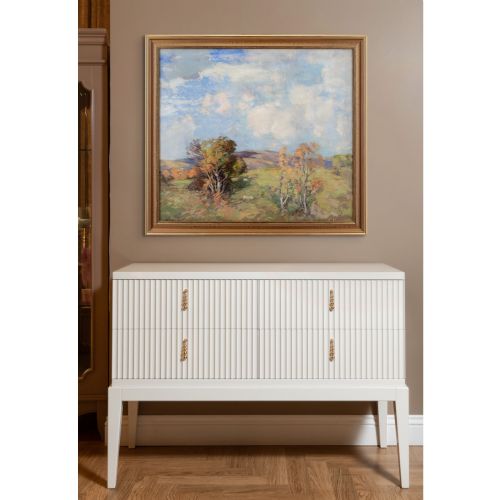
Upon returning, his career went from strength to strength and he sought inspiration amid the picturesque rolling Galloway moors. He returned often to explore miles of unbroken views, from the peaks to the sea, captivated by panoramic sweeping skies and the surge of intrepid waves.

His finest works harness these elements, with swathes of vigorous blue dominating bustling compositions with bulging clouds and sinuous trees torn by the weather. They’re alive, imbued with a natural energy conveyed through his brush. McTaggart was wrong, it hadn’t taken twelve years.

He continued to exhibit extensively over the course of his life both within Scotland and overseas, including at Munich and Auckland, New Zealand. He was also highly regarded as a teacher and delivered numerous lectures in Corstorphine, Edinburgh, where he spent his later years. In 1918, he was elected a member of the RSA.

Today, he’s represented in numerous public collections including at the Aberdeen Art Gallery, Glasgow Museum, City of Edinburgh Collection, Walker Art Gallery, Manchester Art Gallery, and the Royal Scottish Academy of Art & Architecture.

Inscribed on the reverse and held within a later frame.
Learn more about John Campbell Mitchell RSA in our directory.
Medium: Oil on canvas
Overall size: 41” x 37½” / 104cm x 95cm
Year of creation: c. 1920

Labels & Inscriptions: Inscribed with artist’s name and ‘from artist’s studio sale’ on the reverse.
Provenance: The Artist’s Studio Sale / Private collection, UK.
Condition: Cleaned. Frame in excellent condition.
Artist’s auction maximum: £5,800 for ‘On Macrihanish Sands (1917)’, Oil on canvas, Dreweatt-Neate, 27 May 2005 (lot 379).
Our reference: BRV2069
Brave Fine Art has dated this piece to the 1920s.
Exquisite antique paintings that capture the imagination.
You can view the stock and full dealer information on the Brave Fine Art Profile Page

John Campbell Mitchell Rsa, Summer Day - Antique Oil Painting


