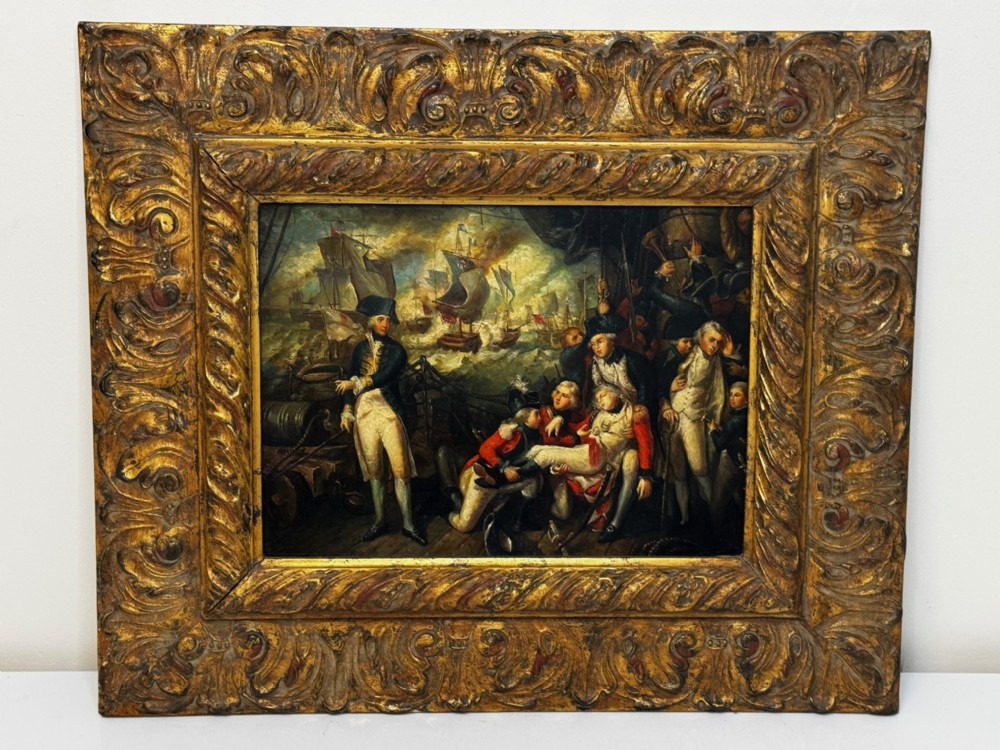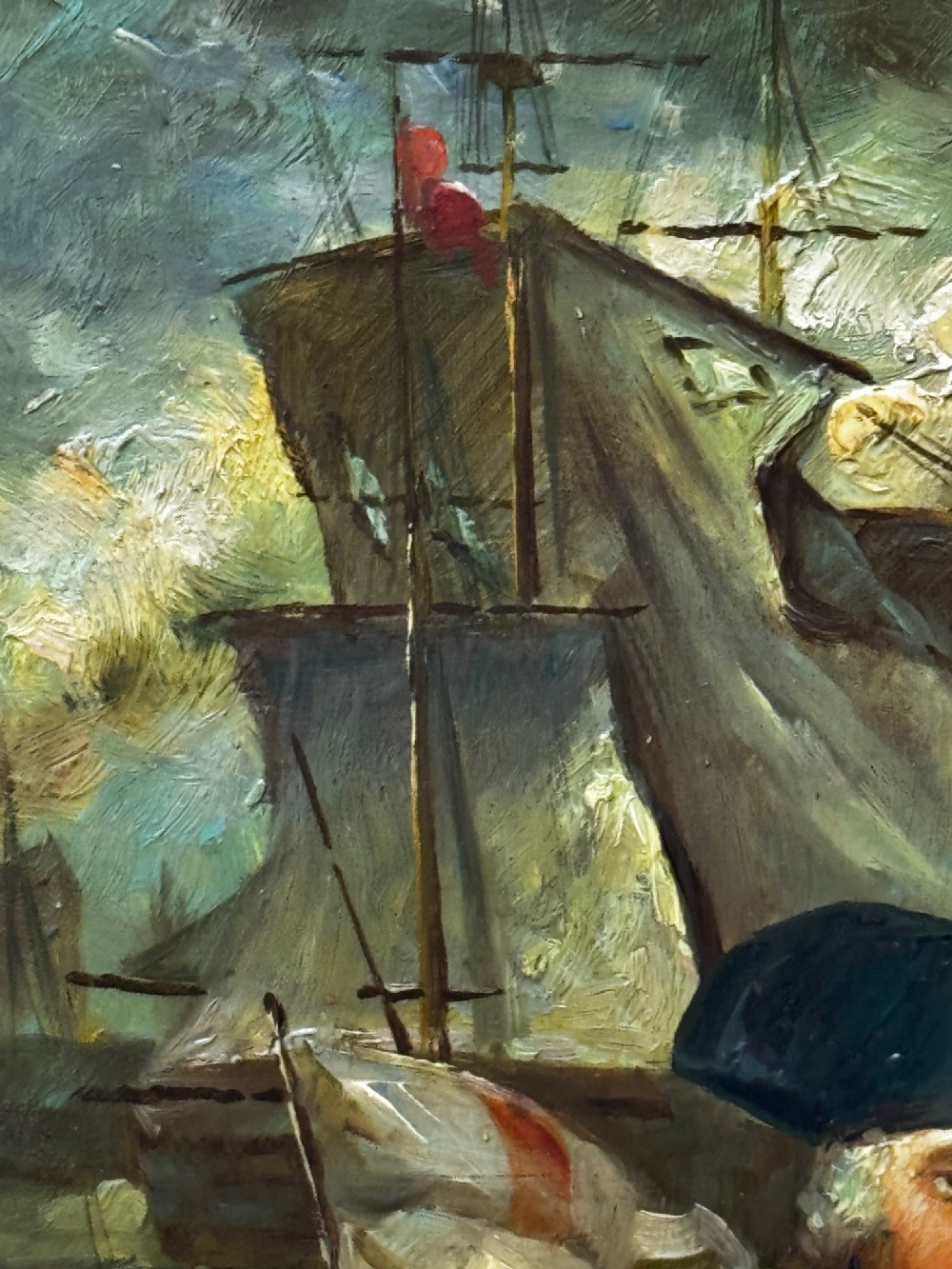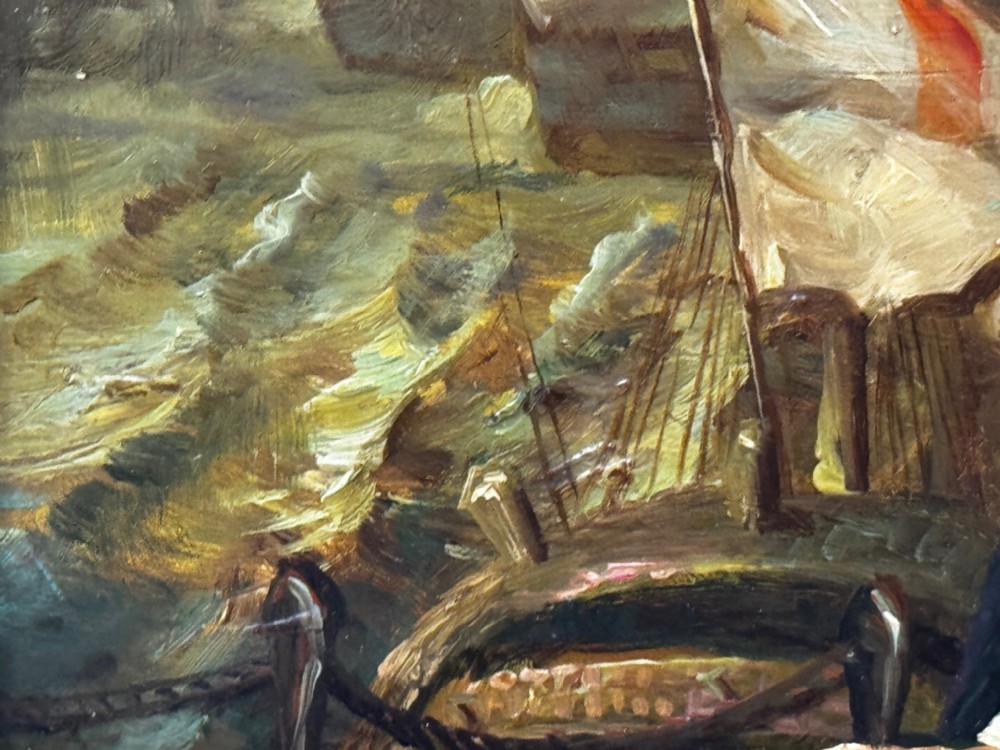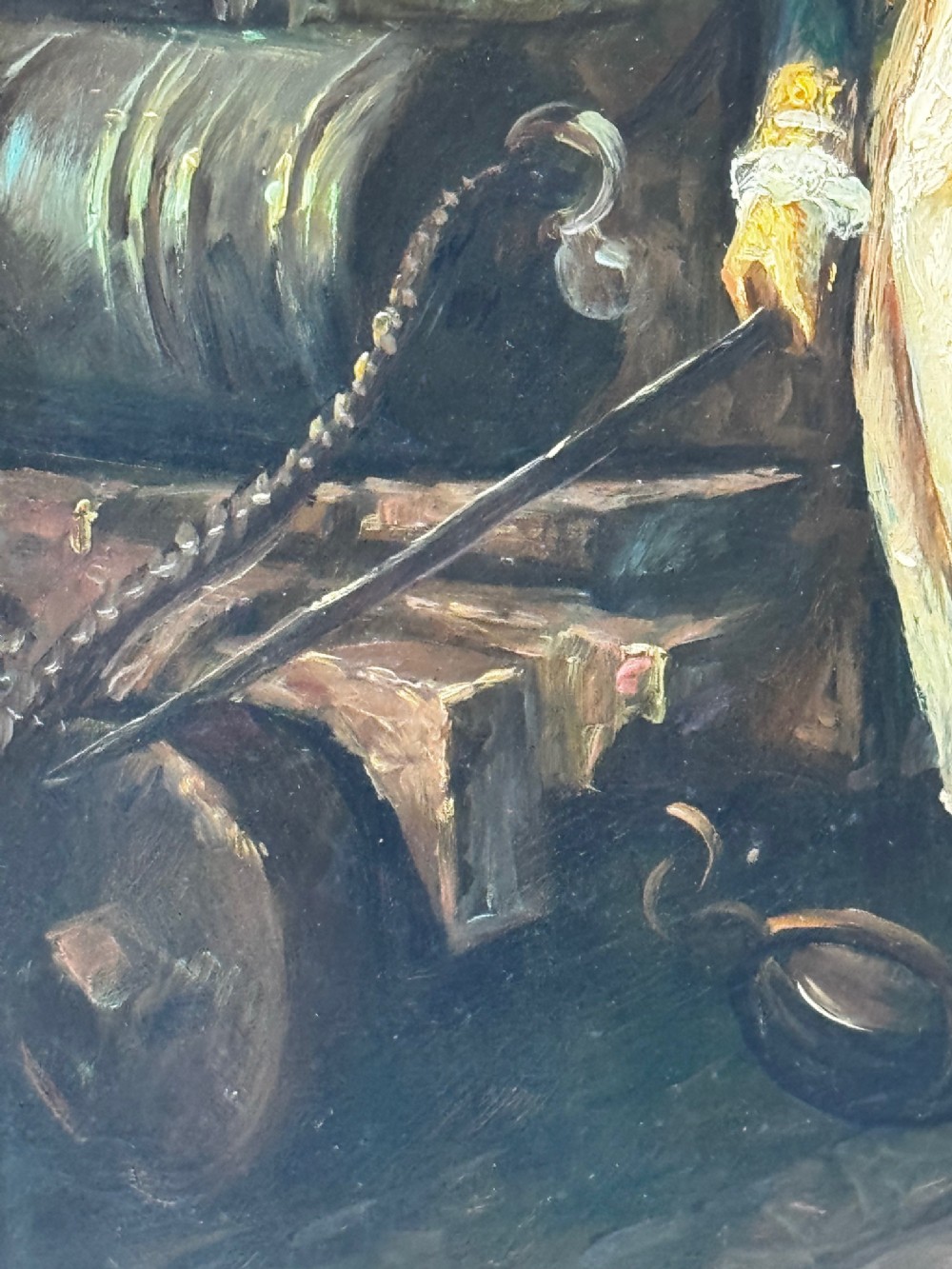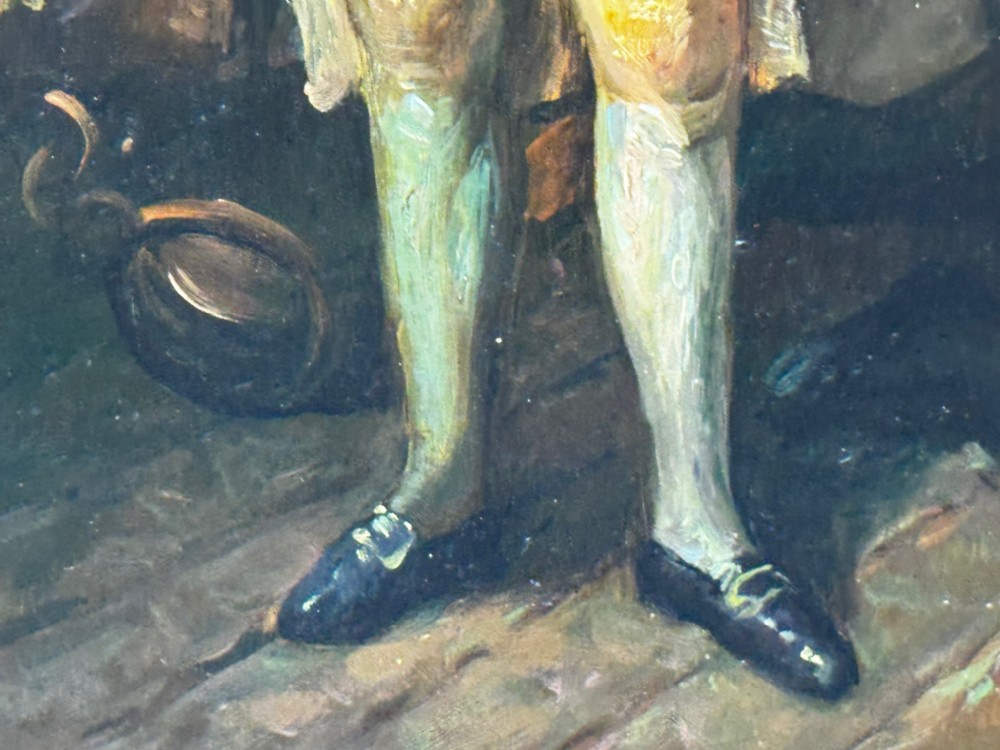
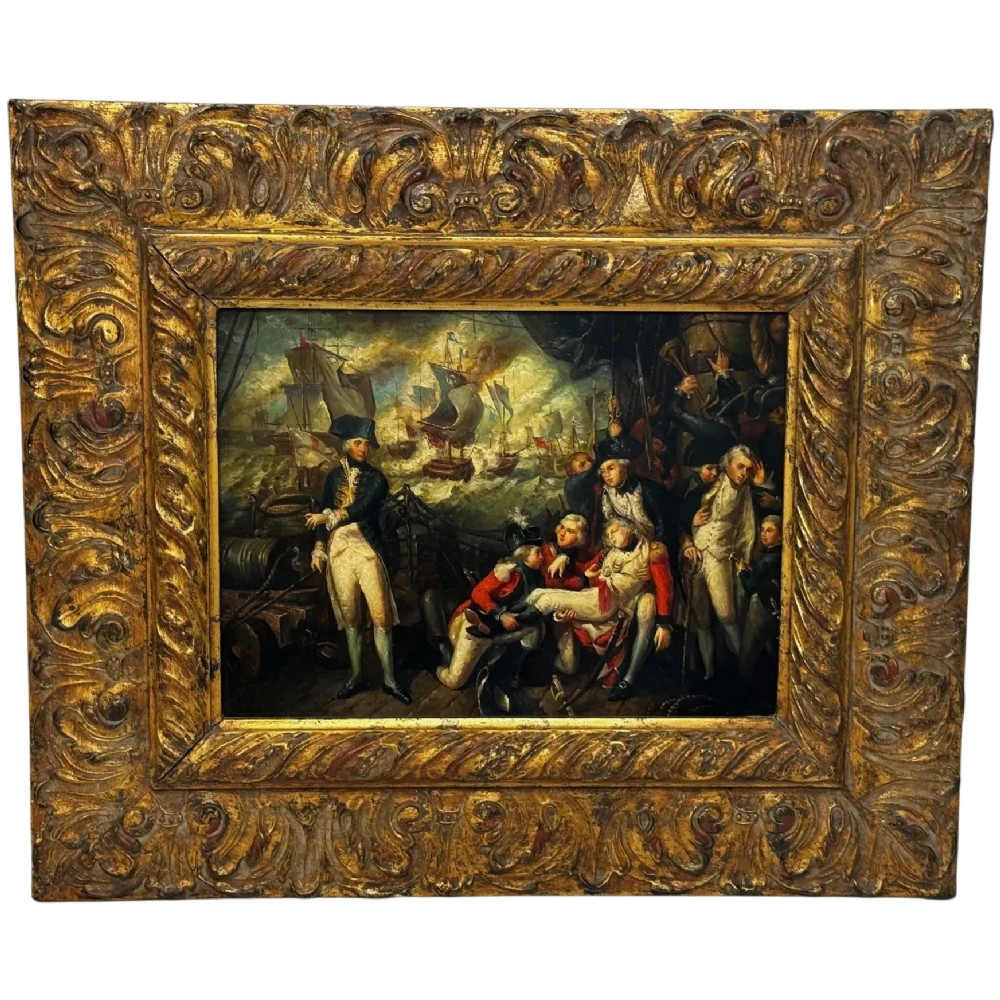
Cheshire Antiques Consultant Ltd has dated this Naval Battle Oil Painting to the Victorian era.
In the style of after Mather Brown.
Unsigned British school artist.
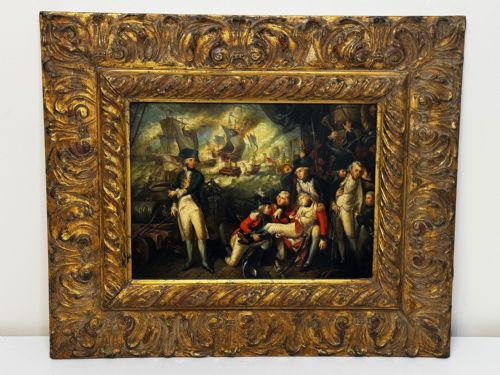
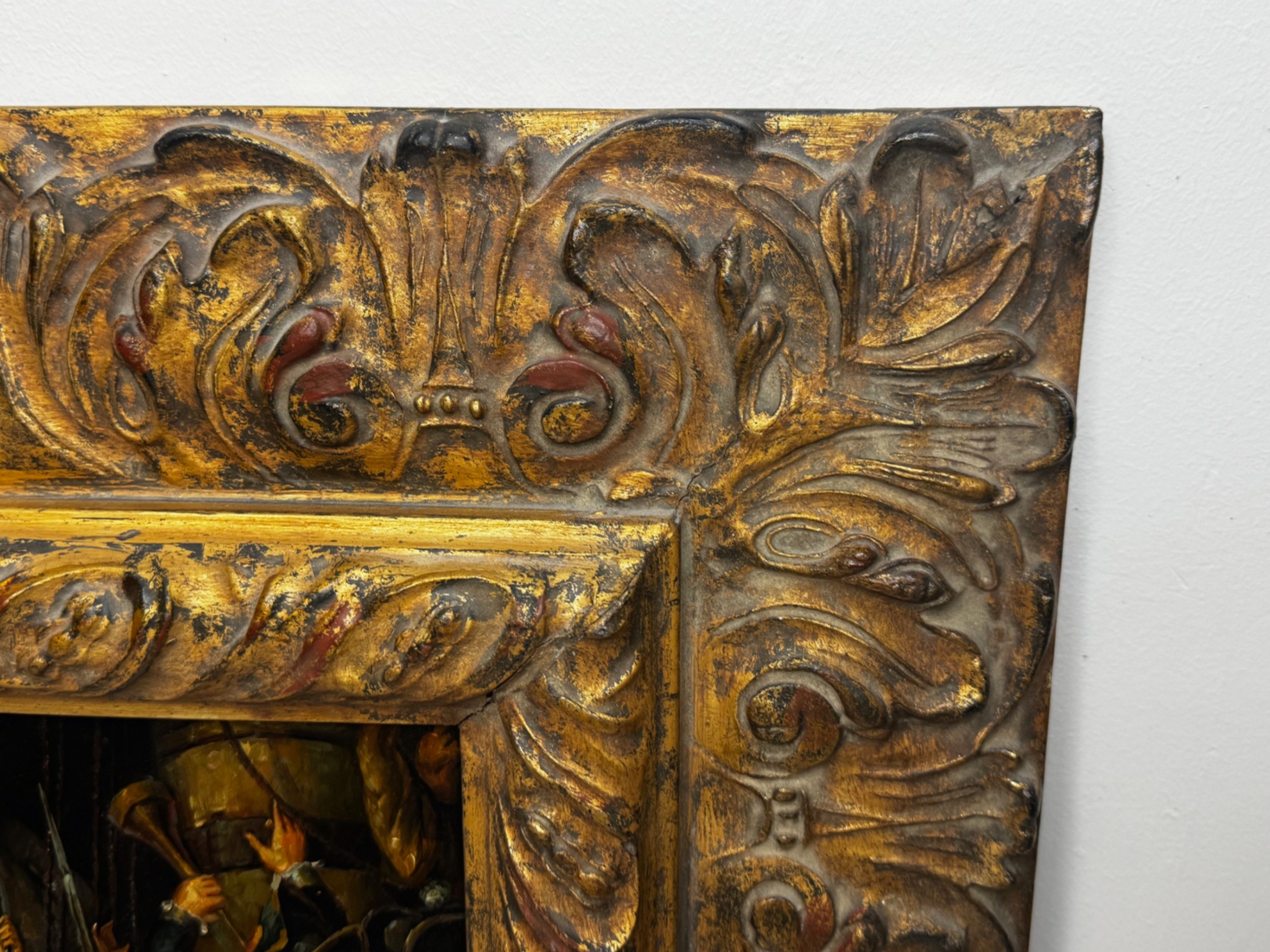
Oil on metal panel set in a fine decorative gilt frame.
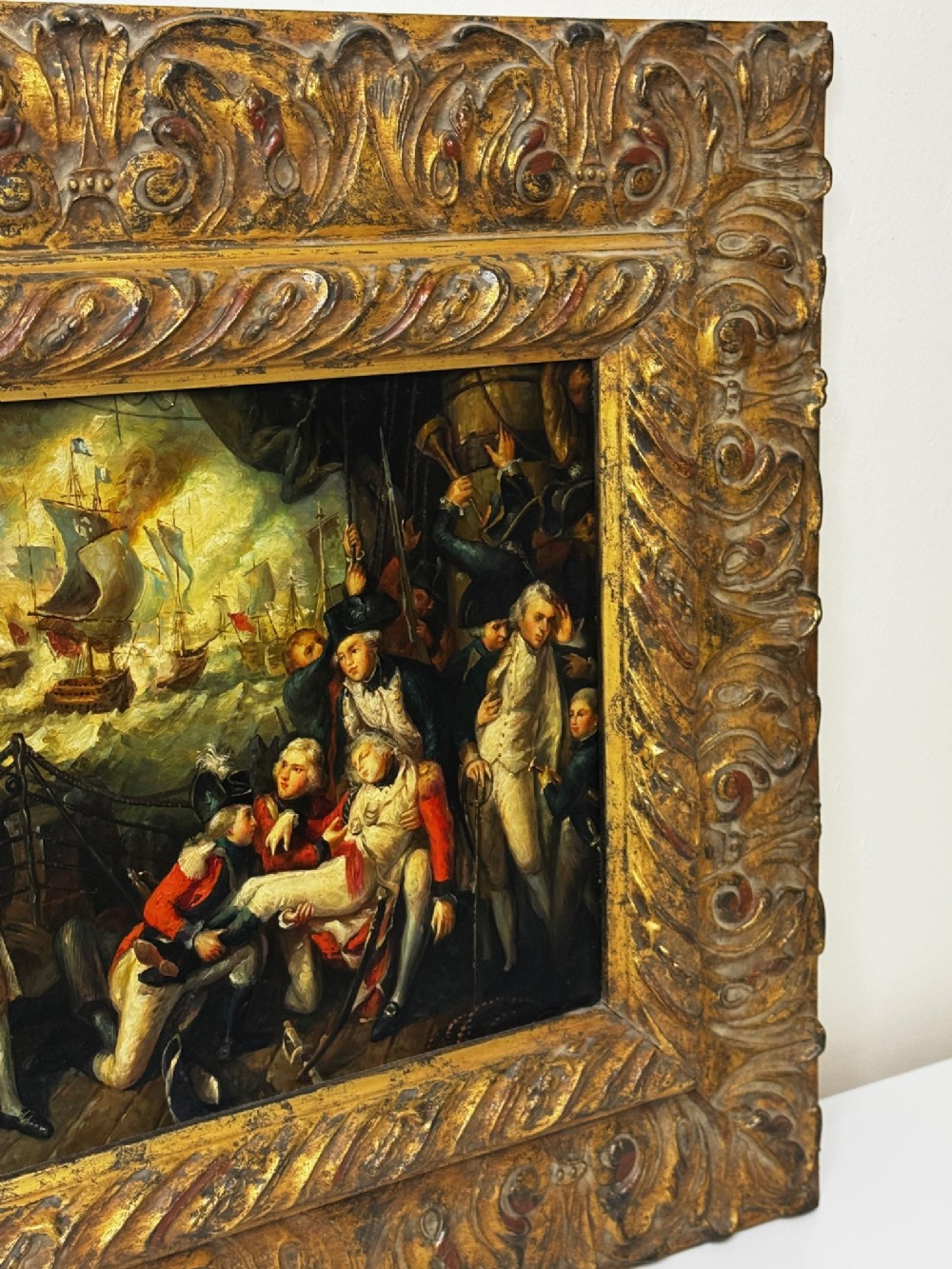
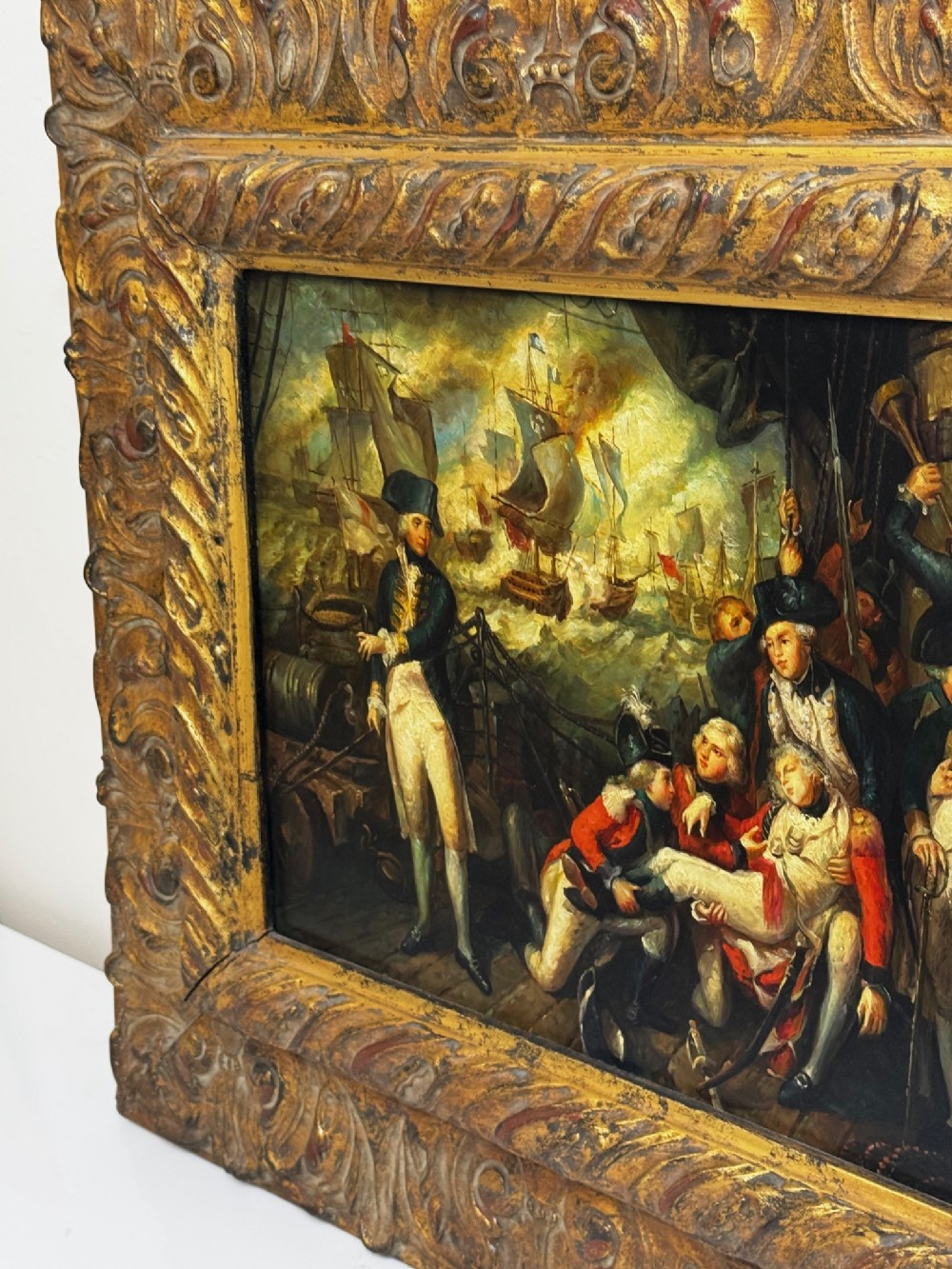
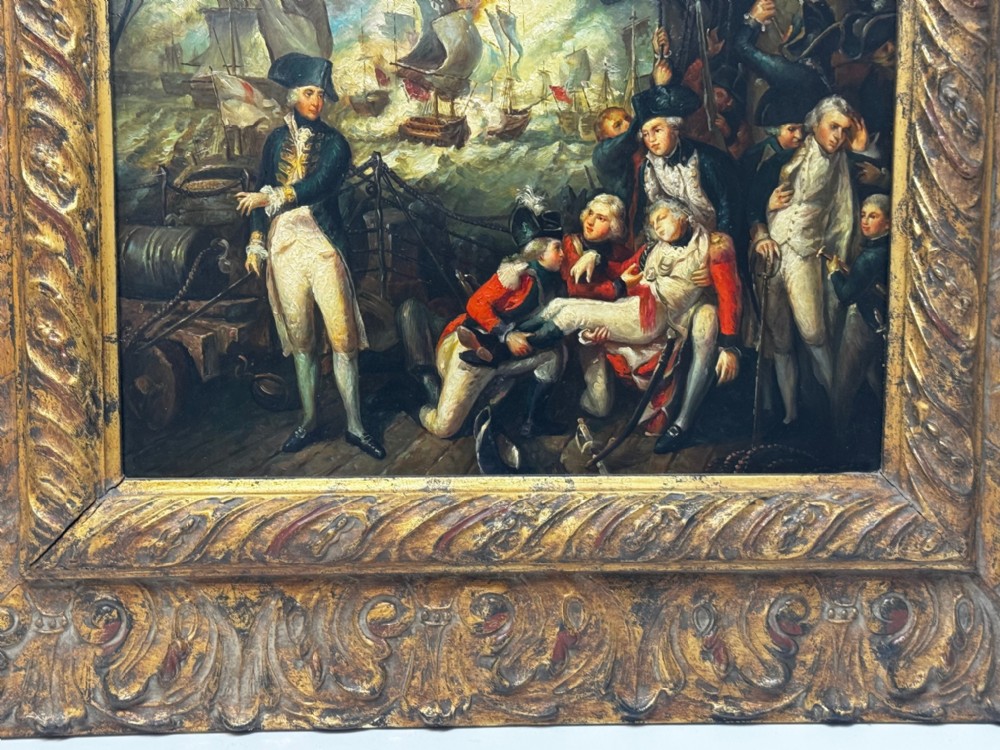
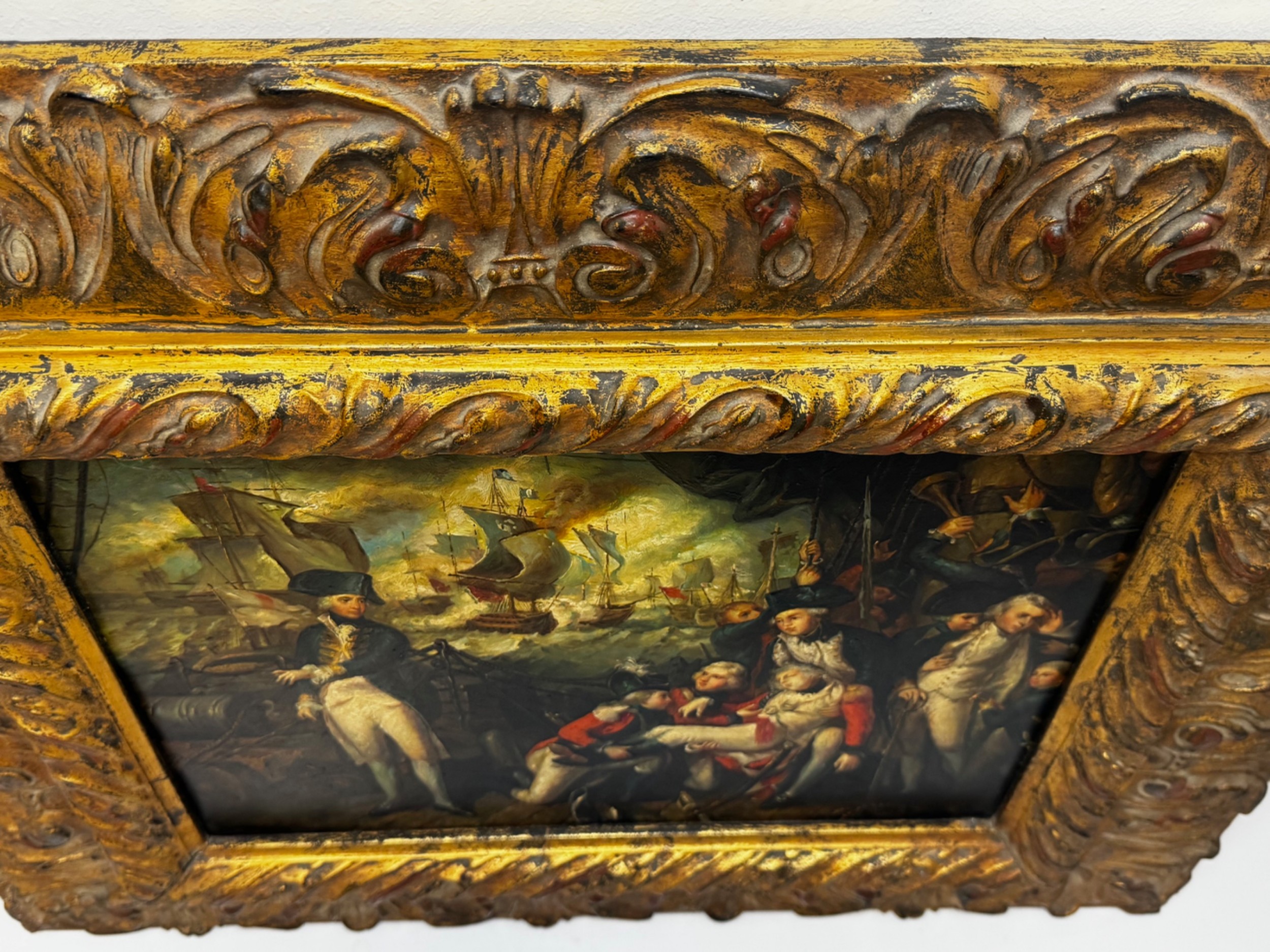
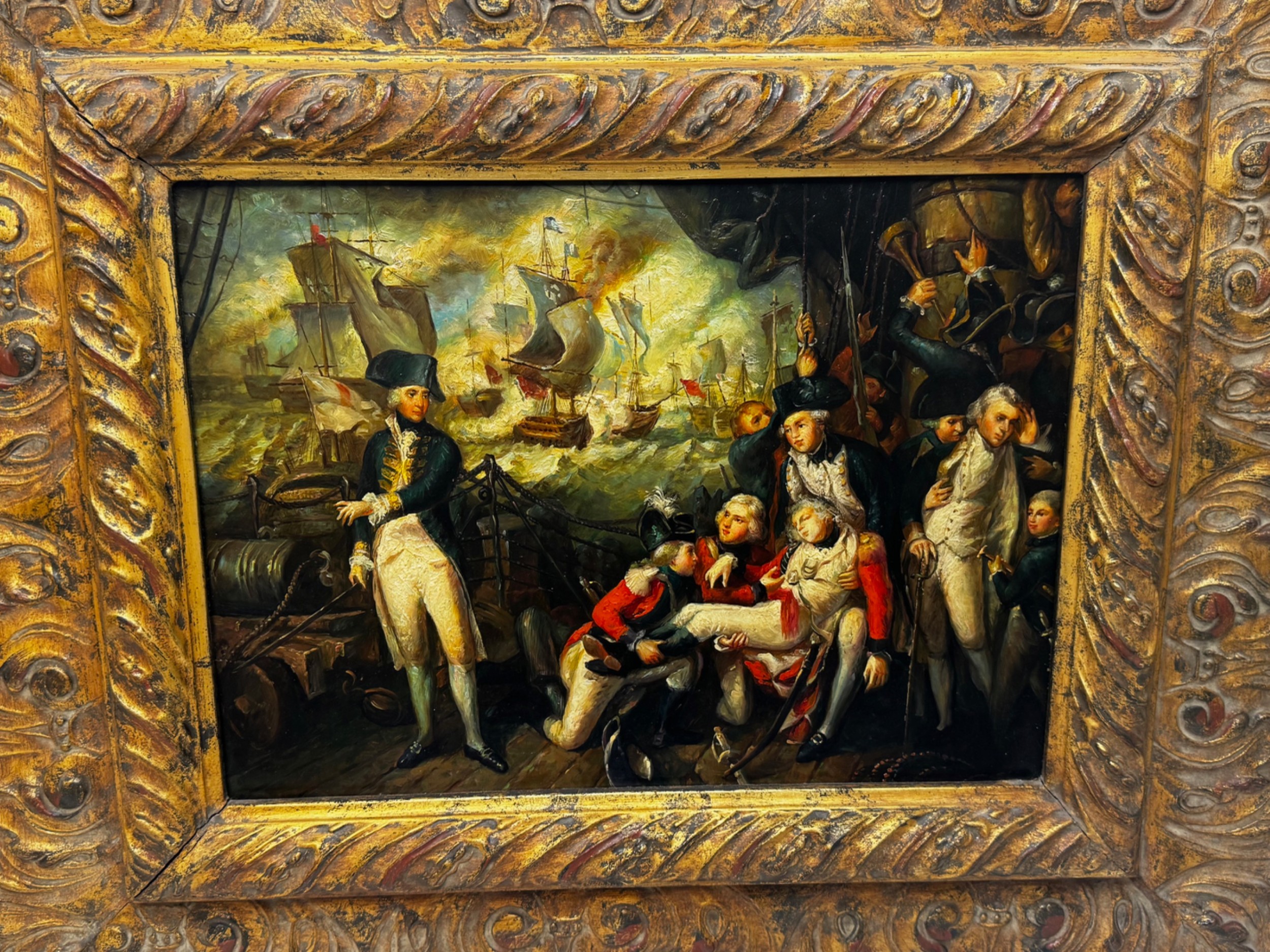
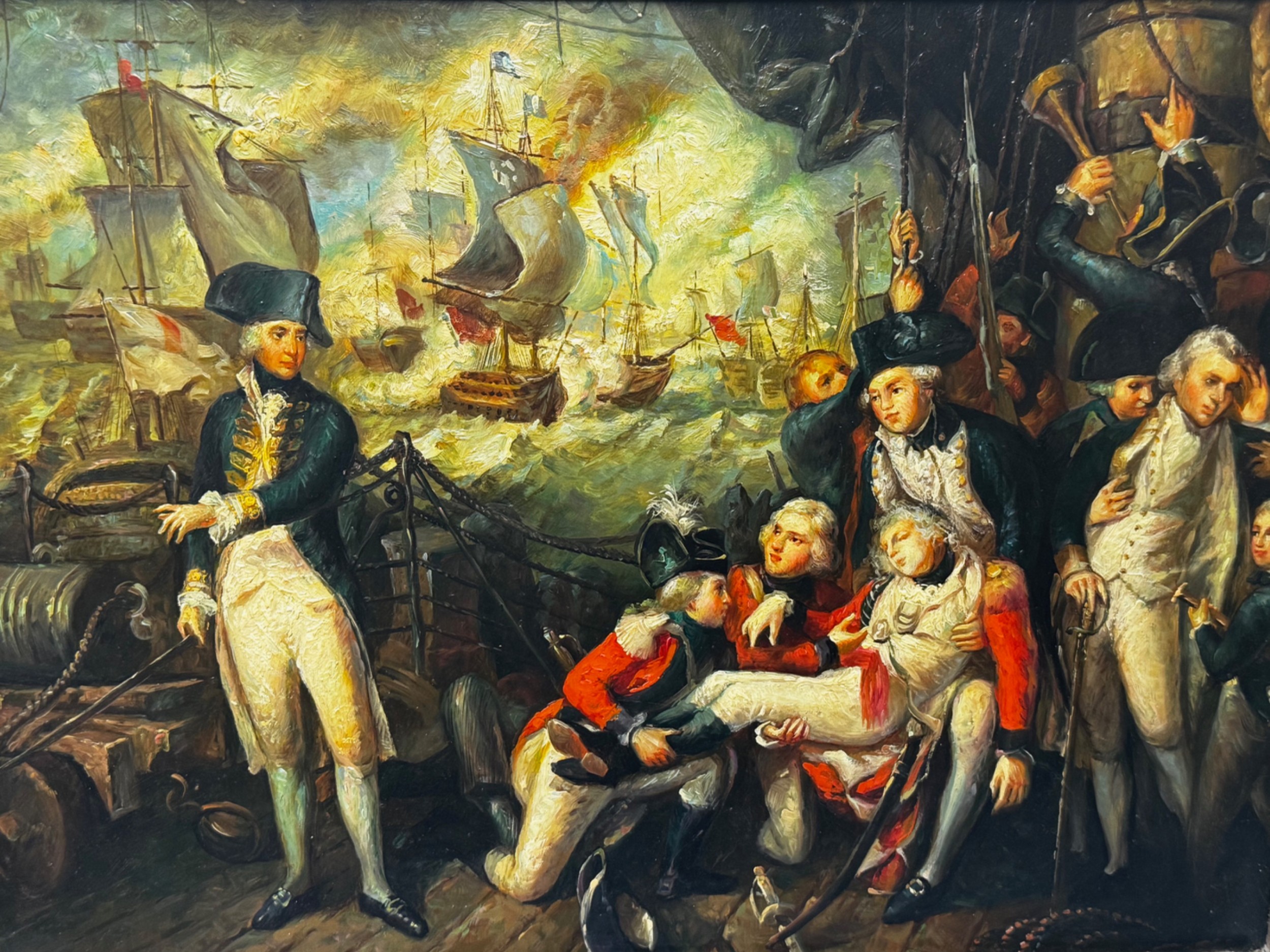
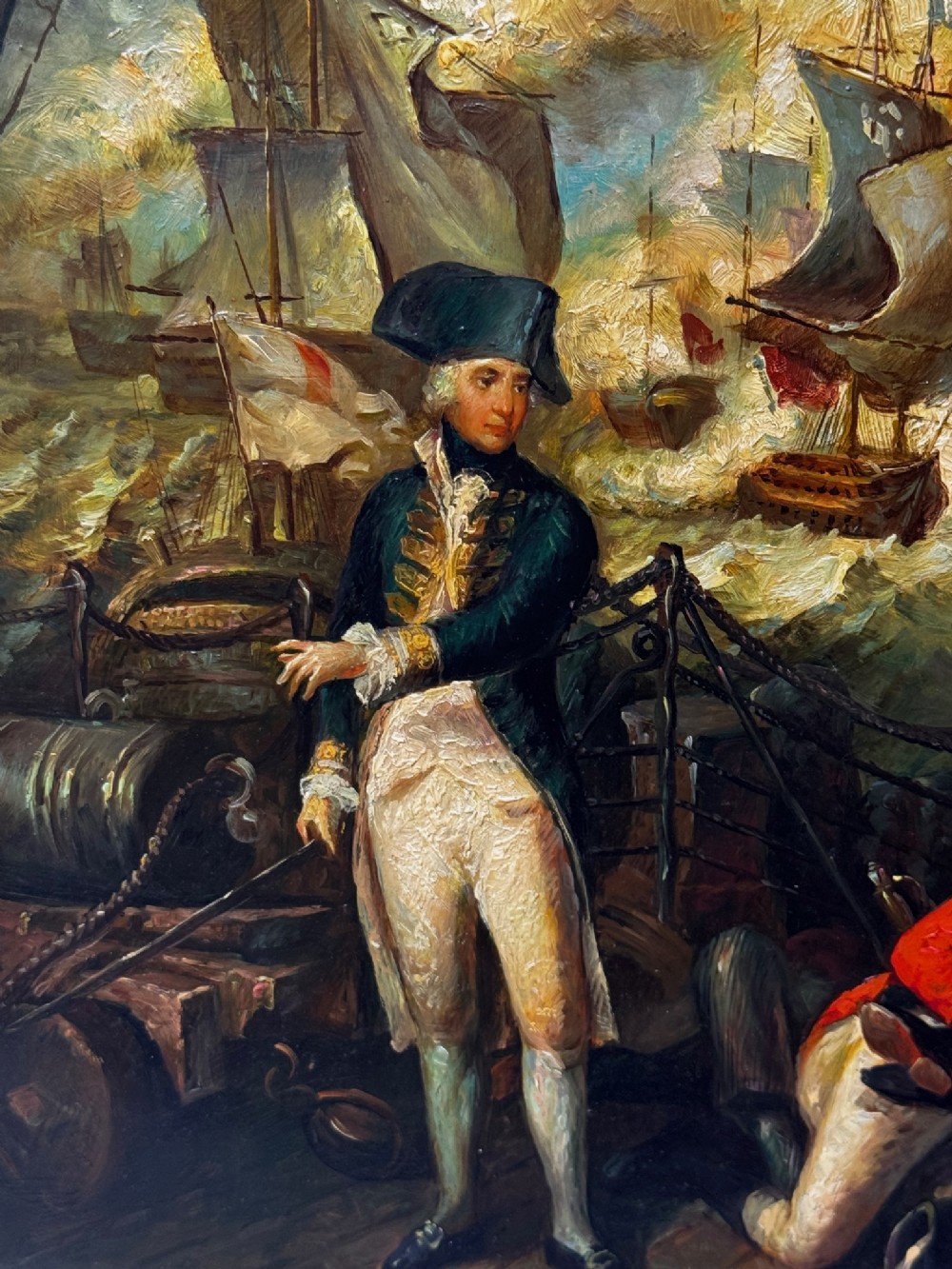
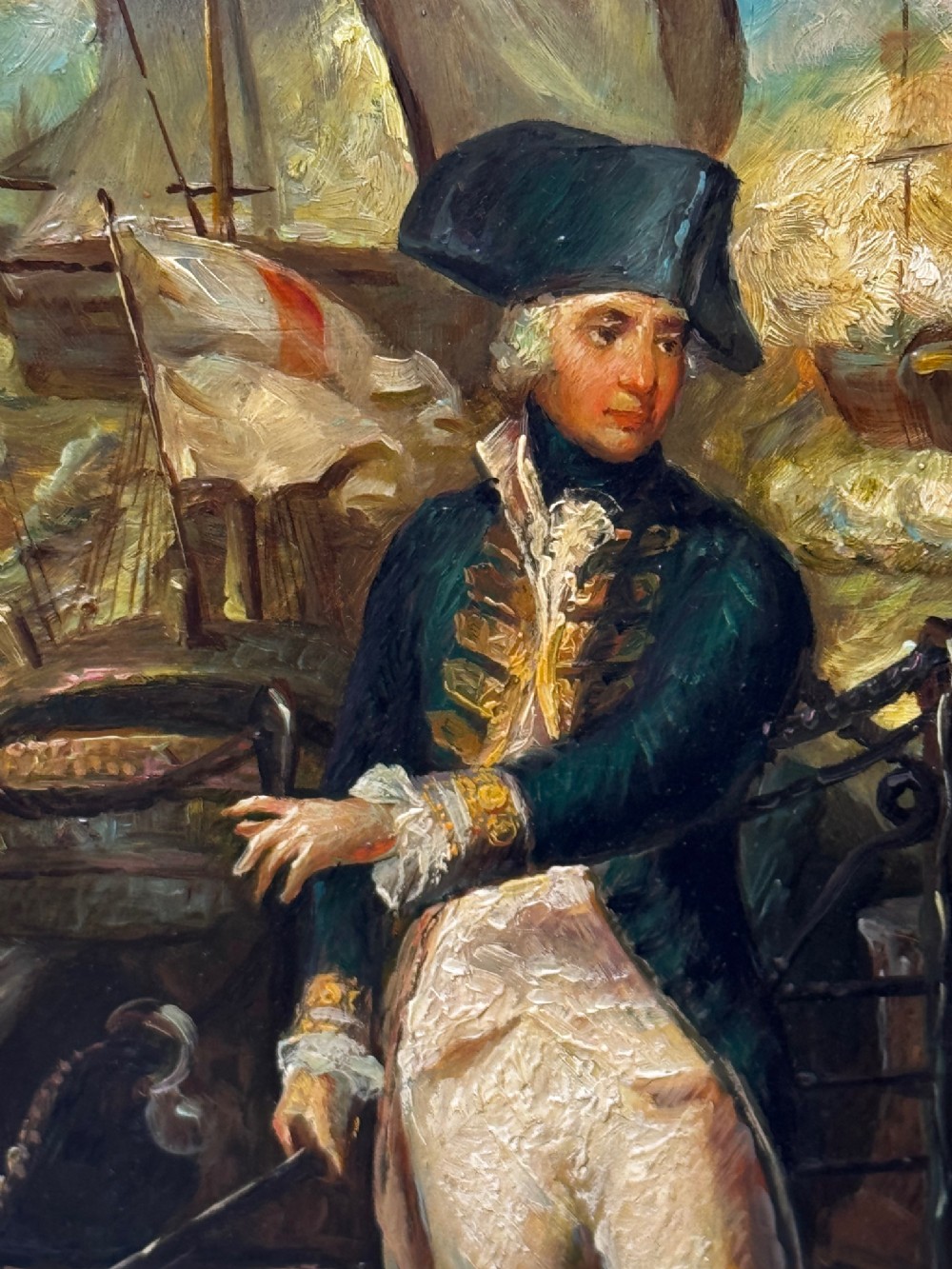
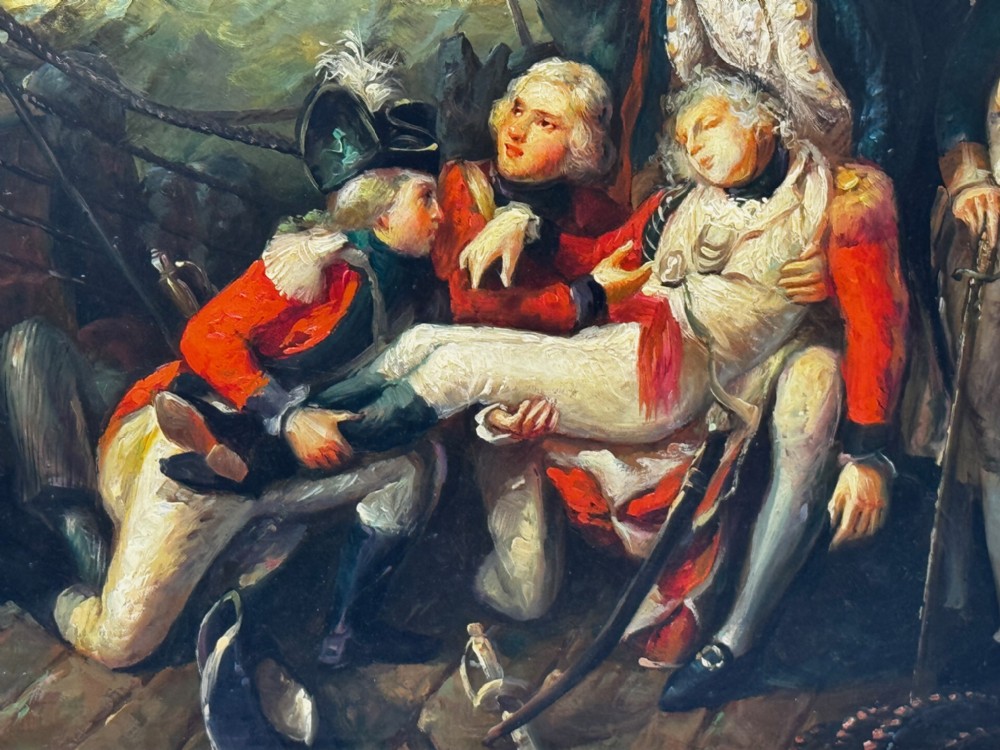
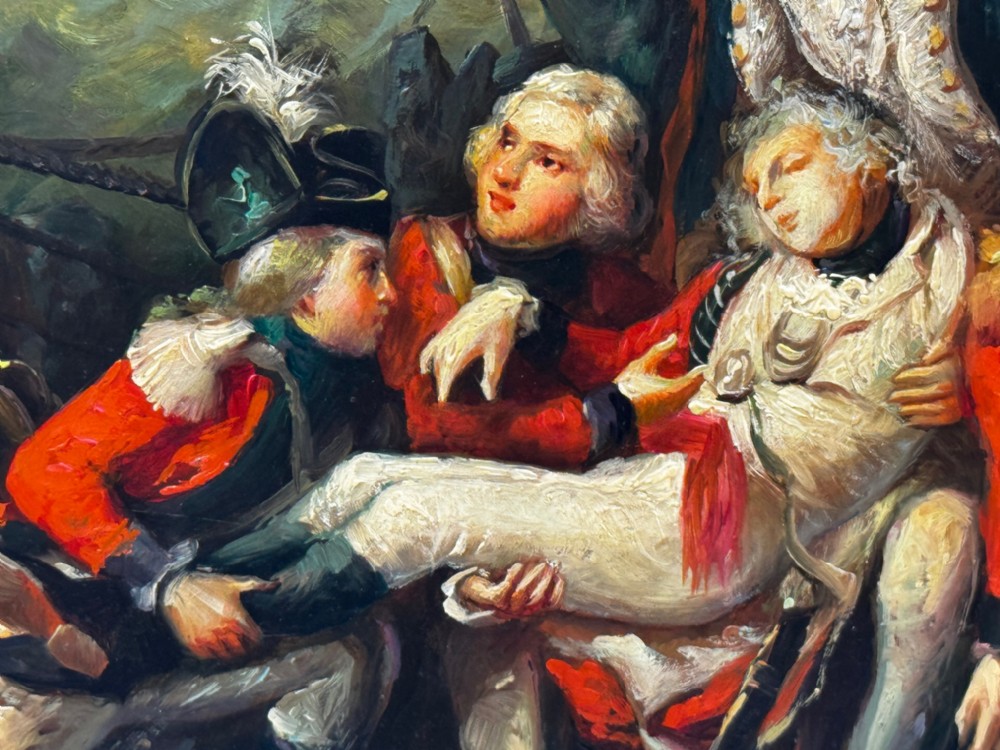
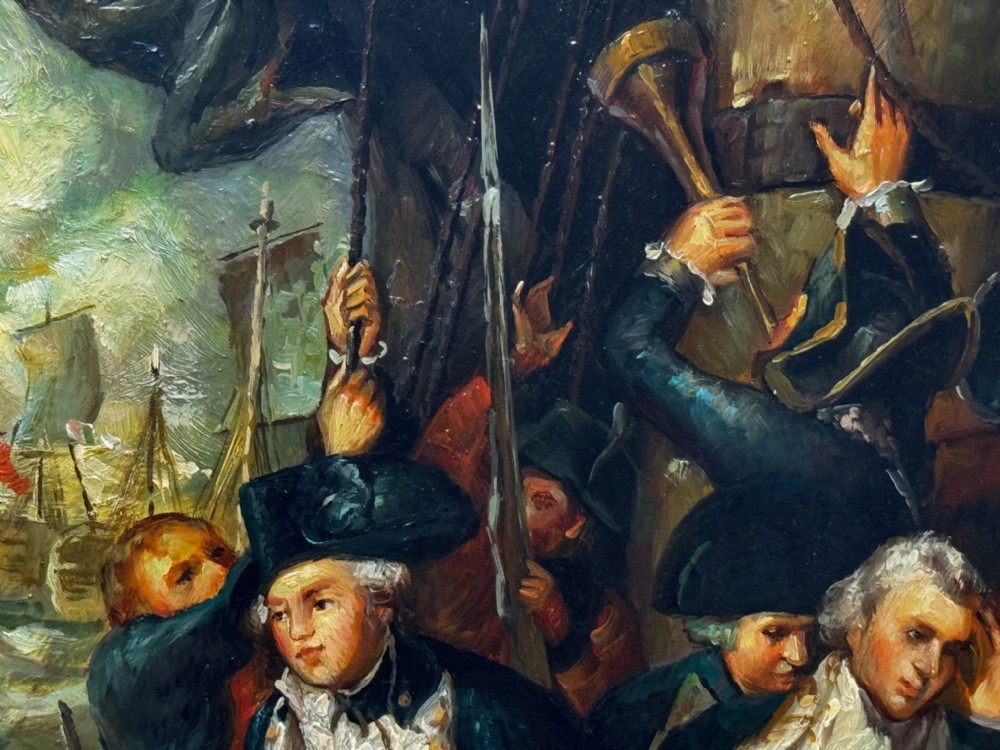
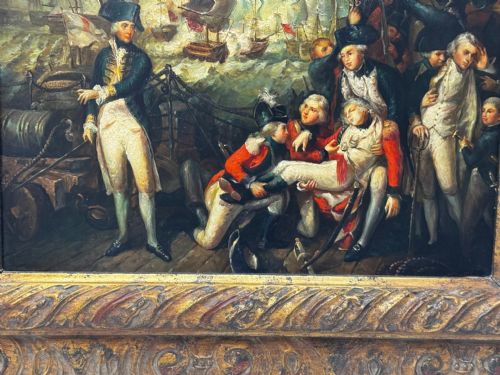
Title “Lord Howe on the Deck of the Queen Charlotte 1 June 1794” After Mather Brown.
Circa 1850 mid 19th century Victorian era.
Set in the original decorative gilt frame which enhances this work even further.
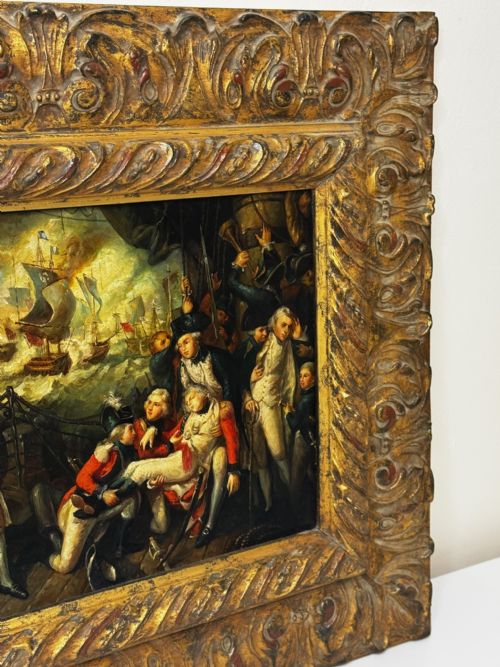
A delightful display size with the frame being 66.5 cm wide and 56.5 cm high.
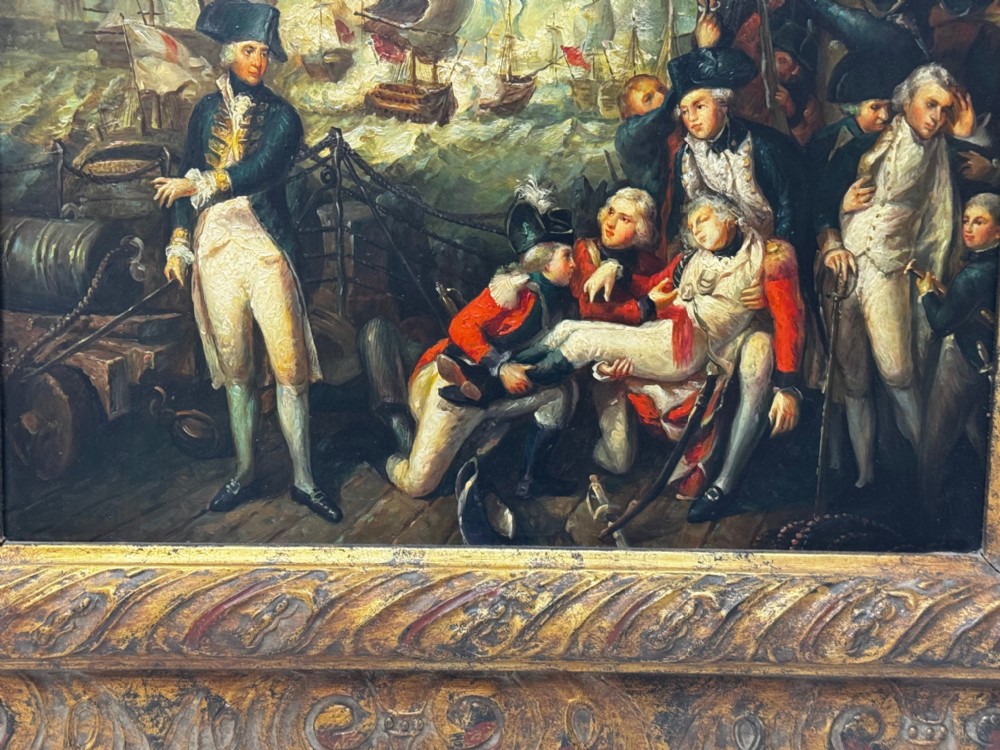
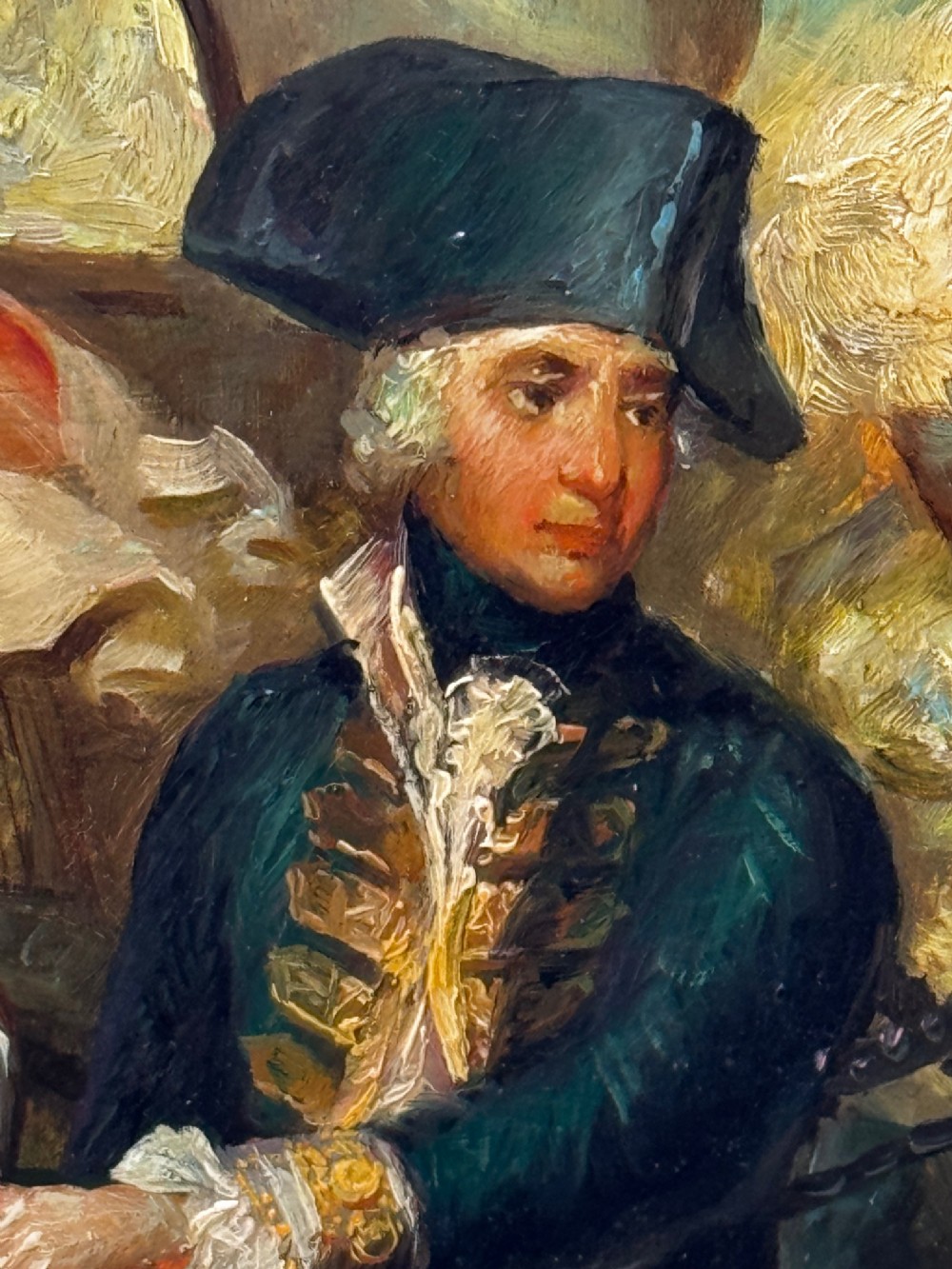
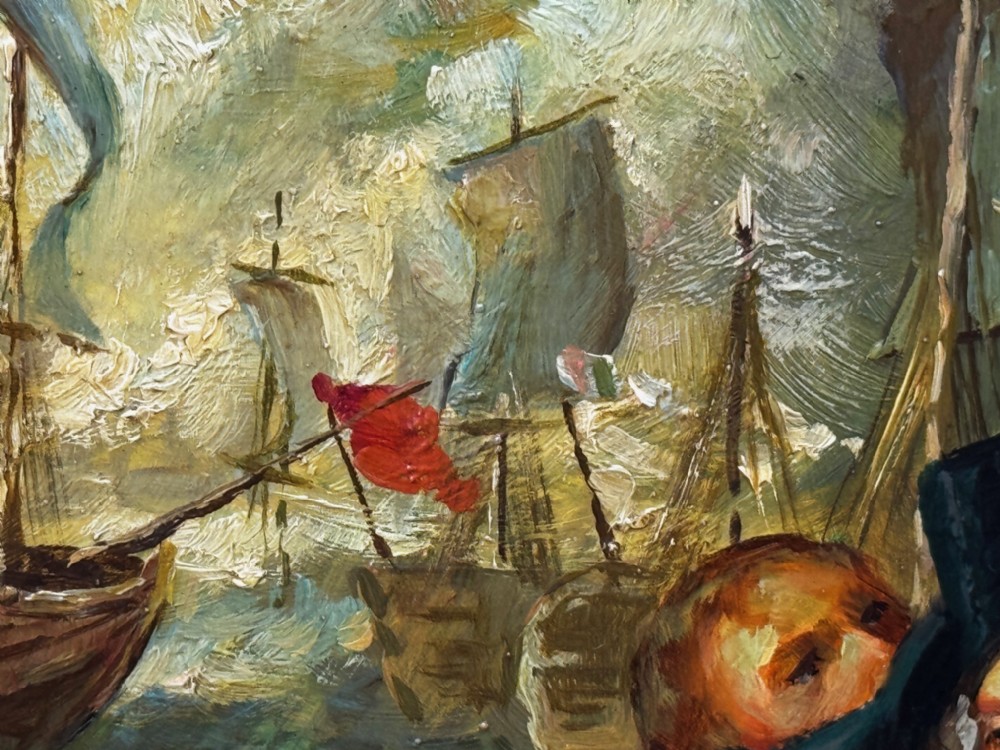
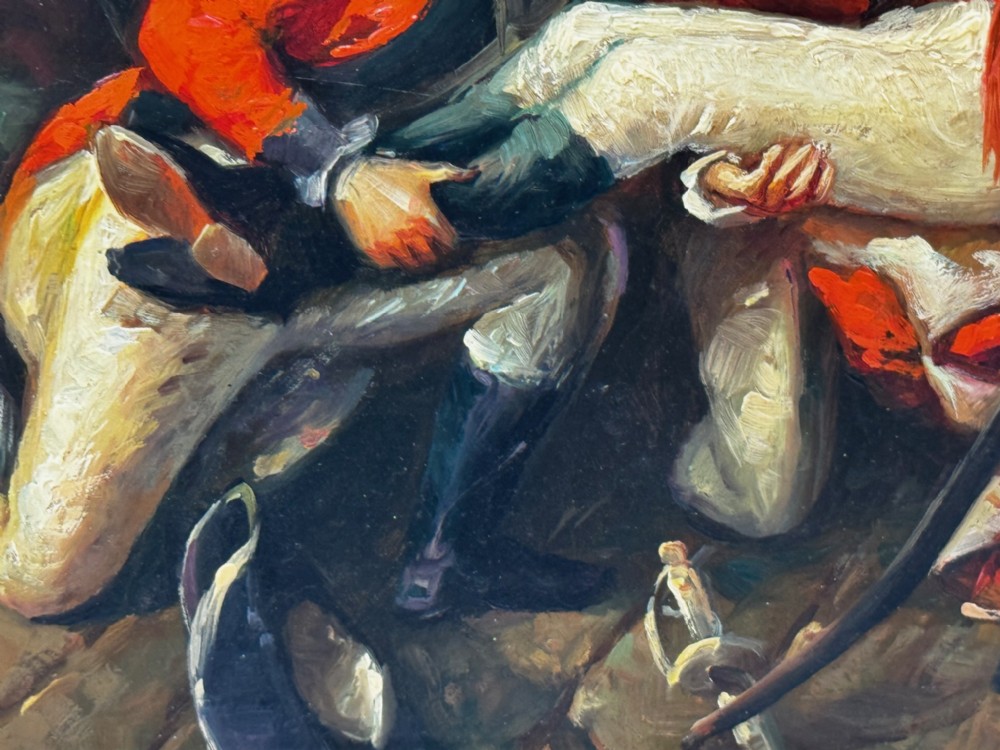
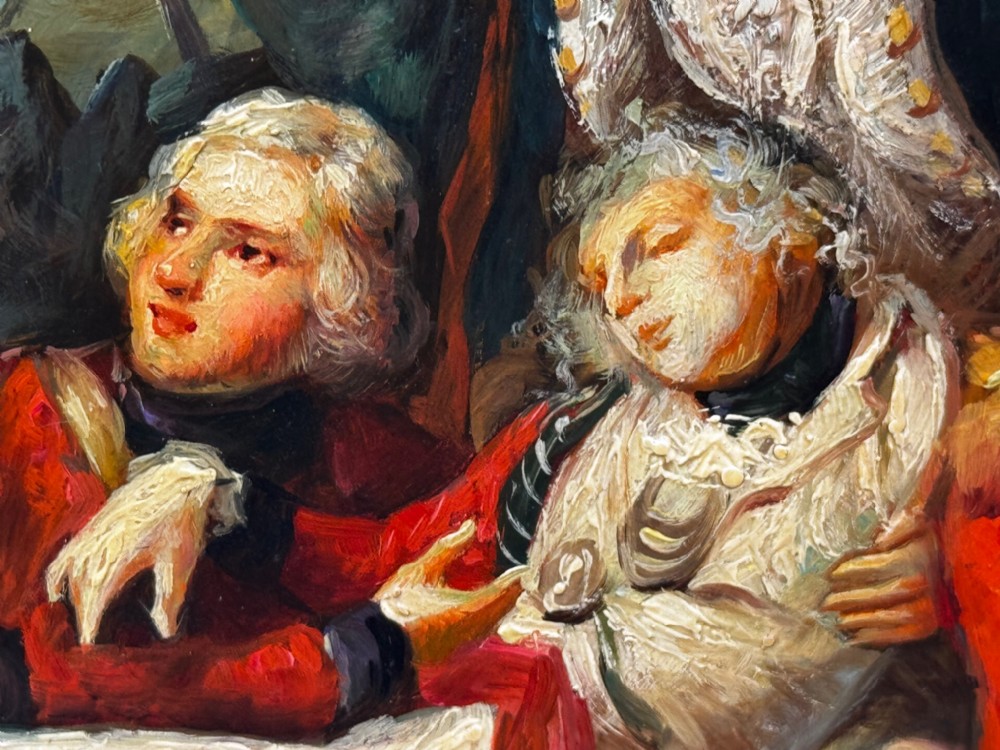
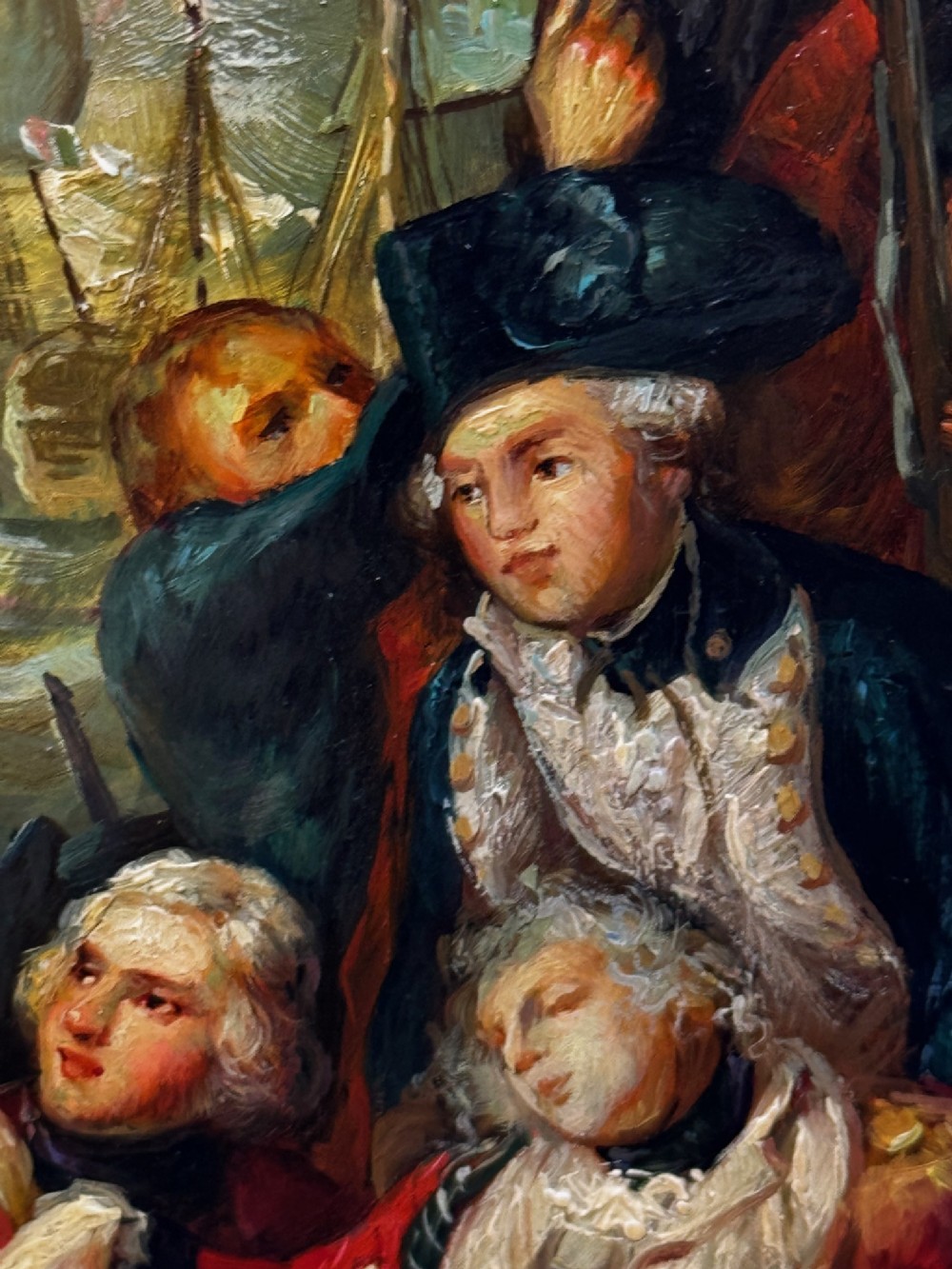
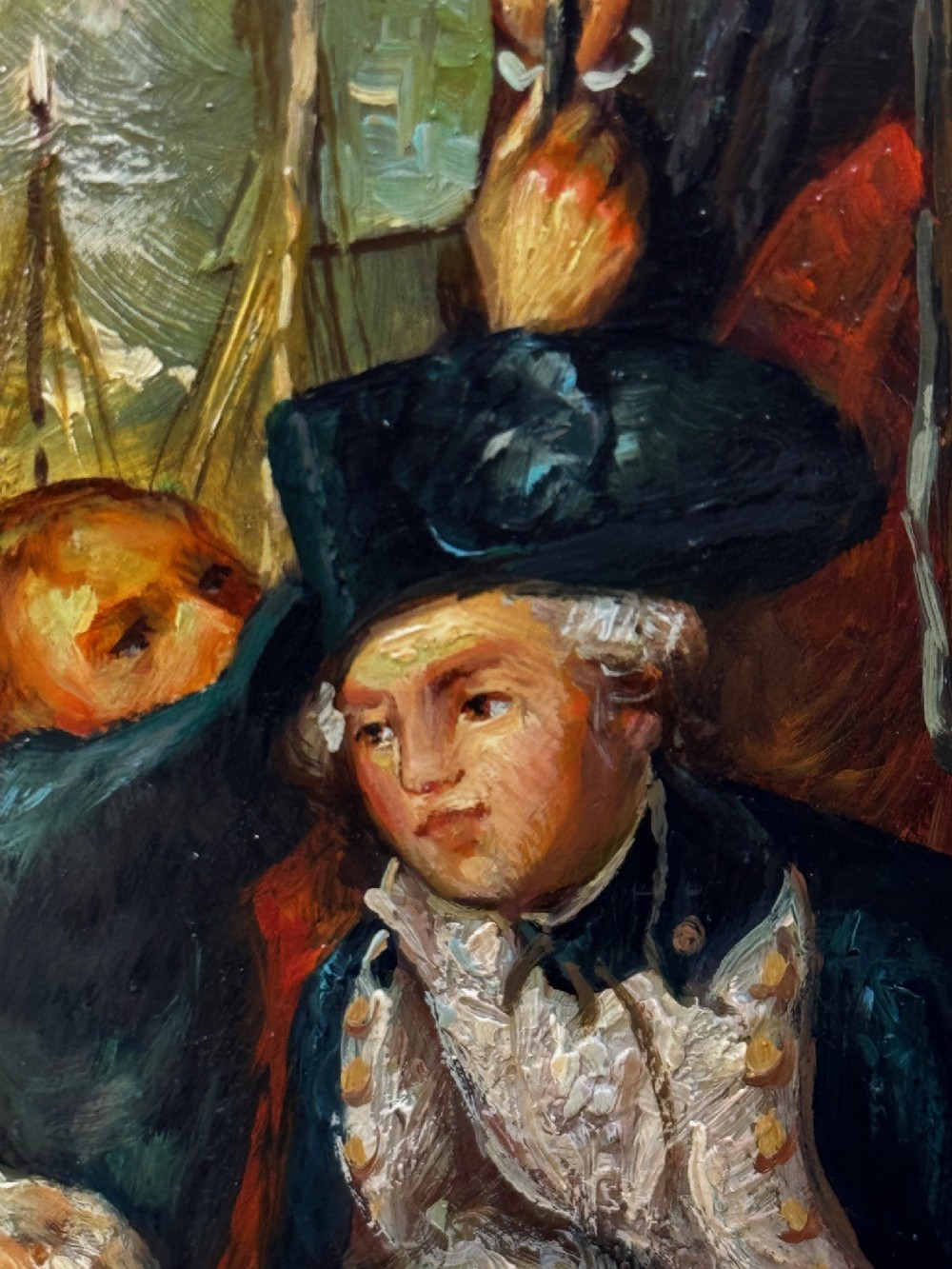
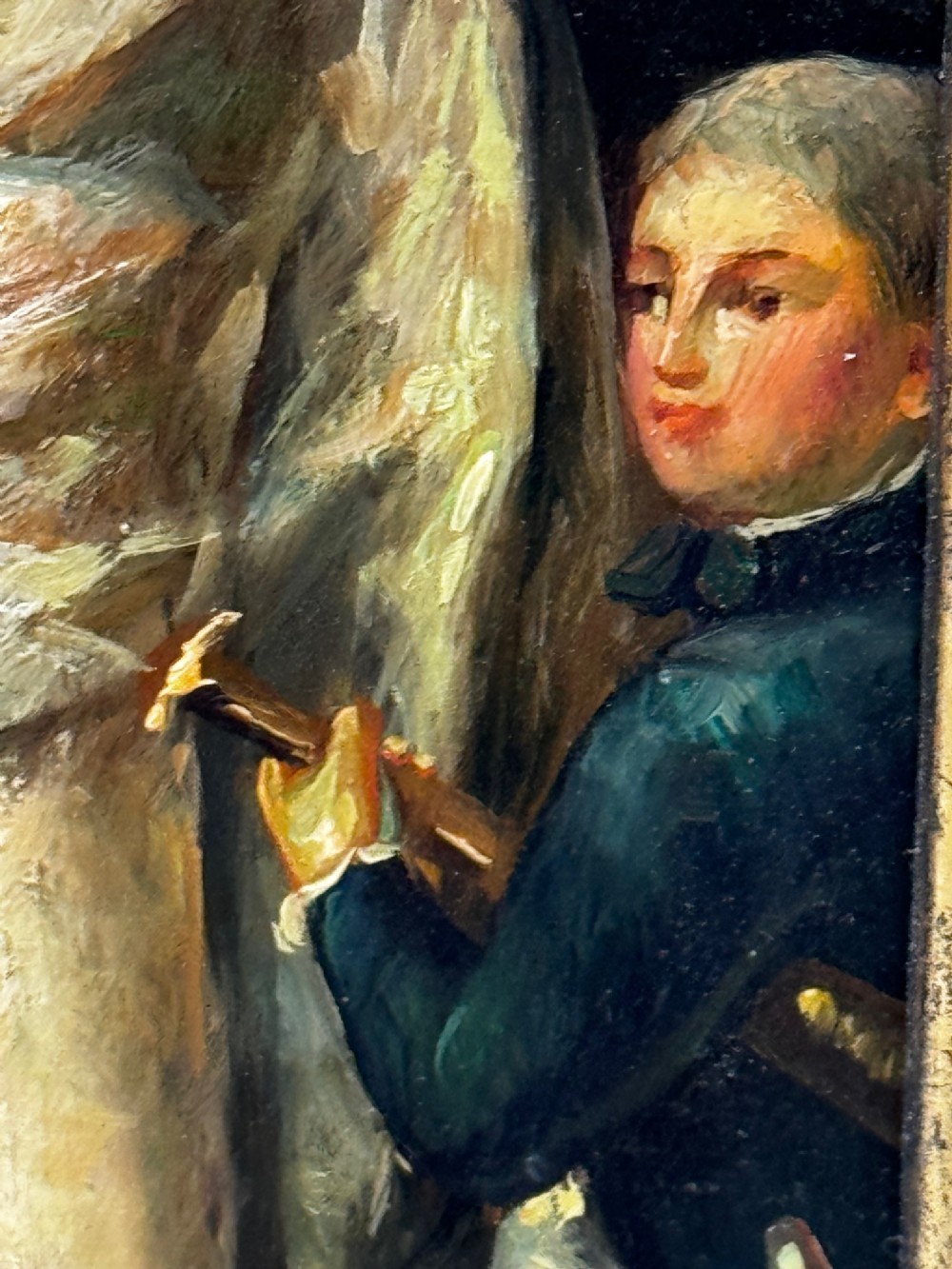
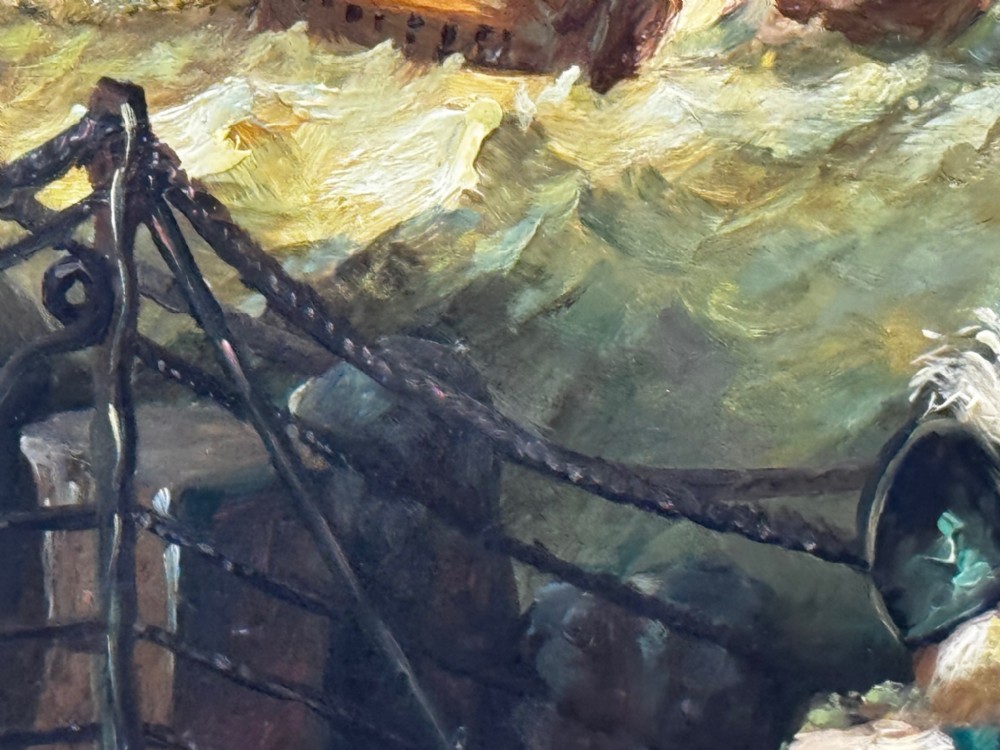
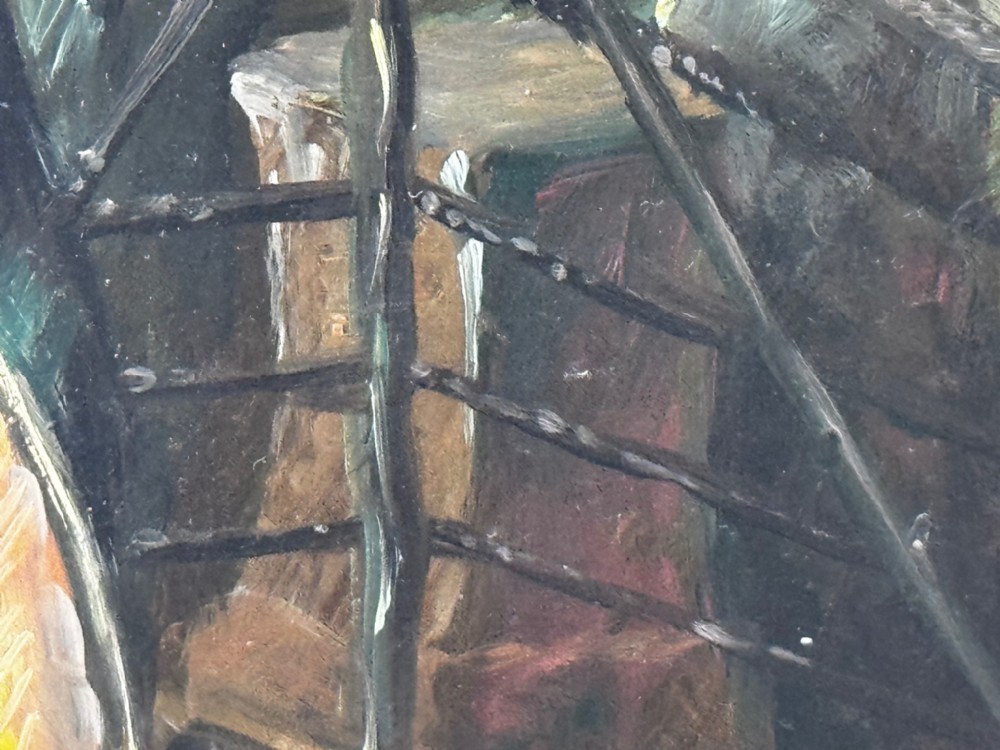
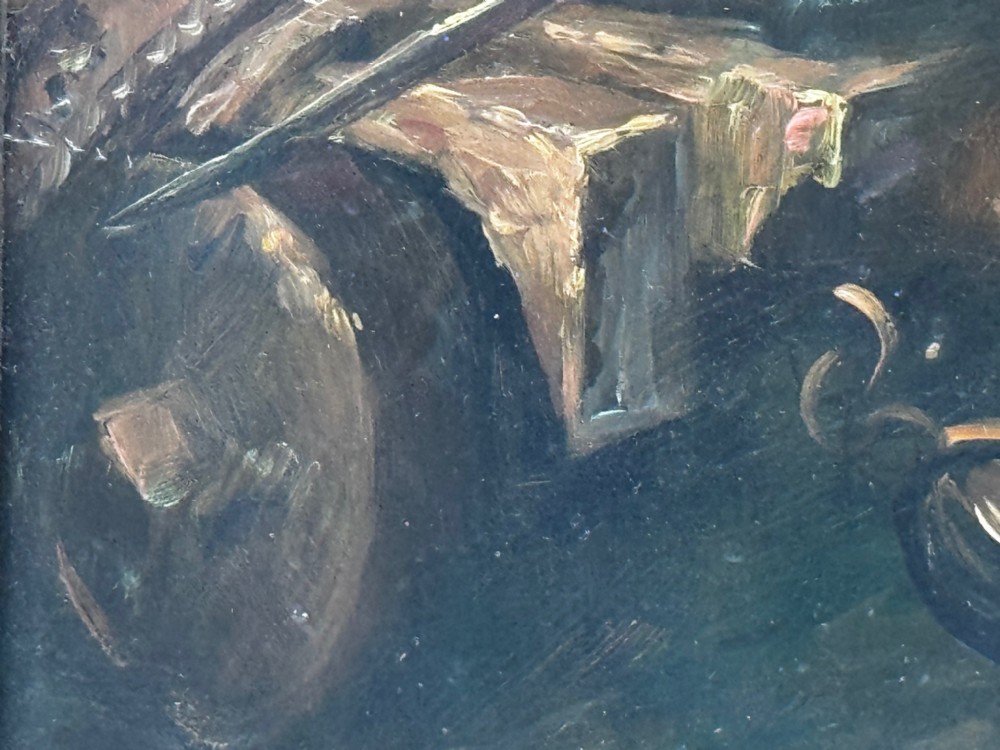
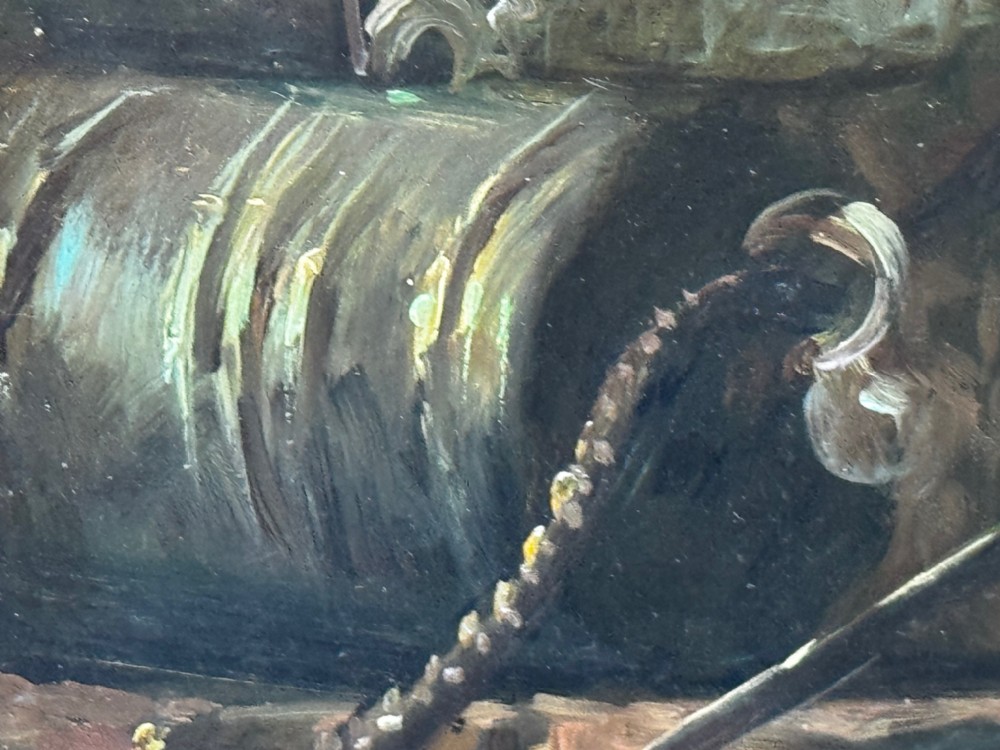
Subject seascape marine, this painting honours the known marine Battle of the Glorious First of June in 1794. Lord Howe is shown second from left in the group onboard the Queen Charlotte's' quarter deck, wearing his admiral's full-dress uniform with a cocked hat. On the left flank is Captain of the Fleet, Sir Roger Curtis, who is leaning against a cannon, wearing his dress uniform of a commodore. Your focus is drawn to the group around the dying Lieutenant Neville of the Queen's Regiment. Walter Lock is the naval lieutenant shown wearing a blue jacket, he lifts Neville by the shoulders. On the left & centre of the group kneels Captain Tudor and Major Isaac of the Second Queen's Regiment and also Queen's Regiment. On the right the Queen Charlotte's flag-captain who is Sir Andrew Snape Douglas, in captain's uniform, holding a head wound. He is helped by Graham Hammond, portrayed in a midshipman's uniform. In the distance ships are firing shots at each other, also men are being blasted out of the water.
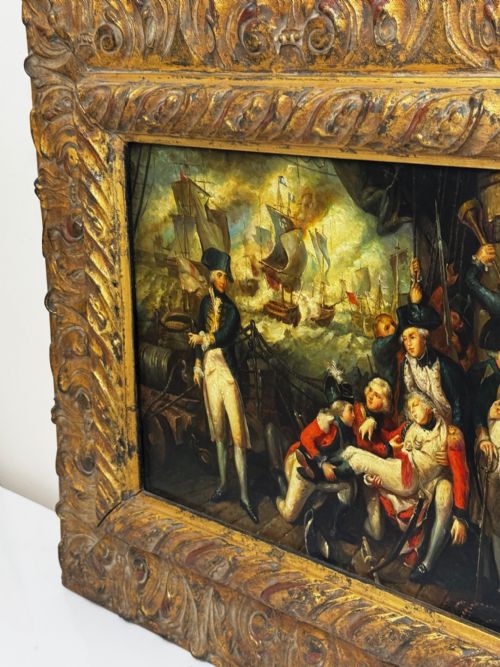
Unsigned.
In our opinion this is a marine masterpiece.
The Glorious First of June (1 June 1794), also known as the Fourth Battle of Ushant, known in France as the Bataille du 13 prairial an 2 or Combat de Prairial) was the first and largest fleet action of the naval conflict between the Kingdom of Great Britain and the First French Republic during the French Revolutionary Wars. The action was the culmination of a campaign that had criss-crossed the Bay of Biscay over the previous month in which both sides had captured numerous merchant ships and minor warships and had engaged in two partial, but inconclusive, fleet actions. The British Channel Fleet under Admiral Lord Howeattempted to prevent the passage of a vital French grain convoy from the United States, which was protected by the French Atlantic Fleet, commanded by Rear-Admiral Villaret-Joyeuse. The two forces clashed in the Atlantic Ocean, some 400 nautical miles (700 km) west of the French island of Ushant on 1 June 1794.
During the battle, Howe defied naval convention by ordering his fleet to turn towards the French and for each of his vessels to rake and engage their immediate opponent. This unexpected order was not understood by all of his captains, and as a result, his attack was more piecemeal than he intended. Nevertheless, his ships inflicted a severe tactical defeat on the French fleet. In the aftermath of the battle both fleets were left shattered; in no condition for further combat, Howe and Villaret returned to their home ports. Despite losing seven of his ships of the line, Villaret had bought enough time for the French grain convoy to reach safety unimpeded by Howe's fleet, securing a strategic success. However, he was also forced to withdraw his battle fleet back to port, leaving the British free to conduct a campaign of blockade for the remainder of the war. In the immediate aftermath, both sides claimed victory and the outcome of the battle was seized upon by the press of both nations as a demonstration of the prowess and bravery of their respective navies.
The Glorious First of June demonstrated a number of the major problems inherent in the French and British navies at the start of the Revolutionary W
Cheshire Antiques Consultant Ltd has dated this Naval Battle Oil Painting to the Victorian era.
Source the historic in 17th, 18th, 19th & 20th century fine arts, painting, sculptures & collectibles
You can view the stock and full dealer information on the Cheshire Antiques Consultant Ltd Profile Page
Oilpainting Sea Battle Lord Howe on Ship Hms Queen Charlotte