

Steve Sly Japanese Works of Art has dated this Japanese Silk Embroidery Panel to the 1890s.

Provenance :
UK Collection .
Featured in - 2020 Vision of an enlightened ruler exhibition - plate 39
Literature :
There is little doubt that a major part of the phenomenon of Japanese works of art exploding onto the worldwide stage leading up to and during the Meiji period was bought about by the Textile manufacturers of Kyoto, the most recognized of which will undoubtedly be the Nishimura company, founded in Kyoto in 1670 as textile traders,
As early as 1873 just one year into his tenure the company were exhibiting at expositions and even during that early period the company picked up significant awards and medals with recognition both nationally and overseas , particularly in Paris in 1878 , thereafter the factory moved to new premises in Kyoto , presumably having outgrown their original site , this move coincided with the building of the new Imperial palace in Tokyo where Nishimura were commissioned to provide 64 embroidered wall panels . the highest accolade had surely now been achieved as “suppliers to the Imperial household” this was the ultimate marketing tool which was now used widely in the sales campaigns and specifically on the product labels , during the 1890's the company continued to innovate and execute new techniques , they employed the finest artists and embroiderers taking the company from strength to strength , multiple gold medals and notable awards were achieved at various national and international expositions , there is little doubt that the appetite for Nishimura products were insatiable particularly in America and Paris where know traders were buying and or commissioning multiple items for their clients collections, and indeed their own gallery's , make no mistake some of these incredible works of art would have been expensive items at the time , with the finest pieces commissioned for the clients of wealthy merchant traders and Imperial household members .

It seemed as if Sozayemon coupled with his accolade of supplier to the Imperial household had cornered this highly lucrative market ,this was the case certainly until the 1890's when the company faced stiff competition from the new kid on the block ,Iida Takashimaya , a company founded in 1831 by Iida Shinshich I (1803-1874) as a small retailer of non silk drapery products , this modest shop called Takashimaya would through successive generations of the Iida family quickly rise to prominence as a major player on the worlds stage, Imperial household suppliers and ultimately stiff competition for the long established Nishimura company . Having only gained a licence for the manufacture and sale of silk products as late as 1855 the new generation led by Iida Shinshichi II began to make inroads into the Kyoto retail market supplying mostly clothing rugs and its speciality Fukusa, to the emerging middle classes , in 1877 Iida first exhibited nationally winning numerous award
Steve Sly Japanese Works of Art has dated this Japanese Silk Embroidery Panel to the 1890s.
Specialists in japanese works of art from the meiji period 1868-1912
You can view the stock and full dealer information on the Steve Sly Japanese Works of Art Profile Page
Steve Sly Japanese Works of Art is a registered member of BADA
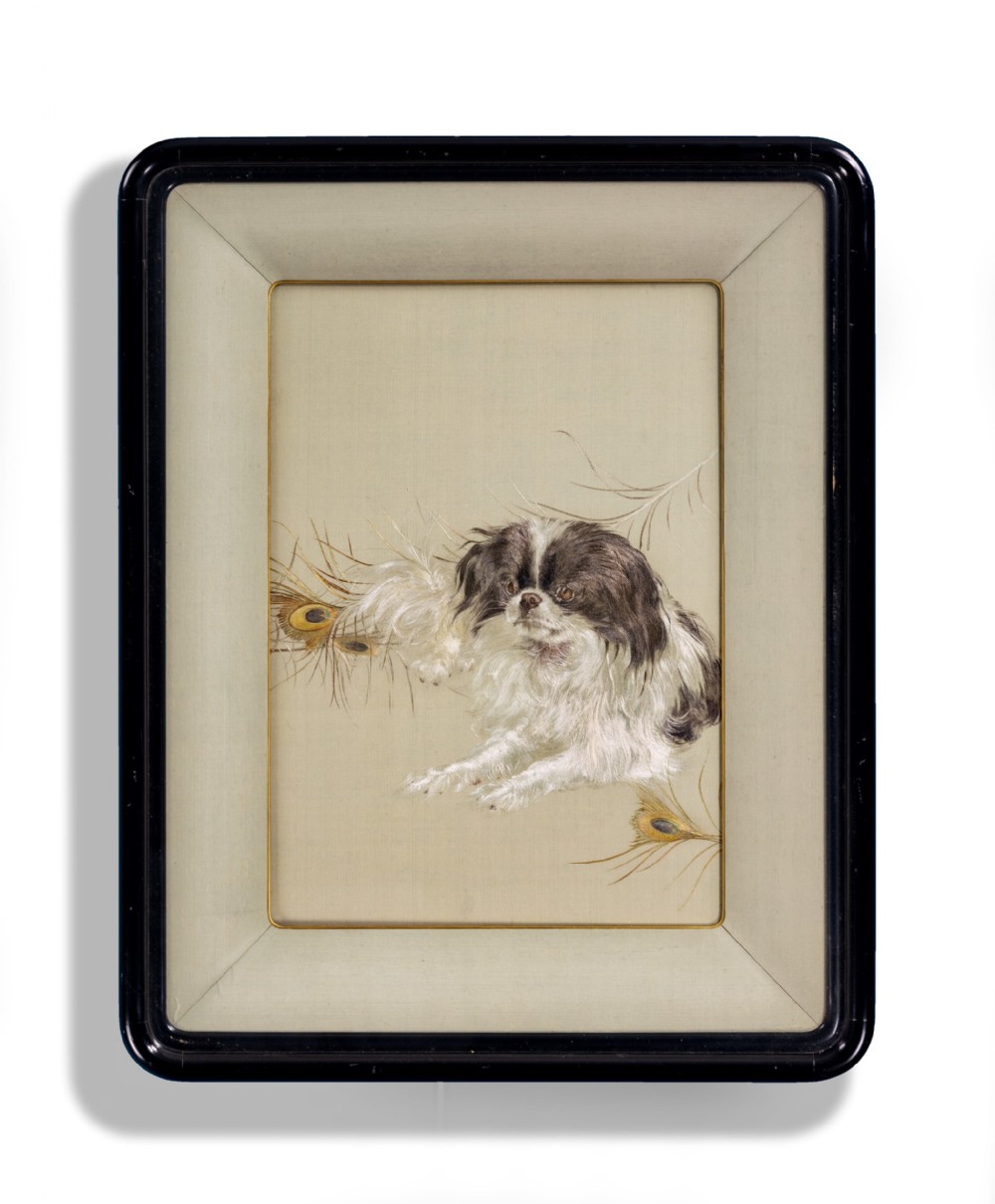
Japanese Silk Textile by Iida Takashimaya Company


