
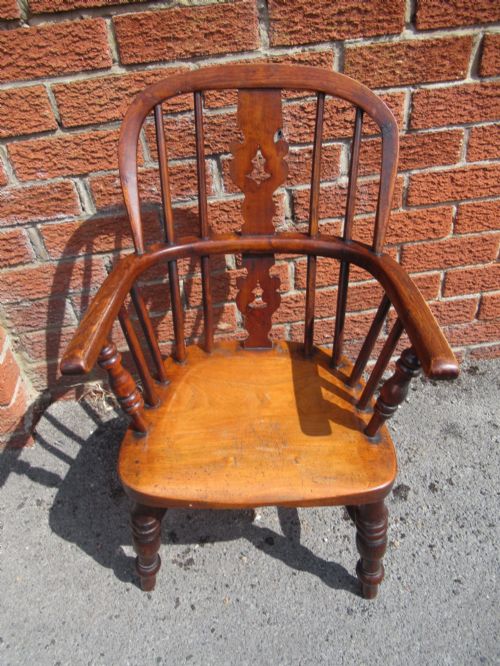


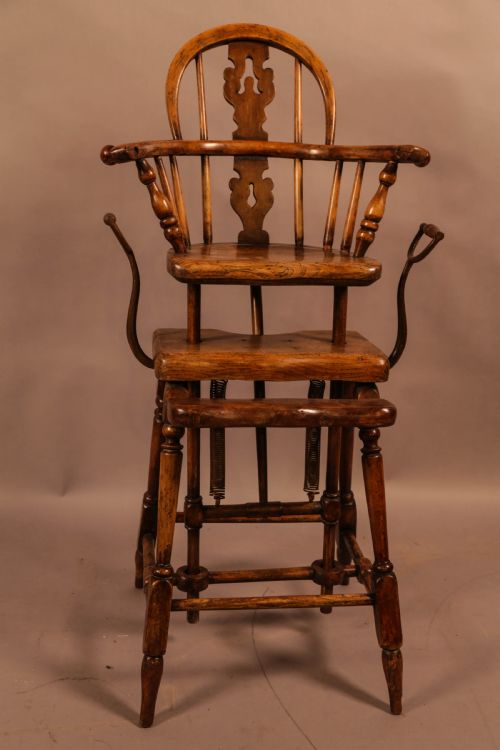

Yew Wood Childs Chair
A yew wood childs chair brings the rich warmth of figured timber into miniature seating, prized for its robust country craftsmanship.
Yew Wood Childs Chair
The predominant form encountered here is the childs Windsor armchair, displaying the characteristic bentwood bow and vertical spindles associated with English country seating. Examples span from the George III period through the nineteenth century, showing regional variations in height, stretcher arrangement, and arm construction.
Makers in English country workshops adapted full-size furniture patterns precisely for younger occupants, resulting in durable seating that balances practical utility with decorative appeal. The survival of such timber work highlights the robust nature of provincial woodworking traditions across these historical periods.
Materials and construction methods
Construction relies on a combination of native hardwoods, utilising yew for its distinct grain and rich warm colour alongside elm for solid saddle seats. Additional timbers like ash and beech often form the turned legs, spindles, and structural stretchers.
Joinery techniques focus on traditional bodging methods, employing turned undercarriages with legs wedged directly into bored seats. Steam bending shapes the continuous arm rails and bows, creating strong tension structures suited to heavy domestic use.
Some miniature armchairs include tiny turned stretchers sized specifically for dangling boots.
Distinctions in quality and execution
Superior examples display highly figured yew timber with deep figuring and varied grain patterns, whereas lesser pieces utilise plainer wood selections. The complexity of the turning on spindles and legs also indicates the skill level of the regional workshop.
Proportion and structural integrity separate fine provincial pieces from standard utility items, particularly in the shaping of the comb or bow and the comfort of the miniature armrests.
The Yew Wood Childs Chair Glossary
- Windsor chair
- A chair built with a solid wooden seat into which the legs and back spindles are direct-tenoned. These robust forms define much of English country seating.
- Crinoline stretcher
- A curved metal or wooden brace linking the legs of a chair to provide extra stability. This feature frequently appears on earlier Windsor designs.
- Splat back
- A chair back featuring a central vertical wooden slat, often shaped or pierced, positioned between the outer uprights. This element provides support and decoration.
- High chair
- A raised seating form elevated on long legs to allow a child to sit at a standard table height. These practical items often incorporate footrests.
- Bodger
- A traditional woodworker who lived and worked in the woods, turning green timber components on a pole lathe. Their output supplied chairmakers with essential parts.
Yew Wood Childs Chair: Frequently Asked Questions
How old is a yew wood childs chair?
Most surviving examples date from the Georgian and Victorian periods, roughly spanning the late eighteenth century through the nineteenth century.
Constructed within English country traditions, these pieces reflect the stylistic shifts and woodworking practices of specific nineteenth-century eras.
What woods are used besides yew?
Makers frequently combined timbers, pairing yew with elm for solid, resilient seats that resisted splitting under stress.
Additional woods such as ash and beech commonly appear in the turned legs, uprights, and structural stretchers of these miniature chairs.
Were these chairs meant for everyday use?
These miniature seats served practical domestic roles in family homes, functioning as high chairs, rocking chairs, or standard low seating.
Their robust construction indicates they were built for daily use by children rather than purely for display or decorative purposes.
What is a Mendlesham chair?
A Mendlesham chair is a distinctive regional style of Windsor seating originating from Suffolk, known for its specific back construction and solid seat.
Such regional variations demonstrate the diverse vernacular traditions practiced by local cabinetmakers and turners across different parts of England.
How do I identify a crinoline stretcher?
A crinoline stretcher is an arched brace that sweeps outward from the front legs to connect with the rear legs of a Windsor chair.
This hoop-shaped reinforcement strengthens the entire undercarriage while adding a graceful architectural line to the turned wooden legs.