
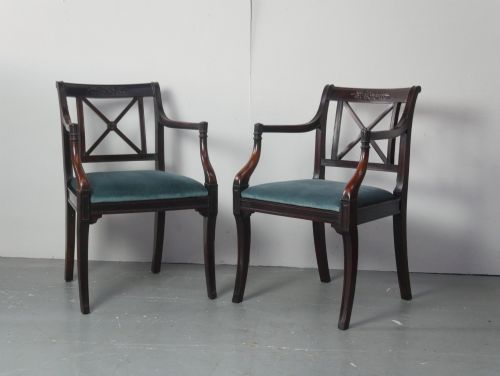
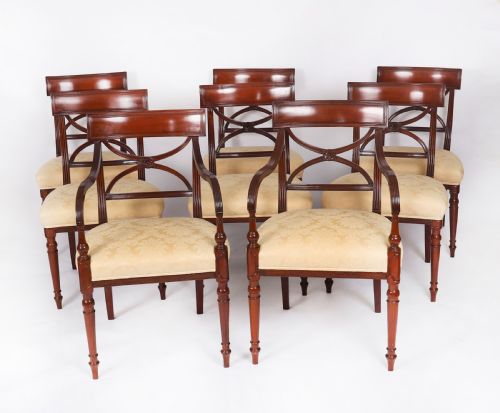
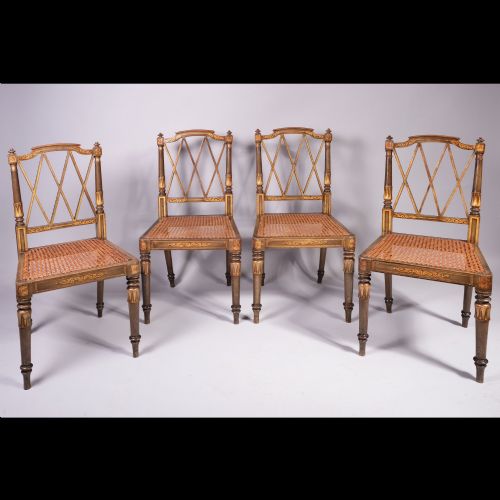


X Back Dining Chairs
These x back dining chairs bring substance to a room, offering sturdy joinery and traditional timber forms that anchor a interior.
X Back Dining Chairs
When searching for x back dining chairs, buyers encounter a diverse selection of formal and country seating derived from Georgian, Victorian, and Edwardian periods. The category encompasses heavy mahogany frames alongside lighter elm and beech country models.
Most examples found on this page reflect formal dining sets or robust kitchen seating originating from the nineteenth and early twentieth centuries. These pieces appear as side chairs, carvers, and larger matched sets suited to everyday use.
How they were made
Cabinet makers utilised dense hardwoods such as mahogany, oak, and walnut for formal dining furniture, employing mortice and tenon joints to ensure rigidity. Turned legs and carved splats demonstrate traditional hand woodworking techniques.
Country variants often combined ash, elm, and beech, utilising steam bending for hoop backs and Windsor frames. Seats were frequently shaped from single timber planks or fitted with rush inserts.
Construction materials span native beech, imported rosewood, and sturdy ash.
What varies in quality
Quality rests upon timber selection and the crispness of carved details, where superior examples exhibit finely figured grain and deep, well-defined mouldings. Poorer specimens rely on flat veneers and softer secondary woods.
Structural integrity dictates longevity, separating tightly fitted original joinery from pieces weakened by excessive drying or poorly executed historic repairs.
Charles Tozer·Gillows·Heals
The X Back Dining Chairs Glossary
- Carver
- An armchair designed to match a set of dining side chairs, usually placed at the head of a table. These feature supportive armrests integrated into the frame.
- Splat
- The vertical central strip of wood within a chair back connecting the crest rail to the seat. On these pieces, the splat forms the characteristic cross shape.
- Balloon back
- A rounded, oval-shaped backrest popular during the Victorian era. The curved top rail resembles the outline of a balloon.
- Windsor
- A traditional chair construction where the legs and back spindles are wedged directly into a solid wooden seat. These rely on turned components and bentwood hoops.
- Harlequin set
- A collection of dining chairs that match in general style and period but vary in subtle details. These assemble gradually over time rather than originating as a single workshop batch.
X Back Dining Chairs: Frequently Asked Questions
How do I clean mahogany dining chairs?
Dust surfaces regularly with a dry cloth and nourish the wood periodically using traditional beeswax. Avoid liquid polishers containing silicone.
Keep timber away from direct heat sources and strong sunlight to prevent the grain from drying and cracking.
Can I mix these with modern tables?
Traditional wooden frames pair effectively with contemporary glass, stone, or metal dining tables through deliberate contrast. The warm tones of mahogany or oak soften minimalist architectural spaces.
Choose simple upholstered pads or neutral leather seats if you wish to bridge the aesthetic gap between old and new.
Are older chairs strong enough for daily use?
Solid hardwood frames built with traditional joinery remain robust and capable of enduring regular family meals. Timbers like oak and mahogany offer exceptional structural resilience.
Check that the leg joints and back splats remain tight without lateral wobble before placing them into heavy service.
How do I identify a Victorian piece?
Victorian examples frequently utilise dense mahogany or walnut, displaying darker patination and machine-assisted joinery alongside hand-finished details. Look for balloon backs and heavy carved splats.
Inspect the undersides for tool marks and timber shrinkage that indicate genuine nineteenth-century age.