



Wooden Serpentine Dressing Mirror
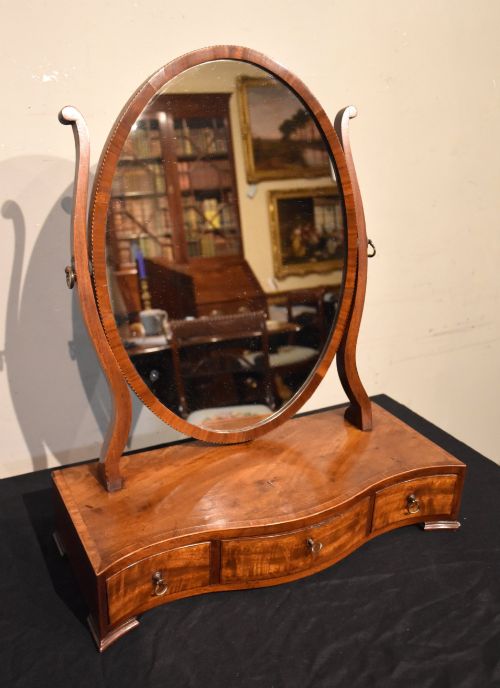
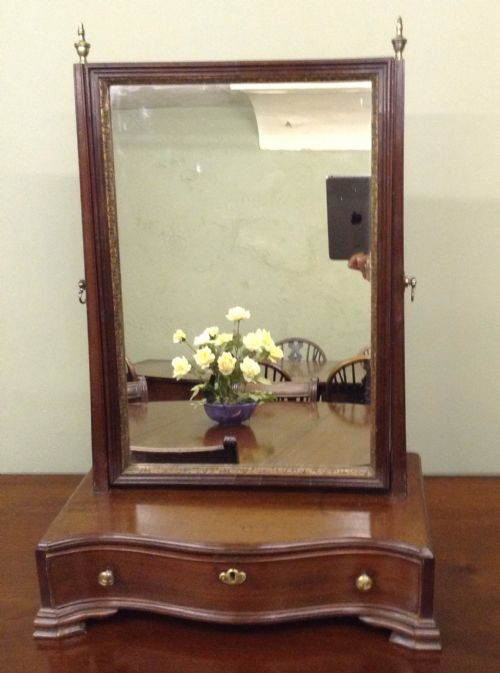
A wooden serpentine dressing mirror sits upon a chest or table, offering a sweeping curved front that defines its classic silhouette.
Wooden Serpentine Dressing Mirror
A wooden serpentine dressing mirror is a portable looking glass designed for a chest or table, frequently referred to in period terms as a toilet mirror. These pieces combine a shaped base containing small drawers with an adjustable swing frame mounted on upright arms. Examples span the eighteenth and nineteenth centuries, taking forms that range from early Georgian workshop pieces to larger Victorian interpretations.
The version most commonly met on this page is the mahogany dressing mirror featuring the characteristic undulating serpentine front line. Makers from the eighteenth century onwards utilised this curved plan to soften the rectangular geometry of the bedroom. Surviving pieces demonstrate how these mirrors served both as practical items for grooming and as decorative furnishings for the dressing room.
How they were made
Cabinet makers constructed these frames predominantly in solid mahogany and walnut, occasionally selecting figured timbers such as flame mahogany for the primary visible surfaces. The distinctive serpentine curve of the base was sawn from solid stock or built up with shaped blocking before veneering. Workshops employed fine dovetail joinery for the small drawers housed within the stepped or ogee-shaped plinths.
The mirror plates themselves swing between upright pillars, secured by brass pivot screws, thumb nuts, or bone rosette finials. Early pieces rely on mirror glass set into rebated frames, backed with protective pine or cedar panels. Structural integrity depended on traditional animal glue and careful joint fitting rather than modern metal fasteners.
Current listings feature wooden serpentine dressing mirrors spanning the Georgian, Regency, and Victorian periods, constructed primarily in mahogany and walnut.
What varies in quality
The distinction between standard examples and the finest pieces lies principally in the selection of timber and the crispness of the serpentine shaping. Superior specimens display symmetrical flame mahogany veneers and finely moulded edges that reveal a confident hand at the workbench. Lower tiers often feature plain, straight-grained wood with simpler, less undulating curves to the plinth.
Hardware and secondary timbers also signal grade. High-quality mirrors retain their original brass work and accurately turned support arms, whereas utilitarian versions show simpler bone or wooden turning. The depth and proportion of the drawer configuration further separate workshop-produced furniture from more basic commercial output.
The Wooden Serpentine Dressing Mirror Glossary
- Serpentine
- A front line that curves outward in the centre and inward at the sides, creating an undulating silhouette. This shape requires skilled carpentry to execute across the curved drawer fronts and moulded plinths.
- Toilet mirror
- A traditional term for a small dressing mirror designed to stand upon a dressing table or chest of drawers. These pieces typically incorporate a box base fitted with small drawers for trinkets.
- Swing mirror
- A looking glass hung on pivots between two vertical posts, allowing the user to tilt the glass angle. The mechanism relies on threaded brass screws or decorative side knobs.
- Flame mahogany
- A distinct wood veneer figure resembling flickering flames, produced by cutting across the branch junctions of the tree. Cabinet makers reserved this expensive timber for the most prominent display surfaces.
- Ogee
- A double-curved moulding shaped like an elongated S, commonly used on the base plinths and framing edges of eighteenth-century pieces. It adds a sense of architectural weight to smaller furniture forms.
Wooden Serpentine Dressing Mirror: Frequently Asked Questions
Where should a wooden serpentine dressing mirror be placed?
These mirrors function best when placed on top of a low chest of drawers, a sideboard, or a dedicated dressing table. Their compact footprint allows them to sit securely while providing a functional height for everyday use.
Because they were originally designed for bedroom or dressing room use, placing them against a neutral wall helps highlight the curved silhouette of the serpentine mahogany base.
How do I adjust the swing mirror?
The glass frame pivots between two vertical upright posts secured by brass side screws or threaded bone knobs. Gently tightening or loosening these side fixtures allows you to set the glass at the desired viewing angle.
Care should be taken to support the glass with one hand while adjusting the fixings to prevent undue strain on the wooden pivot arms.
What is the difference between a toilet mirror and a dressing mirror?
In historical terminology, toilet mirrors and dressing mirrors generally refer to the same category of table-standing glass. The word toilet derives from the French term for a dressing cloth, denoting the morning routine of grooming.
On this page, both terms describe portable mirrors with integrated drawer bases designed to sit upon larger furniture items.
How can I tell an eighteenth-century mirror from a nineteenth-century one?
Eighteenth-century examples often display lighter proportions, finer mahogany scantlings, and hand-cut dovetails within the small drawer boxes. Earlier pieces from the Georgian period frequently utilise walnut or dense, dark mahogany with understated mouldings.
Nineteenth-century Victorian interpretations tend to be larger, sometimes incorporating heavier ogee bases, oval glass plates, or highly figured flame mahogany veneers.