

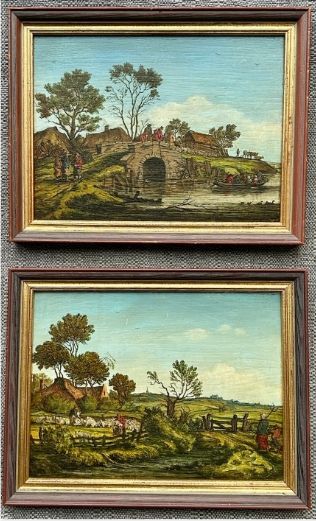
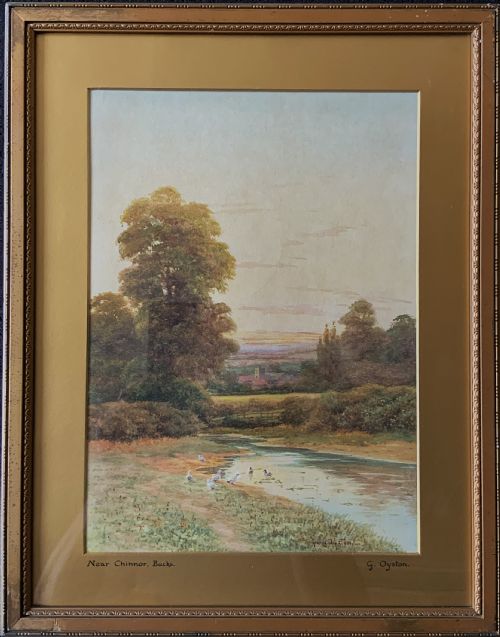


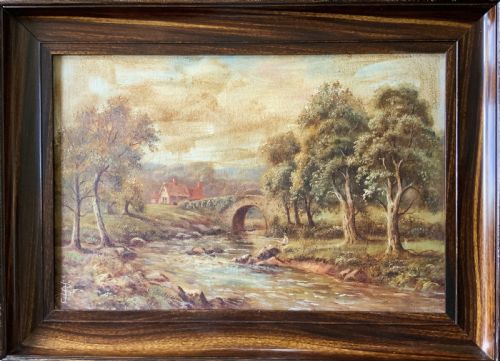

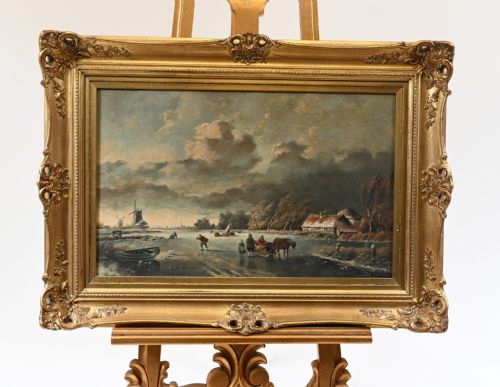


Wooded River Scene
These wooded river scene paintings capture flowing water and timbered banks through oil and watercolour, bringing historic pastoral views directly into your interior.
Wooded River Scene
A wooded river scene presents pastoral views of streams, banks, and waterways framed by trees, capturing the quiet atmosphere of the English countryside and European landscapes. These works primarily take the form of framed oil paintings and watercolours on canvas or wood panels, originating from the nineteenth and twentieth centuries.
Buyers encountering this selection will find works reflecting various traditions, including Victorian realism, British Impressionism, and Dutch or Flemish school influences. The subjects range from specific named rivers like the Severn and the Thames to tranquil woodland streams and secluded lakes.
Many compositions incorporate atmospheric lighting, seasonal shifts such as autumn tones or winter frost, and incidental figures like fishermen or washerwomen. This variety allows collectors to select pieces that match both specific geographic interests and broader historical painting styles.
Materials and execution
Artists painted these works using oil paint or watercolour applied to stretched canvas, prepared wood panels, or paper supports. Oil pigments allowed for rich layering and textured brushwork, particularly suited to rendering the reflective surfaces of water and the dense foliage of wooded riverbanks.
Supporting structures often include traditional gilt wood frames that complement the tonal depth of the paintings. The combination of durable oil paint on solid wood panels or heavy canvas has ensured the survival of these landscapes across multiple centuries.
Wooded River Scene Retail Price Guide 2026
Typical asking prices for wooded river scene among the pieces listed under this phrase on Sellingantiques today, from the lower quarter to the upper quarter. They describe what is for sale here now, not the wider market.
Listings feature oil paint, canvas, wood panels, and gilt wood, spanning the nineteenth century, Edwardian era, and through to nineteen-sixty.
Assessing quality in landscape paintings
Quality in a wooded river scene rests on the artist's handling of light, shadow, and spatial depth within the composition. Superior works demonstrate confident brushwork that brings movement to flowing water and texture to surrounding trees, avoiding stiff or formulaic foliage.
The integrity of the physical support also influences overall standard, with well-preserved canvases and stable wood panels retaining their original pigment vibrancy without excessive retouching. Frame craftsmanship further distinguishes the pieces, as period gilt wood mouldings enhance the visual presence of the artwork.
George Oyston·Florence Adelina Hess·Sydney Yates Johnson·Hubert Wellington·Robert John Hammond·Walter J Watson·Benjamin Williams Leader·Edmond Defonte·Augustus William Enness·Everett W Mellor·Francis Moltino
The Wooded River Scene Glossary
- Oil paint
- A slow-drying medium consisting of pigments suspended in a drying oil, typically linseed oil. This medium allows for smooth blending and rich colour saturation.
- Wood panel
- A flat piece of timber used as a rigid support for painting instead of stretched canvas. Panels offer a stable surface that frequently survives in good condition.
- Gilt wood
- Wood that has been treated with a thin layer of gold leaf or metallic gilt powder. Frames finished in this manner provide a decorative border for traditional paintings.
- Watercolour
- A painting method where the paints are made of pigments suspended in a water-soluble vehicle. These works are typically executed on paper and valued for their translucent quality.
- Plein air
- The act of painting outdoors to directly capture the natural light and atmosphere of a landscape. This method was widely adopted by impressionist painters.
Wooded River Scene: Frequently Asked Questions
What periods do these paintings date from?
The available selection spans the nineteenth century through to the mid-twentieth century, encompassing Victorian, Edwardian, and later modernist schools.
Specific dates within the listings range from the eighteen-nineties up to nineteen-sixty, showing a strong representation of Edwardian and early twentieth-century British art.
How should I hang and light an oil painting?
Oil paintings on canvas or wood panel benefit from stable indoor environments away from direct sunlight and excessive humidity.
Using picture lights or gentle ambient lighting helps illuminate the layered pigments and gilt frames without causing fading or heat damage to the materials.
Are watercolours framed differently from oils?
Watercolour paintings require glass protection to shield the paper and water-soluble pigments from atmospheric moisture and dust.
Oil paintings on canvas or panel are typically displayed unglazed, allowing the textured surface of the paint to be viewed directly.
How do I identify the school or style?
Styles are determined by brushwork technique, colour palette, and regional painting traditions such as British Impressionism or the Dutch school.
Signatures, framing details, and recorded artist biographies further help confirm the historical context and origin of each landscape.