
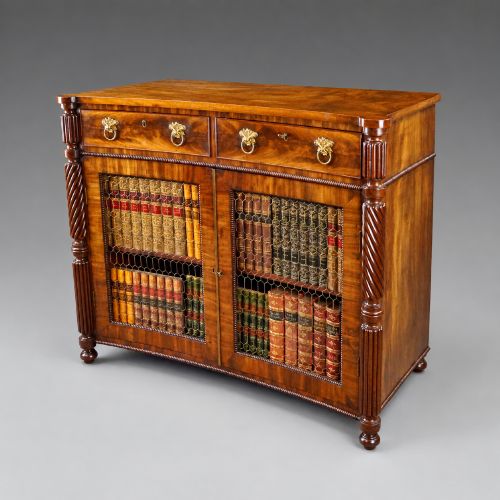
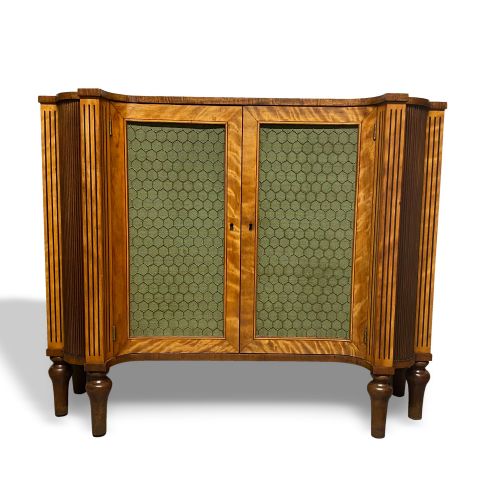
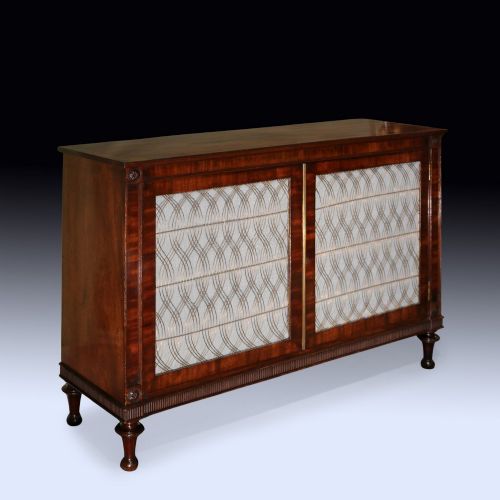


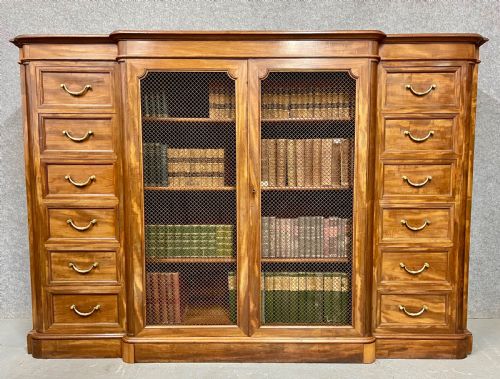


Wire Grille Side Cabinet
A wire grille side cabinet brings architectural warmth to a room while keeping books or collections safely enclosed behind metal mesh.
Wire Grille Side Cabinet
A wire grille side cabinet serves as a functional storage piece originating mainly from the Georgian, Regency, and William IV periods, constructed in forms such as chiffoniers, low bookcases, and traditional sideboards.
The pieces appearing on this page most frequently date to the Regency era and nineteenth century, predominantly fashioned from rich timbers like mahogany and rosewood with characteristic brass wire door inserts.
Cabinets span from compact two-door cupboards to substantial library bookcases and breakfront chiffoniers, reflecting the diverse domestic storage needs of their original nineteenth-century settings.
Construction and materials
Cabinet makers utilised dense hardwoods such as mahogany and rosewood, frequently embellished with satinwood veneers, brass inlay, and mirror glass panels to enhance the visual depth of the timber.
The signature wire grilles, usually woven from brass, were fitted into timber frame doors to allow ventilation for stored books or linens while maintaining a secure enclosure.
The listings on this page span the eighteenth century, the Regency and William IV periods, and the later nineteenth and early twentieth centuries.
Factors of quality
Quality rests in the selection of timber grain, the precision of brass inlay work, and the neatness with which the wire mesh is tensioned and secured into the cabinet doors.
Proportion and architectural detailing set finer pieces apart, with superior examples displaying well-figured mahogany or rosewood and balanced Regency or neoclassical styling rather than plain utility construction.
The Wire Grille Side Cabinet Glossary
- Chiffonier
- A low sideboard or cabinet, popular during the Regency period, often featuring doors fitted with pleated silk behind brass grilles.
- Breakfront
- A piece of furniture where the central section projects forward from the flanking sides, creating a defined architectural silhouette.
- Satinwood
- A lustrous, yellowish timber sourced from tropical trees, utilised extensively for fine veneers and decorative inlay work during the eighteenth and nineteenth centuries.
- Regency
- An English design style spanning the early nineteenth century, characterised by classical neoclassical motifs, clean lines, and dark imported timbers.
Wire Grille Side Cabinet: Frequently Asked Questions
What are wire grille side cabinets?
These are nineteenth-century and earlier storage pieces featuring timber doors inset with woven wire mesh rather than solid wood or plain glass.
They were designed primarily to house books, linens, and domestic items while allowing air circulation within the enclosed compartments.
How were chiffoniers used?
Chiffoniers served as lower sideboards in dining rooms and libraries for storing serving ware, documents, or volumes.
The inclusion of brass grilles and internal fabric backing kept contents neatly obscured while remaining accessible.
How do I date a cabinet?
Dating relies on identifying timber species, hardware construction, and stylistic markers such as Regency neoclassical lines or Georgian proportions.
Earlier eighteenth-century pieces often employ solid satinwood and mahogany, whereas later nineteenth-century examples incorporate distinct brass detailing and rosewood veneers.
How do I style these cabinets?
A wire grille side cabinet works well in a living room or hallway as a focal storage unit for books, ceramics, or lamps.
The textured metal mesh adds visual contrast against plain walls and pairs naturally with traditional or eclectic interior schemes.