



Winged Barrel Back Chair
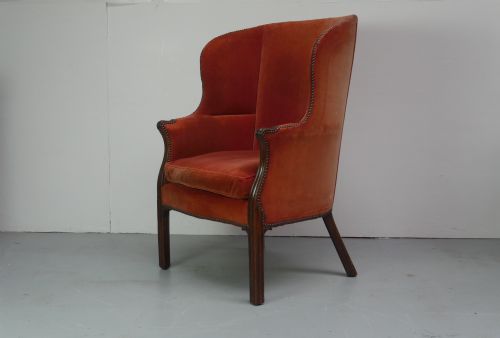
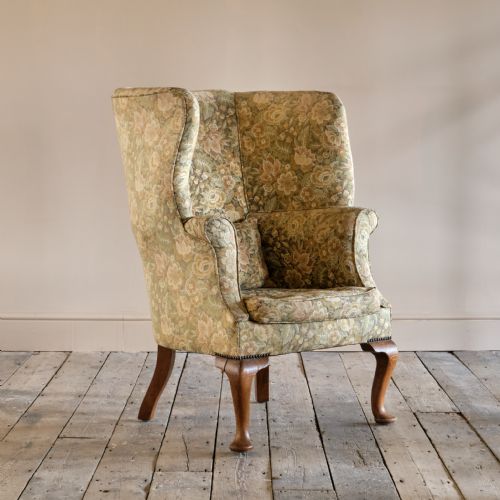
These winged barrel back chair examples offer enveloping comfort and period presence, bringing high wings and deep seating to any room.
Winged Barrel Back Chair
A winged barrel back chair combines a semicircular upholstered back with protective side wings that merge directly into the arms. The pieces you encounter on this page span several centuries, reaching from the eighteenth century through the nineteenth century and into the early twentieth century.
Georgian and George III examples sit alongside Victorian iterations, Queen Anne style revivals, and nineteen-twenties pieces upholstered in velvet, tapestry upholstery, or recycled cotton fabric. These armchairs appear in mahogany, walnut, and various hardwoods, often finished with brass details.
Materials and construction
Makers built the structural frames of these armchairs using sturdy timbers such as mahogany, walnut, and hardwood to support the deep, curving backs. Joinery relied on traditional carpentry methods suited to sustaining heavy daily use.
Upholstery techniques involved padding the frame with traditional stuffings before applying outer coverings of fabric, velvet, or tapestry upholstery. Brass elements frequently accented the legs or castors of these substantial seats.
The site listings feature mahogany, walnut, hardwood, brass, fabric, velvet, tapestry upholstery, and wood across multiple periods.
Distinguishing quality across periods
Quality in a winged barrel back chair rests upon the grace of the timber frame and the proportion of the wings to the curved back. Finer examples display harmonious lines where the arm supports flow seamlessly into the protective side panels.
The choice of covering also shifts the character of the piece, from simple cotton fabrics to rich velvet and textured tapestry upholstery. Earlier Georgian iterations show hand-worked timber framing, whereas later nineteenth-century and twentieth-century versions adapt the form with varying degrees of decorative carving.
The Winged Barrel Back Chair Glossary
- Winged barrel back chair
- An upholstered armchair featuring a continuous curved back and integrated side wings designed to block draughts. This form evolved through multiple centuries of British seating design.
- Mahogany
- A durable hardwood prized for its rich reddish-brown tone and strength in structural frames. Cabinet makers utilised this timber extensively throughout the Georgian era.
- Tapestry upholstery
- Heavy woven fabric depicting pictorial or decorative designs used to cover seat furniture. This textile adds significant texture to the exterior of the chair.
- Queen Anne revival
- A late nineteenth or early twentieth-century design movement recreating the curved lines and cabriole forms of earlier periods. Pieces from this revival echo eighteenth-century aesthetics.
Winged Barrel Back Chair: Frequently Asked Questions
How do I date a barrel back armchair?
Dating relies on examining the timber of the frame, the style of the legs, and the nature of the upholstery materials. Georgian and George III pieces generally exhibit hand-shaped woodwork and traditional joinery.
Later Victorian, Edwardian, and nineteen-twenties versions often introduce machine-cut elements or different stylistic revivals like the Queen Anne style.
Where should I place this chair?
Because of its enclosing shape and substantial proportions, this armchair suits sitting corners, studies, or beside a fireplace. The high back and wings create a private nook for reading or resting.
Ensure adequate floor space surrounds the piece so the curved silhouette remains visible from multiple angles in the room.
What fabrics cover these chairs?
Upholstery ranges widely across the available pieces, including velvet, tapestry upholstery, and recycled cotton fabric. Original or period-appropriate textiles contribute significantly to the visual weight of the furniture.
Subtle ribbed textures and patterned surfaces frequently appear on nineteenth and twentieth-century examples.