
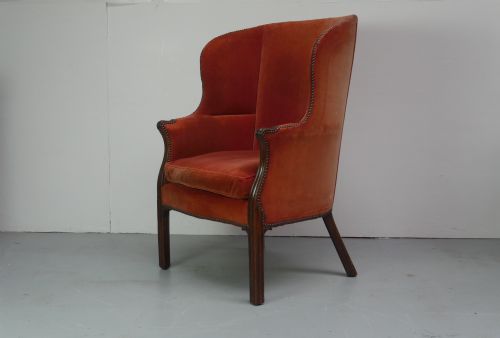

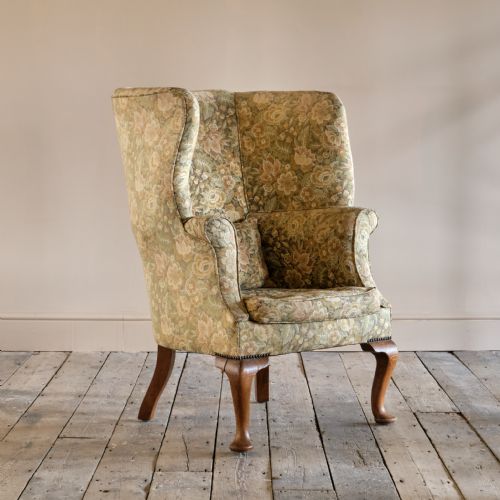


Barrel Back Wing Chair
A barrel back wing chair wraps its upholstered sides around the sitter to keep out draughts by the hearth.
Barrel Back Wing Chair
A barrel back wing chair combines a high, enclosing back with integrated wings designed to shelter the head and shoulders from room currents. You will encounter forms spanning the Georgian and Victorian eras, alongside later pieces from the nineteenth and twentieth centuries.
The defining structural trait is the curved upper back that flows directly into the padded arm wings in one continuous line. Many examples rely on deep buttoning, ribbed upholstery, or smooth leather coverings to finish the frame.
Materials and construction
Frames rely on hardwoods such as mahogany and walnut, shaped to form the curved enclosure that gives the seat its name. Cabinetmakers built these robust wooden skeletons to support heavy padding and tensioned springs.
Upholstery materials range from traditional leather and tapestry to modern cotton fabrics and velvet. Brass details sometimes appear on castors or decorative studwork securing the fabric to the frame.
Listings feature hardwood frames in mahogany and walnut, paired with coverings of leather, velvet, and tapestry.
Judging quality
Superior examples show confident proportions in the sweep of the wooden wings and the depth of the curve. The joinery beneath the upholstery remains rigid, holding the heavy frame steady through generations of use.
Leather quality and button tension distinguish finer versions from simpler ones. Expert execution in the pleating and the alignment of the fabric along the curved back defines the upper tier of these seats.
The Barrel Back Wing Chair Glossary
- Barrel back
- An upholstered seat featuring a semicircular or curved backrest enclosing the sides. This shape provides protection against cold draughts.
- Wing chair
- An armchair with flanking panels attached to the backrest. These wings historically trapped heat around the occupant.
- Deep buttoning
- An upholstery technique where buttons are pulled deep into the padding to create a geometric pattern of dimples. This secures the internal stuffing and adds firm support.
- Porters chair
- A heavily enclosed variant of the wing chair designed to keep watchmen warm near hall entrances. It shares the wrap-around characteristics of the barrel back.
Barrel Back Wing Chair: Frequently Asked Questions
What is a barrel back wing chair?
A barrel back wing chair is a high-backed seat with curved sides and integrated wings designed to shield the user from draughts. The continuous frame encloses the upper body for warmth and comfort.
Historically placed near fireplaces or in large hallways, these armchairs combine substantial wooden frames with deep upholstery. Their distinct silhouette remains a focal point in traditional interiors.
How do I date a barrel back wing chair?
Dating relies on examining the timber species, leg styling, and upholstery methods underneath the covering. Georgian and George III examples display particular cabinetmaking traits distinct from Victorian or Edwardian revivals.
Earlier pieces often use solid mahogany or walnut frames with hand-carved details. Later nineteenth-century versions frequently incorporate castors and machine-tensioned springing systems.
Where should I place a barrel back chair?
These chairs suit corners of living rooms, studies, or libraries where their high backs create a private seating enclave. They function well away from walls so the curved silhouette remains visible from all angles.
Pairing the chair with a low reading table or placing it beside a hearth matches its historical purpose. The enclosed design naturally anchors a seating arrangement in a larger room.
Are these chairs comfortable for daily use?
The enclosed wings and padded backrests offer substantial physical support and a sense of seclusion. Many versions feature sprung seats and deep cushioning suited for extended sitting.
Because seat depths and back heights vary across Georgian and Victorian periods, testing the proportions matters. The enveloping shape provides a distinct posture compared to standard open armchairs.