
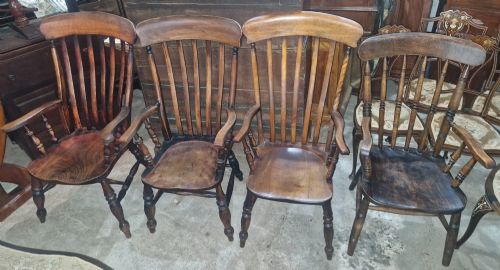
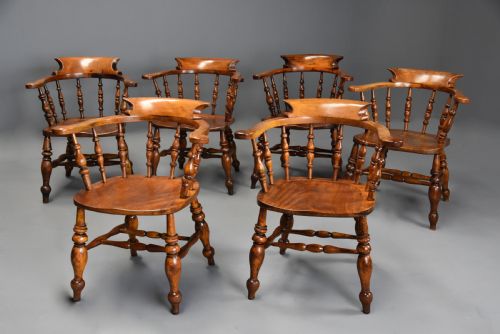
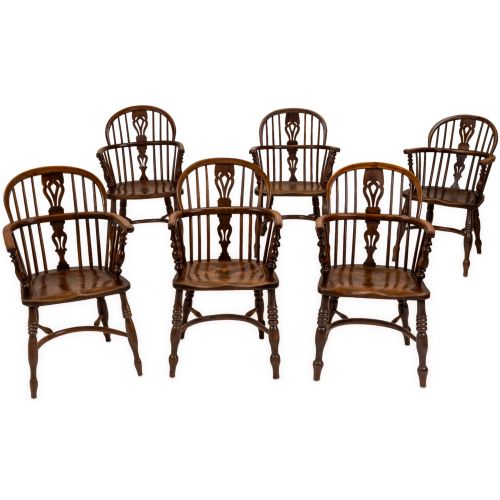


Windsor Armchairs Set
These windsor armchairs set selections bring robust country seating into modern spaces, offering matched timber frames built for daily utility.
Windsor Armchairs Set
A windsor armchairs set brings together sturdy wooden seating originating primarily from nineteenth century vernacular traditions, including Victorian and Edwardian country workshops. These groupings span low back, high back, comb back, and wheelback forms designed for kitchen, dining, or parlour use.
Buyers commonly encounter matched or harlequin sets composed of elm, ash, and yew wood, often featuring turned spindles and sculptural saddle seats. The surviving collections demonstrate the robust construction methods favoured by regional makers across Britain.
Materials and Construction
Traditional windsor armchairs rely on a combination of different timbers chosen for specific structural properties, such as resilient yew or elm for carved seats and flexible ash or beech for bentwood bows and spindles. Craftsmen shaped solid wood components using drawknives and pole lathes before locking the joints through wedged tenons.
Many examples incorporate crinoline stretchers for added rigidity between the legs, while combination woods like ash and elm provide both tensile strength and grain definition. This mixed timber construction ensures the frame absorbs the weight and movement of everyday sitting.
Many nineteenth century kitchen chairs retain subtle ink stamps or maker marks hidden beneath the elm seat saddles.
Evaluation and Character
Quality in a windsor armchairs set rests upon the coherence of the timber matching and the crispness of the spindle turnings. Sets that maintain uniform grain patterns and matching crest rails demonstrate careful assembly from the outset.
The degree of wear on the saddle seats and the integrity of the wedged leg joints distinguish exceptional survivals from utilitarian replacements. Patina developed through decades of domestic use adds depth to the surface texture of yew and elm.
The Windsor Armchairs Set Glossary
- Smokers bow
- A low backed Windsor chair variation featuring a continuous curved arm rail, frequently found in nineteenth century domestic and public interiors.
- Crinoline stretcher
- An arched underframe connecting the legs of a chair to provide lateral stability and prevent the joints from loosening over time.
- Comb back
- A chair design where the central vertical spindles extend upward to support a horizontal top rail, resembling the teeth of a comb.
- Harlequin set
- A collection of chairs sharing similar stylistic traits and dimensions but assembled from different origins rather than carved as a single workshop batch.
- Stick back
- A minimalist chair construction method utilising slender turned spindles inserted directly into a thick wooden seat plank.
Windsor Armchairs Set: Frequently Asked Questions
What is a harlequin set?
A harlequin set consists of chairs that share matching proportions, materials, and regional styles while originating from slightly different sources or batches.
Buyers often select these groupings to achieve a harmonious dining arrangement without requiring an identical factory-produced suite.
How do I care for antique timber?
Maintaining antique elm and yew furniture involves keeping pieces away from direct heat sources and sudden humidity changes to prevent wood splitting.
Applying a traditional beeswax polish periodically preserves the surface lustre and protects the grain from drying out.
Were these chairs used outdoors?
Windsor armchairs were primarily constructed for interior domestic tasks such as kitchen work, dining, and fireside seating in country houses.
While robust enough for heavy use, their timber construction is sensitive to prolonged exposure to damp weather and outdoor conditions.
How do I spot a matched set?
Matched sets display consistent wood species, turning details, and seat dimensions across every chair in the collection, indicating production within the same workshop period.
Slight variations in grain pattern are natural, but overall height and structural rake should align visually.