



Windmill Oil Painting
A windmill oil painting brings open skies, river channels and turning sails onto a wall through layered brushwork and pigment.
Windmill Oil Painting
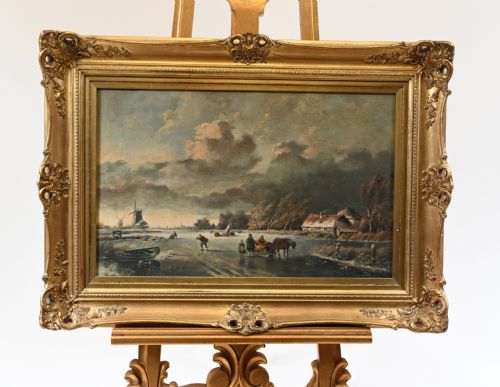
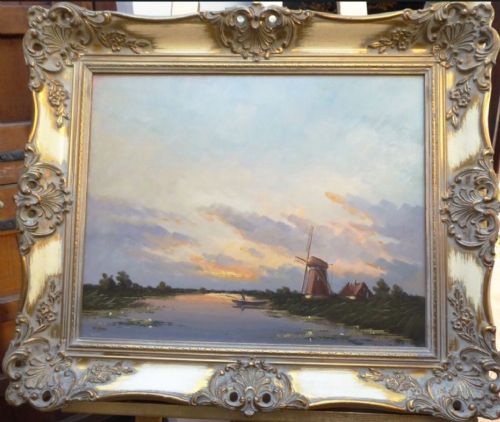
When you search for a windmill oil painting, you encounter works spanning from the eighteenth century to the mid twentieth century, with nineteenth century Dutch and English examples appearing frequently on this page. These pictures capture rural waterways, flatland drainage mills and coastal shores through the lenses of the Norwich School, Dutch Realism, Impressionism and Naive Art.
The subjects range from tranquil frozen canals and summer river views to dramatic sunset skies behind coastal windmills. Formats vary from small wood panels and card supports to large canvases housed in decorative wooden gilt frames.
Materials and handling
Artists built these compositions using oil paint applied to prepared canvas, wood panel, board or card. The medium allowed painters to build texture through visible brush strokes and impasto, capturing the quality of light on water and sails.
Many works retain their original or period frames constructed from wood and finished with plaster and gilt, providing structural housing that complements the painted surface.
A travelling family or a solitary cow occasionally photobombs the drainage mill.
Gradations in handling and composition
Quality rests in the assurance of the brushwork and the balance of light across the landscape. Stronger examples demonstrate confident handling of atmospheric perspective, rendering distance and moisture in the air with economy and precision.
The integration of figures, river traffic and architecture within the wider landscape distinguishes accomplished academic and regional school works from simpler folk art or naive productions.
Edward Seago·Pieter Cornelis Dommersen·John Holland Snr·Kershaw Schofield·William Henry Crome·Joseph Thors
The Windmill Oil Painting Glossary
- Impressionism
- A style of painting emphasising loose brushwork and the depiction of light rather than detailed realism. This approach captures the shifting atmosphere around river landscapes.
- Wood Panel
- A rigid wooden support used by artists before canvas became dominant. These panels provide a smooth or slightly grained surface for oil paint.
- Norwich School
- A regional group of artists inspired by the Norfolk landscape and Dutch masters. Their works frequently depict local rivers, broads and drainage mills.
- Gilt
- A thin layer of gold leaf applied to wood or plaster frames. This finish adds reflective warmth to the presentation of the artwork.
Windmill Oil Painting: Frequently Asked Questions
How do I identify a Dutch windmill scene?
Dutch scenes often feature flat horizons, extensive river networks, flatland drainage mills and low skies. Artists from the Dutch School or visiting painters working in Holland focused on these specific topographic elements.
Compositions regularly incorporate canals, rowing boats and figures in traditional dress alongside the milling structure.
What is the Norwich School?
The Norwich School was the first provincial art movement in Britain, founded by artists who drew inspiration from the local Norfolk countryside. Their paintings frequently record rivers, broads and windmills under expansive East Anglian skies.
Works from this circle bridge naturalistic observation and romantic landscape traditions.
Are these paintings on canvas or wood?
Painters utilised both stretched canvas and rigid wood panels, card or board. Wood panels appear commonly in nineteenth-century works and earlier topographical pieces.
The choice of support often influences the texture and preservation of the paint surface over time.
How should I frame an older oil painting?
Period frames in wood and gilt complement nineteenth-century and earlier canvases by echoing the aesthetic of the period. Maintaining an appropriate frame protects the edges of the canvas or panel.
Avoid modern synthetic mouldings that clash with the historic character of the pigment and support.