
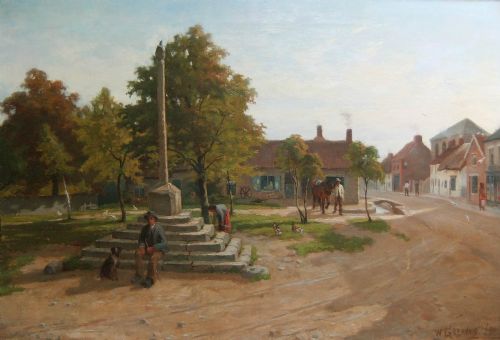


William Greaves Oil Painting
These works capture northern landscapes and pastoral scenes through the lens of a regional painter.
William Greaves Oil Painting
A william greaves oil painting typically depicts rural Yorkshire landscapes, coastal views, and quiet village scenes from the late nineteenth and early twentieth centuries. These works record regional topography, local rivers, and agricultural life with a grounded, observational honesty.
The version most frequently encountered on this page is a landscape canvas or board capturing scenes around Leeds, Wharfedale, and the Yorkshire coast. They offer a direct window into Edwardian and Victorian rural Britain through muted tones and measured brushwork.
How they were made
Artists of this period built their compositions using oil paint applied to stretched canvas, canvas boards, or panels of wood. The pigments were manipulated with brushes to build texture in foliage, water, and skies.
Support materials varied according to the scale and intention of the work, with smaller plein air studies often resting on board while larger finished views utilised traditional woven canvas.
William Greaves Oil Painting Retail Price Guide 2026
Typical asking prices for william greaves oil painting among the pieces listed under this phrase on Sellingantiques today, from the lower quarter to the upper quarter. They describe what is for sale here now, not the wider market.
Listings span the decades from eighteen eighty to nineteen thirty, documenting rural transformation across northern England.
What varies in quality
The strength of a composition rests on the handling of light and atmospheric depth, distinguishing hastily executed sketches from more fully realised pastoral scenes. Works that successfully balance tonal contrast in the sky with detailed ground elements demonstrate greater artistic engagement.
Condition and preservation of the paint surface also dictate the standing of an individual piece. Retaining the integrity of the original canvas support and the stability of the pigment layers without excessive restoration preserves the visual impact intended by the painter.
William Greaves
The William Greaves Oil Painting Glossary
- Canvas board
- A stiff pasteboard primed with gesso and covered in woven cloth to serve as a rigid painting support.
- British Impressionism
- A painting style influenced by French techniques, focusing on natural light and loose brushwork adapted to British subjects.
- Victorian Realism
- An artistic approach dedicated to depicting everyday subjects and landscapes with descriptive accuracy rather than idealized abstraction.
- Plein air
- The practice of painting outdoors to capture direct observations of natural light and weather conditions.
William Greaves Oil Painting: Frequently Asked Questions
What do these paintings depict?
These works primarily portray rural scenes, village streets, and coastal views across Yorkshire and surrounding northern counties. They record local topography, seasonal changes, and agricultural routines of the era.
The subject matter reflects a strong attachment to regional landscapes, capturing locations like Wharfedale, Leeds, and Filey with an observant eye for local character.
How should I hang an oil painting?
Oil paintings on canvas or board require stable indoor environments away from direct sunlight and excessive humidity. Proper hanging involves securing the frame to wall studs using appropriate hardware suited to the weight of the piece.
Keeping the work away from sudden temperature fluctuations prevents expansion and contraction of the wooden stretcher frames and canvas supports over time.
How do I date these works?
Dating relies on stylistic evidence, recorded signatures, and period framing techniques associated with late nineteenth and early twentieth-century British art. Catalogued works often align with specific decades between eighteen eighty and nineteen thirty.
Subject matter and costume details in paintings that include figures also help narrow the timeframe of the composition.
What is canvas board?
Canvas board is a rigid painting support made by gluing woven cloth to a stiff backing board and priming it for oil application. It provided a portable and economical alternative to stretched canvas.
Artists frequently utilised these panels for outdoor landscape studies where portability was essential.