

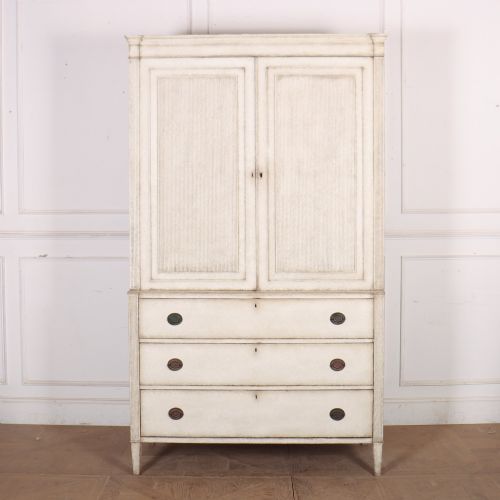


White Wooden Armoire
A white wooden armoire brings generous storage and bright painted character to a room, offering functional heritage piece by piece.
White Wooden Armoire
When you search for a white wooden armoire, you are looking at substantial country storage pieces including linen cupboards, housekeepers cupboards and linen presses. These pieces span the eighteenth century, nineteenth century, eighteen-ninety and nineteen hundred, reflecting traditional domestic storage needs.
The versions you are most likely to meet on this page originate from English and Scandinavian traditions. They appear in painted finishes, often white or pale, alongside natural pine surfaces.
Formally, these items range from simple country house scullery cupboards to more refined Gustavian and Georgian designs. Their primary purpose remains the housing of household linens, garments and provisions within a robust timber frame.
How they were made
Construction relies primarily on solid pine, built by joiners to withstand daily domestic use in country houses and sculleries. Boards are joined to form deep carcass structures designed for heavy household textiles.
Surfaces are finished with paint, sometimes applied in layers over decades, or left as bare timber depending on the regional style. Metal fittings such as brass and iron provide operational hardware for doors and internal fixtures.
White Wooden Armoire Retail Price Guide 2026
Typical asking prices for white wooden armoire among the pieces listed under this phrase on Sellingantiques today, from the lower quarter to the upper quarter. They describe what is for sale here now, not the wider market.
Scullery cupboards hide decades of flour dust and spilled jam behind their cheerful white painted doors.
What varies in quality
Quality separates simple utility furniture from pieces possessing finer regional proportions and cabinetry detailing. The sophistication of the painted surface and the integrity of the original pine structure define the upper tier of these cupboards.
Hardware such as original brass or iron hinges and latches distinguishes better examples from later replacements. The balance between utilitarian strength and decorative restraint marks the difference across periods from the eighteenth to the twentieth century.
The White Wooden Armoire Glossary
- Pine
- A softwood commonly used for country furniture due to its availability and workability. It forms the primary carcass of these cupboards and takes paint finishes readily.
- Gustavian
- A Swedish neoclassical style characterised by pale painted finishes and restrained classical ornamentation. It influences many of the lighter painted pieces seen in Scandinavian traditions.
- Housekeepers Cupboard
- A large storage piece traditionally used by a housekeeper to store linens, dry goods and household supplies. These often feature deep proportions and robust shelving.
- Linen Press
- A tall piece of furniture combining upper storage for folded textiles with lower drawers. It represents a more formal relative of the standard linen cupboard.
White Wooden Armoire: Frequently Asked Questions
What is a white wooden armoire used for?
These pieces provide substantial storage for clothing, household linen and dry goods within deep internal compartments and shelving.
Historically, they served domestic roles in country houses, sculleries and bedchambers where large volume storage was essential.
How do I date a painted pine cupboard?
Dating relies on construction methods, timber thickness and the character of the paint layers applied over time. Eighteenth-century examples often show hand-planed boards and simpler forged iron fixings.
Later nineteenth-century pieces introduce machine-sawn timber and different fastening techniques while retaining traditional country forms.
What is the difference between English and Scandinavian styles?
English country pieces generally emphasise sturdy utilitarian construction in pine, sometimes with simpler panel arrangements. They fit comfortably into vernacular farmhouse interiors.
Scandinavian designs, particularly Gustavian variants, tend towards lighter painted surfaces and subtle neoclassical mouldings that brighten living spaces.
How do I care for antique painted wood?
Maintenance involves keeping pieces away from direct heat sources and sudden humidity changes to protect the timber and paint layers. Dusting with a soft, dry cloth preserves the historic surface without chemical damage.
Avoid abrasive cleaners that can strip or soften aged paintwork.