


White Opal Diamond Ring
A white opal diamond ring pairs the shifting play of colour in an opal with the steady fire of diamonds.
White Opal Diamond Ring
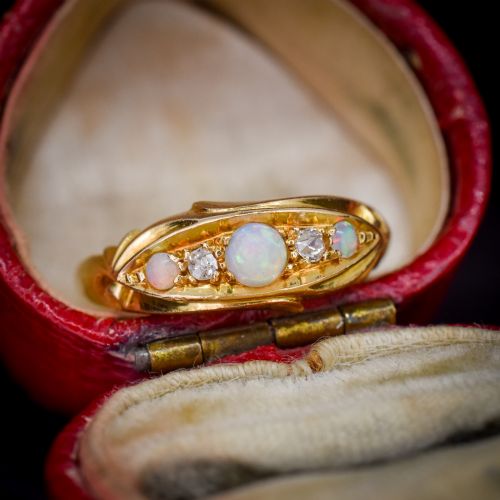
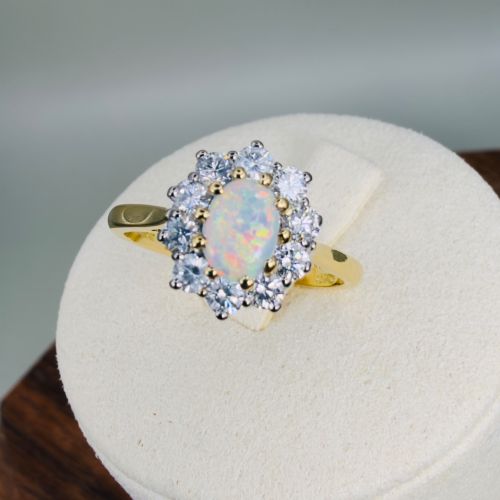
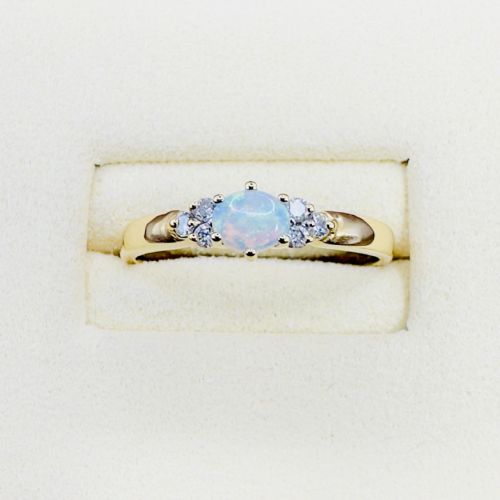
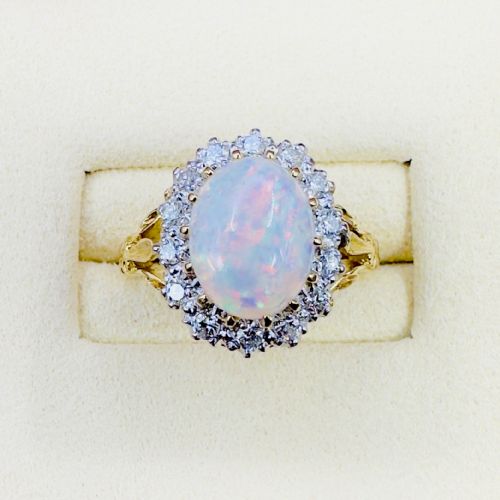
A white opal diamond ring brings together central cabochon opals flanked or framed by brilliant or single cut diamonds, appearing in cluster, boat, trilogy, and five stone settings. These pieces span from the late Victorian and Edwardian eras through the Art Deco period and into mid century designs.
The cluster format dominates the selection, mounting a central oval or round white opal within a tight border of small diamonds. Boat and trilogy configurations also appear frequently, often set in yellow gold for earlier pieces and white gold for later twentieth century examples.
Materials and construction in gold and platinum
Goldsmiths constructed these rings using 18ct yellow gold, 18ct white gold, and 9ct gold, mounting stones into claw, bezel, or illusion settings. Cabochon cutting shapes the opals to display their internal play of colour, while small diamonds provide structural contrast around the main stone.
Earlier settings from the Victorian and Edwardian periods rely on yellow gold claws, whereas Art Deco and later twentieth century examples make extensive use of white gold to complement the cool tones of the diamonds.
Some nineteenth century makers tucked tiny emerald accents beside the diamonds, proving Victorians loved an unexpected flash of green.
Evaluating stone play and metal work
Quality rests primarily on the optical performance of the opal, where a vibrant play of colour across the stone distinguishes superior examples from muted ones. The cut and clarity of the supporting diamonds also contribute to the overall standard of the piece.
The integrity of the setting matters significantly, as secure claws and substantial gold weight in the shank ensure the ring withstands daily wear without risking the softer opal centre.
The White Opal Diamond Ring Glossary
- Cabochon
- A gemstone cut with a smooth, rounded, convex upper surface and a flat or slightly curved base rather than facets. This style preserves the internal play of colour in opals.
- Cluster ring
- A ring design featuring a central stone surrounded by a tight border of smaller gems, typically diamonds framing an opal.
- Trilogy ring
- A ring set with three stones in a row, often symbolising the past, present, and future. In these pieces, an opal typically sits between two diamonds.
- Boat ring
- A navette or boat shaped mounting that tapers to points at either end, popular in late Victorian and Edwardian jewellery.
White Opal Diamond Ring: Frequently Asked Questions
How do I care for my ring?
Opals contain water and require gentle treatment, so remove the ring before washing hands, swimming, or using household chemicals. Store it away from extreme heat and direct sunlight to prevent drying and cracking.
Clean the metal and diamonds with a soft brush and warm soapy water, but avoid soaking the opal. A professional check of the claws every few years ensures the softer central stone remains secure in its setting.
Can I wear an opal every day?
Opals rate lower on the hardness scale than diamonds, meaning they scratch more easily with rough daily use. Wearing a white opal diamond ring daily requires mindfulness about impact and manual tasks.
Choosing a bezel setting offers extra protection for the stone compared to exposed claws. Many people reserve these pieces for lighter wear or social occasions to preserve the surface polish.
How do I date an antique ring?
Hallmarks stamped inside the band provide the most reliable guide to a ring's origin, indicating the assay office, metal purity, and year of manufacture. Stylistic clues like yellow gold boat settings or white gold geometric frames also point to specific decades.
Comparing the cut of the diamonds and the overall construction method helps confirm whether a piece belongs to the Victorian, Edwardian, or Art Deco period.
What is play of colour?
Play of colour refers to the flash of rainbow hues that moves across an opal as the light shifts over its surface. This optical effect arises from the internal diffraction of light through microscopic silica spheres.
High quality white opals display bright, distinct patches of red, green, and blue from every viewing angle. Muted stones show only faint spectral hints.