
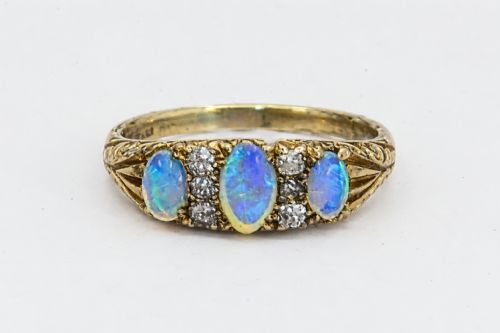

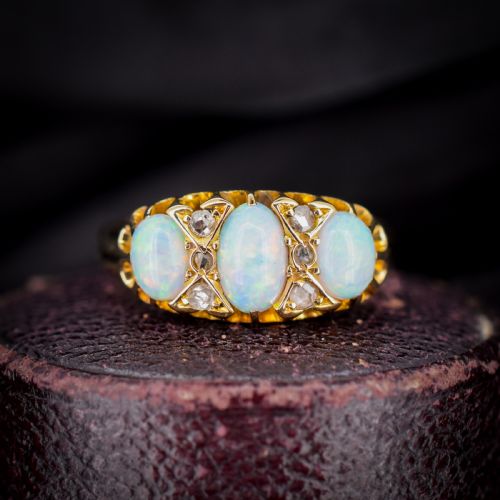
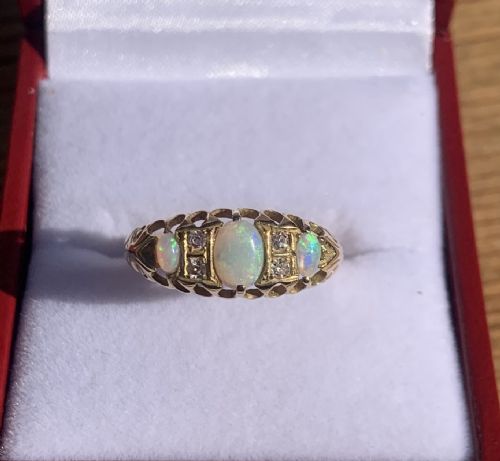


Victorian Opal Diamond Ring
A victorian opal diamond ring brings together the play of colour in natural stones and the steady weight of nineteenth-century gold.
Victorian Opal Diamond Ring
When you search for a victorian opal diamond ring, you find jewellers' work that pairs shimmering cabochons with bright stones set in heavy yellow metal. These pieces appear most often as three-stone arrangements or tight clusters where diamonds frame the central play of colour.
The materials span the nineteenth century and stretch into adjacent decades, appearing in structured boat settings and simple bands. Many carry full British hallmarks from offices in Birmingham, Chester, and London that anchor the piece to a specific decade.
Materials and Construction
Goldsmiths of the period relied primarily on 18ct yellow gold to form the shanks and settings, using silver occasionally for the topmost collets to keep diamonds bright. Stones were cut by hand, resulting in soft rose cuts or early old mine cuts that sit lower to the finger than modern facets.
Opals were selected for their natural fire and shaped into smooth cabochons rather than flat tables. These fragile gems were bedded securely into claw or bezel settings designed to protect the delicate girdle while letting light pass through the stone.
Some multi-gem rings spell out words like 'ADORE' using amethyst, diamond, opal, ruby, and emerald.
Judging the Workmanship
The value of a victorian opal diamond ring rests upon the intensity of the opal flash and the crispness of the surrounding goldwork. Higher quality examples show a dense play of spectral colours across the cabochon without dead spots or heavy internal crazing.
Setting work distinguishes finer pieces from routine production. Well-made mounts display neat, even claws and balanced proportions where the diamonds support the central opal rather than crowding it out.
The Victorian Opal Diamond Ring Glossary
- Cabochon
- A gemstone shaped with a smooth, rounded surface and a flat base rather than faceted planes. This polish suits opals by spreading the internal light evenly across the dome.
- Trilogy ring
- A ring set with three stones placed in a row across the finger. In nineteenth-century examples, an opal often sits flanked by two diamonds.
- Rose cut
- A diamond cut featuring a flat base and a domed crown covered in triangular facets. This old style gives a softer, candlelit sparkle compared to modern brilliant cuts.
- Boat ring
- A navette-shaped setting that curves across the finger like a small vessel. This style elongates the hand and accommodates multiple stones in a linear arrangement.
- Hallmark
- An official stamp pressed into the metal to certify its purity and origin. British pieces often display date letters, town marks, and maker's initials inside the shank.
Victorian Opal Diamond Ring: Frequently Asked Questions
How do I care for my ring?
Opals contain water and require gentle treatment to prevent drying out or cracking. Remove the ring before washing hands, gardening, or using household chemicals.
Store the piece separately in a fabric-lined box to protect the softer stones from scratching against harder diamond jewellery.
Are these opals treated?
The stones seen in nineteenth-century jewellery are natural earth-mined gems. They display genuine play of colour without modern stabilisation or dye treatments.
Inspect the surface under magnification to confirm the natural undulating texture typical of period cabochons.
Can I resize an antique ring?
Most gold rings from this era can be adjusted by a skilled jeweller. The heavy 18ct shank takes solder well without compromising structural integrity.
Check the shoulders and hallmarks first to ensure the adjustment will not disturb the stamps or delicate wirework near the setting.