
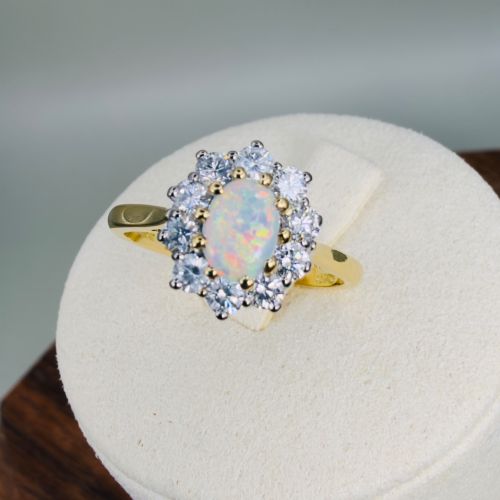
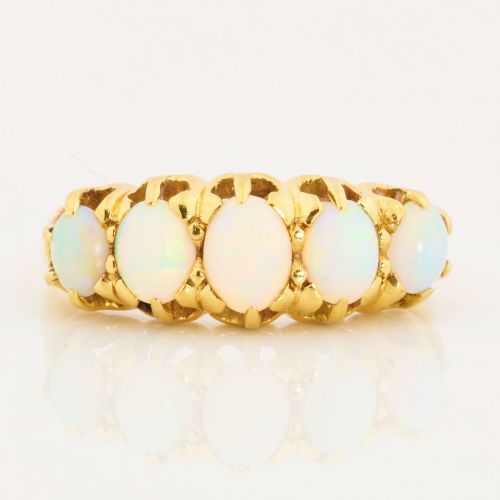
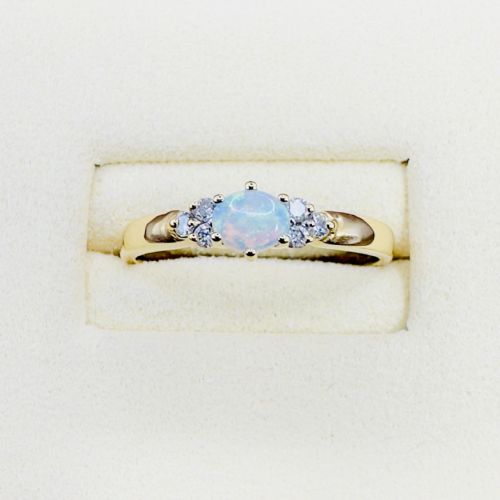
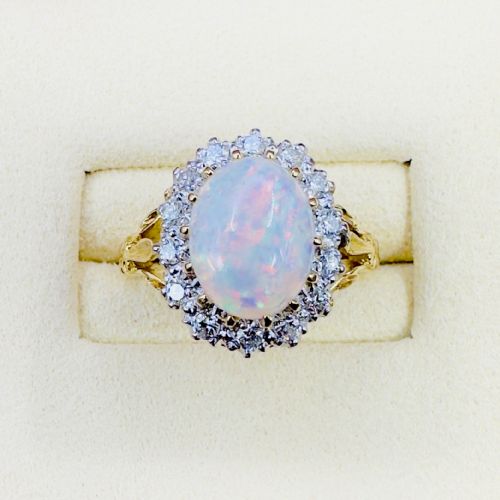
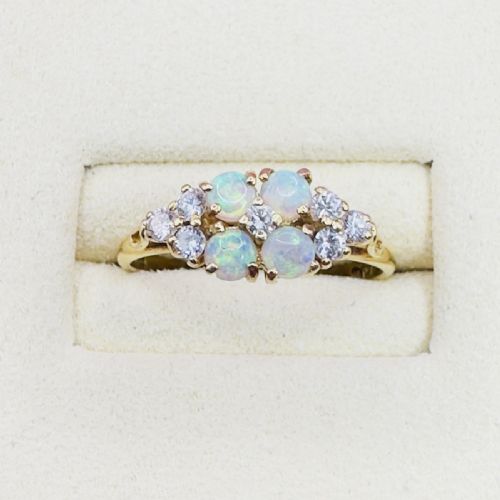


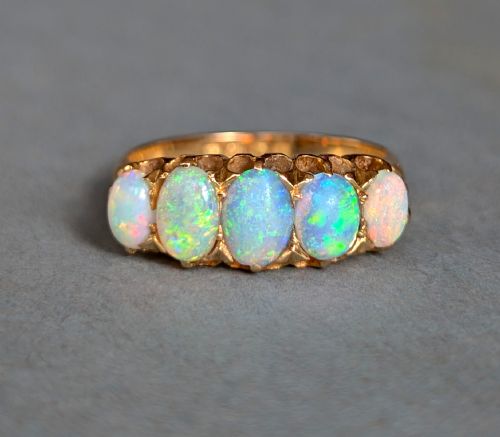
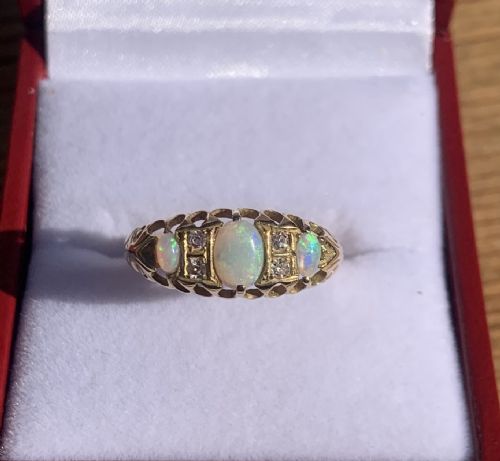


Opal Cabochon Gold Ring
An opal cabochon gold ring brings together smooth, domed stones and warm precious metal across Victorian, Edwardian and mid-century designs.
Opal Cabochon Gold Ring
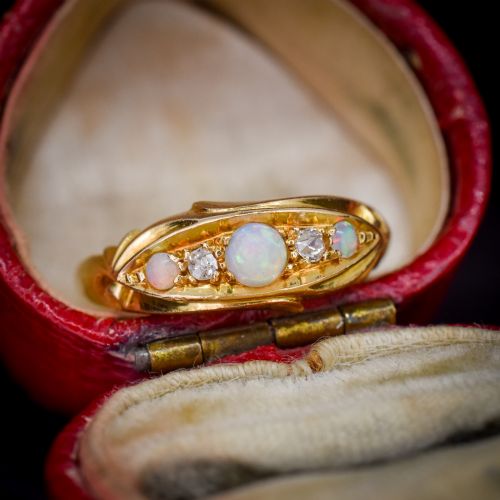
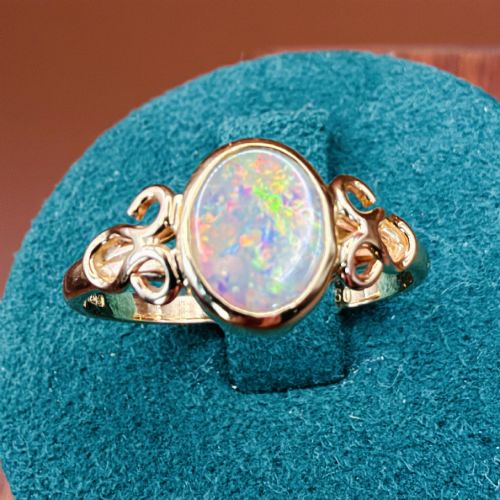
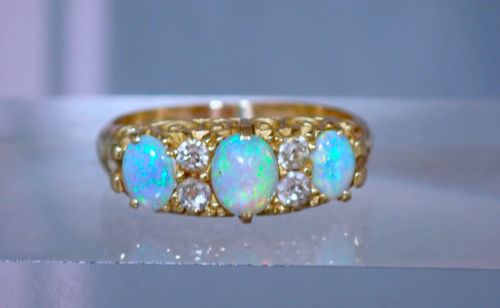
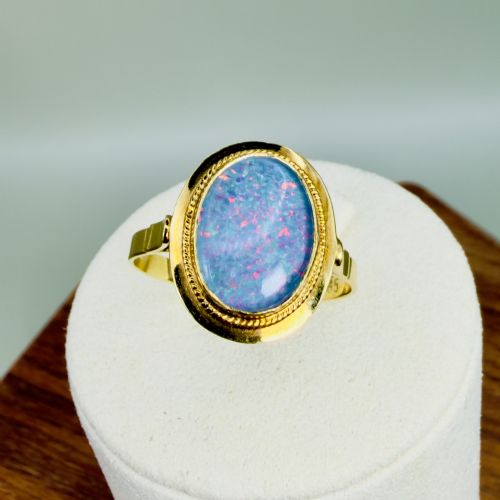
An opal cabochon gold ring is a piece of finger jewellery featuring a polished, rounded gemstone set in yellow, white or rose gold. The pieces on this page span the Victorian and Edwardian eras, through the Art Deco period, into the mid-century decades of the nineteen-fifties and nineteen-sixties.
Buyers will encounter single-stone solitaires, multi-stone cluster arrangements and traditional five-stone rows. The forms range from delicate antique boat settings to substantial cocktail rings holding black, white, boulder and water opals alongside diamonds, rubies or sapphires.
How they were made
Jewellers shaped these opals into smooth cabochons rather than faceted gems, preserving the internal play of colour characteristic of the material. Stones are secured in gold settings, utilising claw mounts, bezel enclosures and cluster formations designed to catch the light.
The metals encompass nine-carat and eighteen-carat gold, alongside fourteen-carat and white gold variations. Workshops employed traditional casting and hand-setting techniques appropriate to each period, from Victorian claw work to twentieth-century cluster constructions.
Listings span eighteen-carat gold, nine-carat gold, fourteen-carat gold and white gold across eight distinct decades.
What varies in quality
The visual depth and play of colour within the opal itself largely distinguish one piece from another. Stones displaying vibrant flashes of spectral colour across the dome sit at the higher end of the scale compared to muted specimens.
The integration of supporting gemstones, such as matched diamonds or calibrated rubies, and the structural integrity of the gold setting influence the overall character of each ring. Workmanship evident in the claw placement and metal finishing marks the distinction between standard production and finer output.
The Opal Cabochon Gold Ring Glossary
- Cabochon
- A gemstone cut with a smooth, rounded, convex top and a flat or curved base rather than facets. This style highlights the optical phenomena within opals.
- Solitaire
- A ring featuring a single set gemstone, directing the visual focus entirely onto the central stone. This setting style appears across multiple periods.
- Cluster
- An arrangement of smaller stones gathered tightly around a central gemstone to create a larger visual presence. Diamonds frequently surround opals in these formations.
- Trilogy
- A ring design incorporating three stones set in a row, often interpreted to represent past, present and future. These pieces frequently combine opals with diamonds.
- Boat ring
- A ring setting shaped like an upturned boat, tapering towards the ends and popular during the Georgian and Victorian eras. This form often houses rows of gems.
Opal Cabochon Gold Ring: Frequently Asked Questions
How do I care for my opal ring?
Opals contain water within their structure and score lower on the hardness scale than diamonds. Store the piece away from sudden temperature changes and harsh chemicals to maintain the stone.
Remove the ring before undertaking physical work or swimming. Clean the gold and stone gently with a soft, damp cloth without soaking the mounting.
Are these opals natural?
The selections encompass natural stones across various classifications, including white, black, boulder and water opals. Each type displays distinct matrix characteristics and body tones.
Individual pieces integrate genuine opals paired with diamonds, sapphires or garnets. Documentation within specific listings outlines the exact stone origins.
How can I date my ring?
Dating relies on stylistic markers, setting techniques and hallmarks stamped into the gold bands. Victorian and Edwardian pieces show characteristic claw work and shank profiles.
Mid-century examples from the nineteen-fifties and nineteen-sixties often feature distinct cluster geometries. Assay office marks provide further chronological reference points.
What is a boulder opal?
A boulder opal forms naturally within ironstone matrix, leaving part of the host rock attached to the back of the gem. This backing provides natural stability and depth to the stone.
Pieces featuring boulder opals display unique patterns where the iridescent opal veins run through the ironstone. These rings offer a distinct appearance compared to solid crystal opals.