
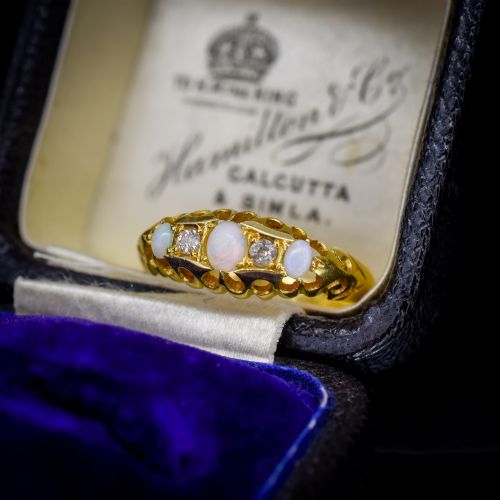
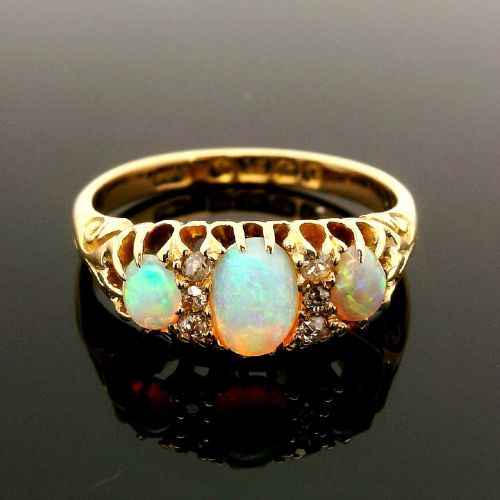
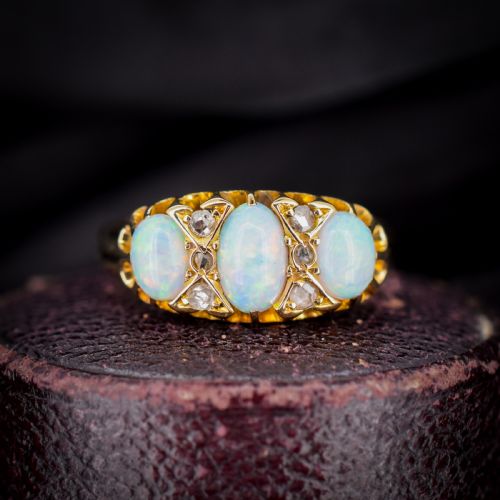

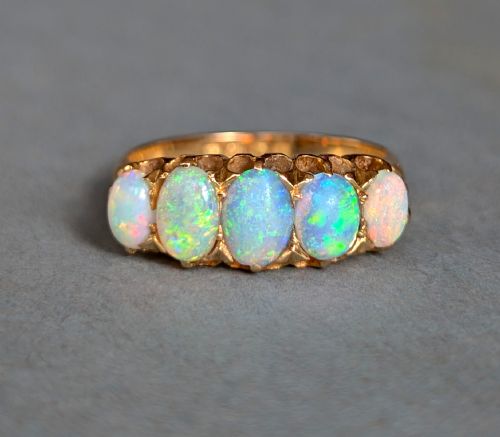


Carved Gallery Opal Ring
A carved gallery opal ring brings together vibrant play-of-colour stones and intricate metalwork.
Carved Gallery Opal Ring
A carved gallery opal ring showcases opals paired with diamonds set in gold mountings, spanning the Victorian and Edwardian periods as well as the mid-century era. These pieces appear as boat rings, three stone settings, five stone arrangements, and trilogy designs.
The selections available here range from late nineteenth century Victorian examples to Edwardian pieces dated around 1900 and 1902, alongside 1960s vintage items. Buyers searching for a carved gallery opal ring encounter formations featuring 18ct gold, 18ct yellow gold, and white gold.
Construction and Materials
Goldsmiths utilised 18ct gold, 18ct yellow gold, and white gold to form the bands and settings for these rings. Natural opals and diamonds are integrated into the designs, structural components that define both boat shapes and multi-stone configurations.
Techniques from the Victorian and Edwardian eras involve mounting stones securely within detailed galleries. The combination of gold types with natural opal and diamond creates distinct ring structures found across the periods.
Carved Gallery Opal Ring Retail Price Guide 2026
Typical asking prices for carved gallery opal ring among the pieces listed under this phrase on Sellingantiques today, from the lower quarter to the upper quarter. They describe what is for sale here now, not the wider market.
Every boat ring quietly carries a miniature fleet of opals and diamonds upon the hand.
Assessing Quality
Quality in these rings rests upon the visual impact of the opal's play-of-colour and the integration of accompanying diamonds within the 18ct gold or white gold mountings. Pieces from the Victorian and Edwardian periods demonstrate varying degrees of intricacy in their gallery work.
The distinction between standard examples and finer items lies in the stone selection, such as the scale of diamonds in a trilogy or the balance of stones in a five stone ring. The execution of the gallery work itself establishes the character of each piece.
The Carved Gallery Opal Ring Glossary
- Gallery
- The decorative under-basket or side section of a ring setting that elevates the stones above the finger. Intricate metalwork here defines the carved gallery style.
- Boat ring
- A curved boat-shaped setting layout popular in the nineteenth and early twentieth centuries. This form typically sweeps across the finger to hold a row of stones.
- Trilogy ring
- A three-stone ring configuration often symbolising past, present and future. In these listings, opals and diamonds combine in such three stone formats.
- Play-of-colour
- The optical phenomenon where flashes of spectral colours move across an opal as the stone is turned. This property determines the visual appeal of each opal.
Carved Gallery Opal Ring: Frequently Asked Questions
What periods do these rings come from?
The pieces span the Victorian period, the nineteenth century, Edwardian years around 1900 to 1902, and mid-century circa 1960 examples.
Such dates reflect the specific craftsmanship eras recorded in the available selections.
What metals are used in the settings?
Makers utilised 18ct gold, 18ct yellow gold, and white gold to construct the bands and mountings for these opal and diamond rings.
These precious metals provide the structural foundation for the carved gallery designs.
How do three stone and boat rings differ?
Boat rings feature a curved, boat-like silhouette holding multiple stones, whereas three stone configurations focus on a primary triad arrangement.
Both styles incorporate combinations of opals and diamonds set in gold.
Are diamonds always included with the opals?
Diamonds frequently accompany opals in these Victorian, Edwardian, and vintage configurations, appearing alongside them in boat, trilogy, and five stone settings.
Such pairings highlight the contrast between white diamonds and the play-of-colour in the opals.